Sunday, October 15, 2023

Race Report: Baltimore Marathon

After our trip to Cape Cod, Deb and I flew directly from Boston to Baltimore, where I ran the Baltimore Marathon on October 14.


We were originally scheduled to arrive in Baltimore at 2:15 on Friday, but Delta changed their flight schedule.  Our revised arrival time was 3:07, which didn’t give us as much time as we were originally expecting to have.  I would’ve been nervous about that, but the expo went until 8:00 PM.

We stayed in a downtown hotel that was right next to Camden Yards, where the race started.  It’s a shame the Baltimore Orioles lost in the American League Divisional Series.  Had they advanced to the championship series, they would’ve had a home game on Saturday.  Our hotel was so close to the stadium that we had this view from our hotel room.


We were also just a couple of blocks from the convention center, where the expo was held.  We didn’t get to our hotel until 4:15, but I was back from the expo by 5:00.

After organizing my clothes for the race, I had dinner with my friend Aaron at a Detroit-style pizza place near the waterfront.  On my way to dinner, I walked right past the finish area for the marathon.  Most of the barriers were already in place.

I got to bed early, slept well all night, and woke up about 30 minutes before my alarm would’ve gone off.  The race didn’t start until 8:00 AM, so I didn’t need to be up too early.

The temperature was in the 50s, but I didn’t know when the rain would start.  For most of the morning, there was about a 50% chance of rain.  There was no question it would rain in the afternoon, but I didn’t know how much of the race would be in the rain.  I was only expecting intermittent showers, but to hedge my bets I wore tights.  I had a Tyvek jacket that I wore to the start.  In case of heavy rain, I kept a plastic rain poncho folded up in my fanny pack.

The starting line was close enough to my hotel that I could wait until 20 minutes before the race before going outside.  I was able to use the bathroom in my hotel room, so I didn’t need to allow time to wait in port-o-potty lines in the start area.

I neglected to pack the charger cable for my GPS watch.  After using it for the Cape Cod Marathon and two shorter runs, I didn’t know for sure if I had enough battery life for another marathon.  I left that watch at the hotel and used my older Timex, which is just a plain stopwatch.  I’ve grown accustomed to my watch giving me splits, but I had to go back to my old practice of just reading my watch at each mile marker and doing the arithmetic in my head.

I ran Boston qualifying times in my last three marathons, but those were all on fast courses.  One was sharply downhill, one was slightly downhill, and the other was mostly flat.  This race was hilly, so I went in with lower expectations.  I needed to wait and see how I felt after the first few miles.

When I got to the start area, I saw there was a 3:50 pace group.  I lined up with them and decided to run at that pace long enough to evaluate whether the pace would be sustainable on this course.

Besides having a view into the stadium, our hotel room also had a view of the starting line.  Deb was taking pictures before the race started.


About 10 minutes before the race started, it started to rain.  It was only sprinkling, but I decided to keep my jacket on, instead of tying it around my waist.

Starting with the 3:50 pace group took all the guesswork about how fast to start.  I followed the pacers, and I didn’t look at my watch for the first half of the race.  The first few miles had a gradual uphill trend.  Running uphill, I found the pace to be tiring, but I knew it would eventually get easier.  I forced myself to keep up with the group, even though it seemed like I was working way too hard.

The first song I heard during the race was Fallin’ by Alicia Keys.  That was a reminder that I fell during my last race, and I should pay attention to my footing.  In the downtown area, the pavement had cracks in a few places.  Also, the pavement was slippery from the rain.

About halfway through the second mile, I started to feel hot.  I took off my jacket and tied it around my waist.  After taking off my jacket, I realized there weren’t any drops hitting my arms.  Because the pavement was wet, I didn’t notice that the rain had stopped.

Shortly before the three mile mark, we entered Druid Hill Park.  As we crested a hill, one of the pacers told us this was the highest point on the course.  There would be other hills, but from here, it was more downhill than uphill.

As we continued through the park, we entered the Maryland Zoo.  The zoo has African penguins, and two of the zookeepers brought one of the penguins outside to watch the race.  We all got to see the penguin as we ran by.

Where we entered the zoo, it was the beginning of a downhill section.  The leaders of our pace group were running the whole race at a consistent pace.  They ran uphill at the same pace that they ran downhill.  For most of the runners in the group, the downhill sections were a chance to rest and recover from the uphill sections.  I’m used to speeding up going downhill, so I took the downhill sections at my own pace.  I often got ahead of the pace group, but they would catch up to me again on the next uphill section.

Shortly after leaving the zoo, we reached a spot where we had a good view of the downtown area to our right.  One of the pacers told us when this view was coming up.  In general, they gave us lots of useful information throughout the race.

Between six and seven miles, we turned and started running back toward the downtown area.  The next two and a half miles had a gradual downhill trend.  One of the pacers told us to pay attention to how this section of the course felt, because the section from 24 to 26 would be similar.

I continued to speed ahead on the downhill sections, but I was never too far ahead of the group.  They were always talking, and I could hear them right behind me.

At nine miles, we passed close to where we would eventually finish.  Then we started an out-and-back section along the west side of the inner harbor.  When I got to the 10 mile mark, I asked myself how I felt.  I was getting tired.  It didn’t seem like my effort would be sustainable for 16 more miles, but I decided to stay with the pace group until the halfway mark and then re-evaluate.

By now, it was raining again, and I also felt more wind near the inner harbor.  Earlier, I had been hot going up hills, so the colder conditions initially felt good.  I knew I’d get cold if it rained for the rest of the race, but my more immediate concern was the condition of the streets.  They were getting slick again.

I could see faster runners coming back on the other side of the street.  When I saw the 3:40 group coming back, I knew we were only a couple minutes away from the turnaround.

Somewhere between 12 and 13 miles, we reached the end of the out-and-back section, and we started heading east.  The next few miles were along the other side of the inner harbor.

By now, the rain had stopped again.  I questioned whether I could keep up with the group, but I was afraid to drop back.  I was afraid that if I unhitched myself from the group, I would keep slowing down until my pace felt comfortable.  There’s a big disparity between my all-out race pace and the pace I find comfortable.  If I started running by myself, I could easily slow down by a minute per mile.  If I did that now, I could easily give up so much time that I wouldn’t even break four hours.  For that reason, I wanted to keep up with the group until I had no more than 10 miles to go.

I was so determined to keep up with the group for a while longer, that I sped up and ran in front of them.  I could still hear them, so I knew I was never too far ahead of them.  Somehow, it felt easier to stay ahead of them than to follow them.

When I reached the halfway mark, I looked at my watch.  I was more than a minute ahead of schedule foe a 3:50 finish.  Then meant I had a little bit of room to slow down later in the race.

Suddenly, the pace no longer felt difficult.  Maybe it was just psychological, but I easily stayed ahead of the group for the next few miles.

By the beginning of the 15th mile, it was starting to rain again.  Now I had an extra incentive to keep up my current pace.  If I slowed down, I was more apt to get cold.  I would also be out in the wet conditions for that much longer.

While each additional mile I finished, staying on my current pace for the rest of the race seemed more feasible.  In my previous two races, I managed to dig deep and pick up my effort in the late miles.  I was feeling tired earlier in this race, but I wasn’t trying for as fast of a time.

As I got close to 16 miles, I could hear one of the pacers talking to the group, but I couldn’t hear everything she said.  I heard “Don’t panic” and “you can see the merge.”  I looked ahead and saw a huge pack of runners coming from the left and turning onto the same street we were on.  It was about a block and a half ahead of me.  This was the point where the half marathon merged with the marathon.  For the next 10 miles, we would all be running together.

I didn’t know if these runners would be going at a faster or slower pace.  They outnumbered us by about 20 to 1, so if they were slower, it would be difficult to keep up a consistent pace.

As I reached the merge point, it quickly became apparent that the runners merging in with us weren’t going as fast.  I look around to see which runners I recognized as marathon runners.  There were two runners in front of me who I had consistently seen in front of me for the last mile or two.  One was a guy in a red T-shirt.  The other was a woman wearing a clear plastic rain poncho.  I followed them through the crowd of slower runners.

It wasn’t long before I passed the guy in the red shirt.  Then I could only follow the woman in the rain poncho.  She was weaving through the crowd aggressively.  It took a lot of effort to keep up with her, but I was afraid that if I didn’t I would start running at the pace of the runners around me.

I suspected I had sped up since the merge.  I wasn’t looking at my watch, so I didn’t actually know how fast I was going.  It just felt faster.  I could no longer hear the pace group behind me.  I didn’t know if I was getting way ahead of them or if they were no longer audible over all the other runners.  The street was incredibly crowded now.

We turned a corner and started up a hill.  Going up the hill, I couldn’t keep up with the woman in the rain poncho, but I tried to stay close enough that I could still see her.  I got hot running up this hill.  That’s when I realized the rain had stopped again.

This hill was long and tiring.  I realized here that the “don’t panic” comment wasn’t in reference to the merge.  The pacer who said that probably told the group about this hill and told them not to panic, because there would be downhill sections later.

I never saw the 16 mile mark.  When I saw the 4 mile sign for the half marathon, I realized I had also missed the 17 mile sign.

As I continued up a long hill, I started to lose contact with the runner I was trying to follow.  As I neared the top of the hill, I didn’t care as much if there were slower runners in my way.  I was slowing down anyway.

We turned another corner and started a long downhill section.  Now I cared.  I can speed up on the downhills, so I didn’t want to be bottled up behind a wall of slower runners.  I found a gap and raced down the hill.  By the time I reached the bottom, I caught up to the woman in the rain poncho.  Then we started up another hill, and I fell behind again.

By the time I reached the 19 mile mark, I was getting really tired, but I didn’t have much more than seven miles to go.  I was sure I could hang in there for seven miles.

Next, we began another out-and-back section along one side of a lake.  I didn’t know how long it would be, so I started looking for pace groups coming back.  I saw a pace group, but I couldn’t see their sign, so I didn’t know which group it was.  Then I recognized Aaron.  I knew he started with the 3:40 group, so I assumed he was seven or eight minutes ahead of me by now.  That meant I was within four minutes of reaching the turnaround.

By now, I had lost sight of the woman in the rain poncho.  I had been moving through the crowd of half marathoners for the last four miles, so the people around me weren’t that much slower than my own pace.  It would have been easy to just run with the crowd.  At times I did, but then I’d remind myself to keep passing people.  It wasn’t as easy when I didn’t have someone else setting the pace for me.

If I was alert, I would’ve started looking for the 3:50 group as soon as I made the turn.  By the time I thought of it, I had already missed them.  For the past few miles, I thought I was way ahead of them.  Now I realized they must be pretty close to me.

There was one more out-and-back section.  This one was much shorter.  Going out, it started out downhill, but the last part before the hill was uphill.  Going downhill, I spotted the woman in the rain poncho.  She was only half a block ahead of me now.  I was gaining ground, but only until I started uphill.  Then I lost ground again.

This time, I looked for the 3:50 group as soon as I made the turn.  They were right behind me.  After the turn, we briefly rain downhill, but then turn uphill again.  By the time I reached the next turn, they had caught up to me.

After the group caught me, I really struggled to keep up with them.  I thought they would drop me.  Then we hit another uphill section, and it got even harder.  After falling behind, I dug deep and summoned up the effort to catch up to them again.  It was raining again, and trying to accelerate on slick pavement made it even harder.

I got alongside of one of the pacers and asked her when we would crest the hill.  She said it would be like this for another mile.  She asked me if I remembered what she said earlier as we started the stretch from seven to nine, which was mostly downhill.  I did.  Then she said after this uphill section, we would get to that same downhill section.

She yelled to the entire group that she needed everyone to put on their big boy or big girl pants.  This was the last really tough section of the course.  It wasn’t easy, but I gave it everything I had for the next mile.

The spectators in the late miles were great.  One of them told us we had two more minutes of climbing, and then it would be downhill.  That information really helped.

After cresting that hill, I saw the 23 sign.  It was still another mile before the section of the course I was anticipating.  Fortunately, this mile was also downhill.

At first, I needed to use the downhill to recover, while staying with the group.  After a few blocks of running downhill, I was able to speed up and get a little bit ahead of the group.

Between 23 and 24 miles, I turned a corner to start the last long section running back into the downtown area.  We weren’t on the same street as before, but this street ran parallel to that one, and it had the same gentle downhill trend.

The section from seven to nine had a short uphill section, so I assumed this street would too.  I could see it from a distance, but I felt it when I got there.  It was tough, but the spectators were encouraging.  When I got to the top, a woman said, “Just one more hill.”  I didn’t know there would be another hill, but I appreciated the advance warning.

When I reached the 25 mile sign, I didn’t think to look at my watch.  Instead, I looked when I saw the 12 mile sign for the half marathon.  It was the first time I looked at my watch since the halfway mark.  To break 3:50, I needed to run the last 1.1 miles in 9:40.  At my current pace, I would do it, but I was hoping for more of a cushion.

The last 1.1 miles were mostly downhill, and I really worked the hill.  As I moved through the crowd of runners, I caught sight of the woman in the rain poncho.  It had been three or four miles since I last saw her.  I worked hard to close the gap, but the closest I came was half a block.

The last hill was steep, but it was also short.  I shortened my stride and pushed hard to keep up my pace.  After cresting the hill, I worked the last downhill as much as I could.

When I made the final turn onto Pratt Street, I knew I was only a few blocks from the finish.  Looking ahead, I could see the finish.  It was comparable to making the turn onto Boylston Street at the end of the Boston Marathon.

I finished the race in 3:47:58.  It was the third time in 21 days that I qualified for Boston.  The last time I did that was four years ago.  This one wasn’t as fast as the last two, but it was a tougher course.  I no longer need a fast course to qualify.

The second half of the race wasn’t quite as fast as the first half, but it was close.  I slowed down by less than a minute.

The finisher medal is in the shape of a crab, and the shell opens to reveal the image of the Constellation, which is docked in the Baltimore harbor.


I had been drinking at every aid station, so I didn’t need to drink anything in the finish area.  My clothes were wet, and I was cold, so I didn’t hang around for long.  I picked up some post-race food and walked back to my hotel as quickly as I could.  I ate while I was walking.

One of my cousins lives in the Baltimore area.  Deb and I went to his house for dinner later in the day.

Saturday wasn’t a good day for sightseeing, because it rained all afternoon.  Sunday morning, Deb and I walked down to the harbor to see the Constellation.


Race statistics:
Distance:  26.2 miles
Time:  3:47:58
Average Pace:  8:42
First Half:  1:53:38
Second Half:  1:54:20
Lifetime Marathons/Ultras:  496
Maryland Marathons:  5
Boston Qualifiers:  156

Thursday, October 12, 2023

Race Report: Cape Cod Marathon

On October 8, I ran the Cape Cod Marathon.  Deb has always wanted to visit Cape Cod, and I had never run this marathon before.  Deb was also interested in visiting Martha’s Vineyard, Nantucket, and Plymouth.  Since these places are all close to each other, we decided to spend a week in the area.


Saturday, October 7

We flew to Boston and drove from there to Falmouth.  I had received emails from the race organizers warning us that construction on the Bourne Bridge was reducing traffic to one lane, causing significant delays.  With that in mind, we took a route that avoided this bridge.  It was a longer route, but the drive time was more predictable.

The remnants of Tropical Storm Philippe was making its way up toward Maine.  The storm wasn’t hitting Massachusetts directly, but it brought rain to the region.  We encountered some rain on our drive to Falmouth, but it was winding down by the time we arrived.

Packet pickup for the marathon was at Mullen-Hall School.  Packet pickup on Saturday was only available until 3:00 PM.  To make sure we got there in time, we went there first, before going to our hotel.

After checking into our room, we did some shopping along Main Street.  Then we went for a scenic drive, stopping at Nobska Lighthouse.


We returned to Main Street for dinner, where I was able to get a pizza with scallops and bacon.

Sunday, October 8

Sunday was race day.  The race didn’t start until 8:00, so I was able to grab a quick bite to eat before we left the hotel.  Deb dropped me off at Mullen-Hall School, where the race started.  We were able to come into the building to stay warm until the race started.  They had a gear check, so I could wear extra layers to the start and have them available later when I finished.

This is a relatively flat course.  There are few hills, but they’re not that big, and they’re mostly in the early miles.  In the last year, I’ve qualified for Boston four times, but all four of those races were on downhill courses.  One of my goals has been to get back into good enough shape that I can qualify on a course that doesn’t have any net descent.  This was the right course, but with the weather was challenging.  The temperature was in a comfortable range, but we had winds averaging about 20 MPH.

Without the wind, I would’ve committed to goal of breaking 3:50, which is what I need to qualify for Boston.  Because of the strong winds, I didn’t think that would be feasible.  I decided to see how the first few miles went before committing to any goals.

When the race started, I almost instinctive began running with a short stride and a rapid cadence.  That’s how I run in downhill races.  Three of my last four marathons had downhill starts, so I started running that way without even thinking.

As I realized how rapid my cadence was, I paid more attention to how I felt.  I wouldn’t have a good feel for my pace until I finished the first mile.  In the meantime, I tried to establish a good pace, while not working too hard.  That’s always easier said than done.

For most of the first mile, we were running straight toward the coast.  There were enough runners around me that I wasn’t noticing the wind too much.  When we reached the coast, we turned and started following the coast.  Now, we were going straight into the wind, and it was strong.  I was worried my hat would blow off, so I pulled it on as tight as I could, and I tilted my head down.

I reached the first mile marker in 8:25.  I knew that pace wouldn’t be sustainable, particularly now that I was fighting the wind.  I eased up a bit, so I wouldn’t wear myself out.

Early in the second mile, we turned and ran away from the coast.  Now we weren’t going into the wind, so it was a little easier to gauge whether my effort was sustainable.

I reached an aid station much earlier than I expected.  I didn’t feel like I needed to drink yet, and I didn’t want to disrupt my rhythm, so I skipped that one.  There were plenty of aid stations.  I drank Gatorade or water at all of the others.

Mile two wasn’t quite as fast as the mile one, but it was still easily fast enough for a Boston qualifier.

Next, we turned onto a paved bike path that eventually brought us back to the coast.  We were surrounded by trees, so we were sheltered from the wind.  That mile was slightly faster than my first one, so I had to back off again.

When we got back to the coast, we turned back onto the same road we were on earlier.  At first, I could feel the headwind.  Then we road moved away from the coast, and we had shelter from trees on both sides.  That helped a lot.  It took most of the sting off of a section of the course where we were going into the wind.

This was the only part of the course that could be called hilly.  Miles four through six were rolling.  The hills weren’t all that big, but it was enough to affect my pace.  I slowed down a little going uphill and then picked up my pace going downhill.  Mile four was the first one to be slower than 8:40, but I was still going at a Boston qualifying pace.  With each mile, I got more serious about that goal.

At the five mile mark, we ran past Nobska Lighthouse.  Coming up to the lighthouse, we had to climb a hill.  Just as I crested the hill, I felt the full force of the wind.  There was no shelter now.  After the lighthouse, it was briefly downhill, but the wind resistance was crazy.  We ran past a beach, and I saw big waves crashing on the beach.

My time for mile six was 8:48.  That was my slowest mile so far, and it was the first one that wasn’t on a Boston-qualifying pace.  I knew, however, that we were reaching the westernmost point on the course.  After that, I could enjoy several miles with the wind at my back.

Right at 10K, we turned onto another paved bike path.  The next several miles were flat, and the wind was mostly at our backs.  At first, I could actually feel the tailwind.  Then, as we were more sheltered by trees, I didn’t feel the wind at all.  The important thing was that I no longer felt any resistance from the wind.

For the next few miles, my pace was in the low 8:30s.  I questioned whether I should be running that fast.  On one hand, it’s faster than I needed for a Boston qualifier.  On the other hand, I knew that later in the race, I would have to run into the wind again.  I expected the late miles to be much slower, so I wanted to get in some faster miles while it was easier.

After about nine miles, I started to feel warm.  I could feel the inside of my shirt getting sweaty.  I had been wearing gloves since the beginning of the race, but I didn’t feel like I needed them anymore.  I took them off and stuffed them in my fanny pack.  I knew I’d have to run into the wind later, but I also expected it to warm up a few degrees by then.

By now, we were back on that same coastal road, but we were going in the opposite direction.  Looking out at the waves, I could see that the wind was coming from the southwest.  It wasn’t directly at our backs, but it would feel like a tailwind whenever we were going east (along the coast) or north (away from the coast).

We turned onto the same street we started on, but after a few blocks, we turned and continued east until we reached the inner harbor.  Then we ran around the harbor.

Mile 10, shouldn’t have been any more difficult than the previous three miles, but I slowed down by about 10 seconds.  It’s possible I just got relaxed a bit in that mile, but I started to second guess whether I had been running too fast.  Was I starting to get tired already?  I continually asked myself the same questions.  Was I working to keep up my fast pace?  Yes.  Was I working so hard that I would run out of gas later?  Maybe.  I wasn’t sure, but I was committed to breaking 3:50 if I could.

I saw a mile marker up ahead, but I knew it was much too soon to by coming up on 11 miles.  It was the 25 mile sign.  Later in the race, we would come back this same way.  From here on out, every easy mile with a tailwind would be balanced by a mile with a headwind.  The tougher miles would all come at the end, when I might be running out of gas.

I sped up to 8:32 in mile 11.  Then I slowed to 8:42 in mile 12.  In mile 13, I tried to pick up my pace again.  I apparently overdid it.  I ran that mile in 8:17.  That was my fastest mile of the race.  I’m still not sure how that happened.  I know I was picking up my effort in that mile, but I didn’t think I picked it up that much.  Maybe we had a stronger tailwind in that mile.

Between miles 11 and 12, I saw the 24 mile sign for when I’d be coming back.  I never saw 23 or 22.  Then, just before the 13 mile mark, I saw the 21 sign.  When I looked at a map of the course before the race, I noticed a couple loops that we would run on the way back, but not on the way out.  The 22 and 23 mile marks, were apparently on one of those loops.

At the halfway mark, I was almost on pace for 3:45.  Knowing I would have to come back into the wind, I didn’t expect to run as fast in the second half.  I was cautiously optimistic that I could break 3:50, but I just didn’t know much I would slow down going into the wind.

In the 14th mile, we turned and crossed a long bridge over one of the many inlets.  I started to see faster runners coming back.  As they came back over the bridge, they turned to begin a loop that we wouldn’t run until later.  The fastest men had already gone by, but I saw a few of the elite women coming back across the bridge.

In the next mile, we turned and ran away from the coast.  Before I got to 15, I saw the 17 mile sign for the runners coming back.  That told me I had less than a mile before turning around to come back.  When I eventually saw the 16 sign for the runners coming back, I knew I was almost to the turnaround.  I had mixed feelings about that.  On one hand, it always feels better psychologically to know you’re on your way back toward the eventual finish.  On the other hand, it would get tougher physically.  I still had the wind mostly at my back, but after the turn the wind would be against me.

As I started coming back toward the coast, I could feel the wind resistance.  I picked up my effort to compensate.  Some runners were slowing down, so I made a point of going past them.  I saw one runner who wasn’t slowing down.  She seemed to be maintaining a consistent pace, so I tried to keep up with her.  At first, it took effort just to keep from falling farther behind her.  I continued to pick up my effort until I was gaining ground.  When I finished the 17th mile, I saw I actually sped up to 8:23 in that mile.  I didn’t expect to go that fast with wind resistance, but I was working harder now.

Soon we turned and headed back toward that long bridge.  Here, we were going more directly into the wind.  Suddenly, I caught up to the woman I had been chasing.  She must have slowed down going into the stronger wind.  I didn’t want to slow down, so I went past her.

At times, I was tempted to tuck in behind another runner, so they could block the wind for me.  Doing that might mean slowing down to their pace when I could go faster.  I kept going around people, even though it meant fighting the wind myself.

After the bridge, I turned and started one of those loops.  I liked the loops.  On these sections, we felt the wind from different directions, instead of just going straight into it.  Also, these sections took us farther form the coast, where we were more sheltered from the wind.

As soon as I turned the corner to start this loop, I saw the 18 mile sign.  I knew 19 and 20 were also on this loop, because I never saw them before.  My time for mile 18 was also in the 8:20s, despite the wind resistance.  I didn’t expect to actually speed up when I started running into the wind, but it gave me a lot of confidence.

In my next mile, I didn’t have to fight the wind, but I also didn’t have anyone to chase.  Several of the runners ahead of me were either walking or slowing down.  I tried to keep up the same pace, but I must have let up a little.  This mile wasn’t as fast as the previous two.

Before I finished that loop, the woman I had worked so hard to catch before passed me.  Now I had someone to chase again.  That helped me pick up my pace, but only until I passed her again.

I reached the 21 mile mark just as I was getting back to the coast.  In miles 19 and 20, I slowed to roughly 8:30, but in mile 21, I sped up to 8:21.  Then I turned the corner and felt the full force of the wind.  Along the coast, there was no shelter from it, and I was now going directly into it.

I fought like mad to keep from slowing down too much.  At times, I wondered if this would wear me out too much for the remaining miles.  It reminded me of last January’s Las Cruces Marathon.  After maintaining a good pace for 21 miles, I turned into a strong headwind.  I wasn’t able to keep up the same pace running into that wind, and I used so much energy, that even after turning out of the wind, I kept slowing down.

I had to fight the wind for almost a mile, before we turned to begin the last loop.  As I turned the corner, I told the runner next to me that it was nice to get out of that wind.  He agreed.

Right after the turn, I saw the 22 mile mark.  I slowed a little in that mile, but not as much as I thought.  I slowed to 8:35, but I was pretty happy with that.

On the loop, a volunteer said to watch for the turns.  This course has a lot of turns, but they’re all marked well.  In addition, there were volunteers at every turn to make sure you knew which way to go.  I give this race high marks for that.  You won’t miss a turn and get lost on this course.

I sped up to 8:24 in mile 23, but then I had to run along the coast again.  When I turned into the wind, I didn’t remember how far it was to the next turn.  Ahead of me, I could see a hill.  I didn’t want to have to run up that hill going into the wind, so I was hoping we would turn before the hill.  At first, I didn’t see any runners on the hill, but as I kept looking ahead of me, the runners reaching the hill continued going straight.  Getting up the hill was tough.  After the hill, I still couldn’t see the next turn until I got around a bend.  When I got close enough, I recognized the turn.

We were starting to go around the inner harbor again.  I could remember where I had seen the 24 mile sign before.  When I saw it, I kept running hard until I got there.  I was no longer running into the wind, yet I was just as tired.  I was still putting in just as much effort.

I ran that mile in 8:25, even though it was mostly into the wind and there was a hill.  If I was happy about running mile 22 in 8:35, I was ecstatic about running mile 24 ten seconds faster.

Our race bibs had our names printed on them, so I heard a lot of spectators cheering for me by name.  As I was making my way around the inner harbor, I heard two women yell, “Go David” and “Keep it up, David.”  Just as I was passing them, one said in a softer voice, “He looks tired.”

I knew how tired I felt, but hearing someone say that made me acknowledge it more completely.  That could’ve taken the wind out of my sails, but then I looked down the street and saw the 25 mile sign in the distance.  I focused on getting there.  I ran mile 25 in 8:24.  After so many recent miles in the 8:20s, I realized I might actually be running the second half faster than the first half.  By now, I was confident I had already done everything I needed to do to break 3:50.  That was in the bank.  My goal now was to run negative splits.  I might even break 3:45.

There was a brief downhill section right at the 25 sign.  I used that to keep up my pace as I headed into the second-to-last turn.  After the turn, I knew it was only about half a mile to the last turn.  I was going into the wind, but not for that much longer.

About a block before the last turn, I saw a course marshal guiding us to turn right at the next corner.  As I made the turn, I caught up to a runner who looked like he was struggling to keep moving.  I said, “We’re done with the wind.  Just run to the school.”  I don’t know if it helped him to hear that, but it’s what I would’ve wanted to hear.

With about half a mile to go, I kept up my effort.  Then my watch recorded my split for mile 26.  It was 8:21.  My watch sometimes recorded splits before I got to the mile marker, so I looked at my watch again when I reached the 26 sign.  My time so far was 3:42:06.  I wanted to know if I would break 3:45.  I had almost three minutes to get there.  It was in the bank.

As I looked at my watch, I briefly took my attention away from the road.  There was a small pothole.  It was only about five inches in diameter, but my toe caught it, and I went down.  I slammed into the pavement so hard that my fanny pack came off.  I got to my feet as quickly as I could.  The runner closest to me stopped to make sure I was alright.  When he saw me pick up my fanny pack, he resumed running.

For the record, I don’t remember seeing other potholes on this course.  Most of the pavement was in excellent condition.  I just picked the worst possible time to take my eyes off the road.

I didn’t take the time to put my fanny pack on before I started running again.  It was awkward to run while carrying it, so I had to put it on while running.

I didn’t have far to go, but that fall took a lot out of me.  I wasn’t running nearly as fast now, but I just needed to keep moving.  I’d get there in time.

I felt like I scraped my hands, but when I looked at them, there were no visible scrapes.  I also felt like I skinned my knee, but I was wearing tights.  I’d have to wait until after the race to see if there was a hole or tear in my tights.

I was just starting to pick up my pace again when I heard a runner approaching from behind.  It was the same woman I had passed in mile 14 and again in mile 21.  Apparently, she was never that far behind me.  After we went through the final intersection, she passed me like I was standing still.

At this point, I was only competing with the clock.  I could see that I would easily get there before 3:45.  I crossed the line and stopped my watch, but I didn’t look at my time yet.

As I moved through the finish area, I drank a cup of Gatorade, and then I got my finisher medal.  I don’t need to bother taking a picture of my T-shirt.  The finisher medal depicts the T-shirt design.  It’s a nice shirt.


I saw Deb waiting for me at the exit from the finisher chute.  She was tracking me online and was able to show me my official time.  It was 3:44:04.  Despite falling, I ran negative splits by more than a minute.

I really don’t know how I did that.  With the wind, the second half was much tougher than the first half.  Also, this course, while mostly flat, is nowhere near as easy as the Clarance DeMar Marathon, yet I ran faster here than I did at that race.   I don’t know where that came from.  This was my second consecutive BQ, but this time I did it on a course with no net elevation change.  I also did it with more than five minutes to spare.

I stopped in the food tent long enough to get a donut, a can of NA beer, and a bag of potato chips.  Then I went inside to retrieve my gear bag, and we drove back to the hotel.

Deb dropped me off, and then she went shopping while I got cleaned up.  When I took off my tights, I saw multiple cuts and scrapes on my right knee.  The tights didn’t seem to be damaged at all, but my knee was bleeding.

I also banged my right elbow when I fell.  By chance, I already had a band-aid on that elbow from a previous scrape.  I could’ve taken that band-aid off a couple days ago, but I kept forgetting.  I banged my elbow exactly where the band-aid was, so it kept me from scraping the same spot even worse.  I didn’t realize it yet, but the band-aid was also providing compression.

When I took off the band-aid, my elbow looked no worse for wear.  Thirty minute later, I look at my elbow, and there was swelling about an inch thick.  I had never seen swelling like that.  It didn’t happen until after I took the band-aid off.

I also started to notice some mild soreness on the right side of my rib cage.  I don’t think I broke anything.  It didn’t hurt that much.

When Deb got back, we went back into town together to have ice cream at one of the shops on Main Street.  Then we had dinner at an Irish pub.

By the end of the day, the swelling on my elbow was only half as thick.  By the next morning, the swelling had gone down completely.

Monday, October 9

We left Falmouth right after breakfast to drive to Hyannis, where we dropped off our rental car and boarded a ferry to Martha’s Vineyard.  The ferry trip took an hour.  When we arrived in Oak Bluffs, we only had to walk about two blocks to get to the inn where we were staying.

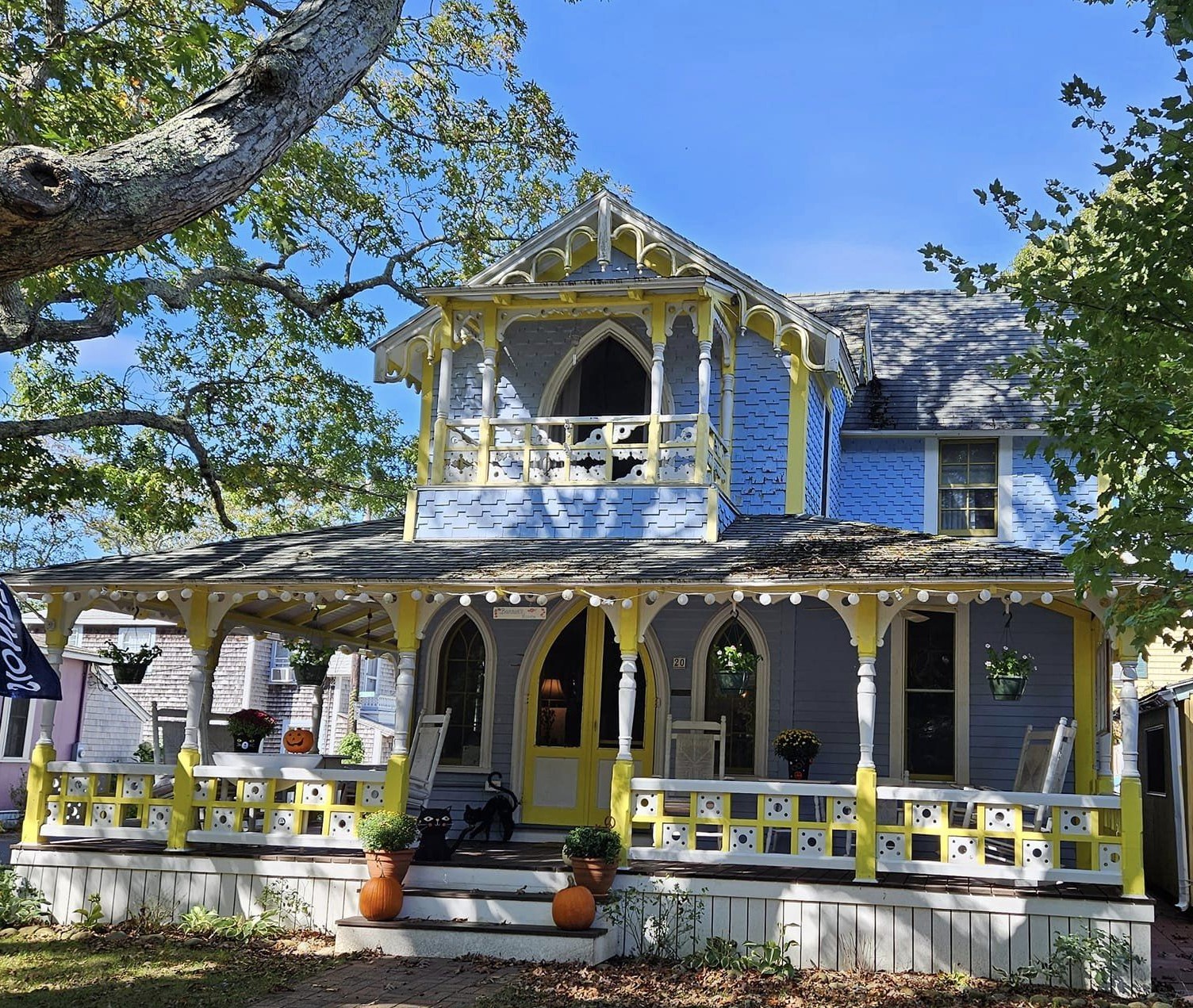
When we arrived, it was too early to check into our room, so we stored our luggage and started sightseeing.  We did a little window shopping, ate a lunch, and walked around the Martha’s Vineyard Camp Meeting Association, to see all the colorful homes.


When we were done with sightseeing in Oak Bluffs, we checked into our room.  Then we took a bus to Edgartown to do some sightseeing there.  We started by walking to the Edgartown lighthouse.


On our way back into the downtown area, we stopped by the waterfront.


The homes in Edgartown are all white with black shutters, so it wasn’t as colorful as Oak Bluffs.  Some of them, however, had flowers and interesting decorations.


On our way back to the bus stop, we saw the Old Whaling Church.


When we got back to Oak Bluffs, Deb went back to the Martha’s Vineyard Camp Meeting Association, while I went back to the inn to do a workout.  Some of the exercises I do require putting weight on my elbows.  That was difficult with the scrapes on my right elbow.  I also started to notice that the right side of my ribcage was more painful when I took a deep breath.  It’s possible I bruised a rib when I fell.

For dinner, we went to restaurant that’s known for having the best lobster rolls on the island.  It was certainly the best lobster roll I’ve ever had.

Tuesday, October 10

After getting up early to eat a light breakfast, I went out for an early morning run through Oak Bluffs.  My route took me past the East Chop Lighthouse, and I was out early enough to see the sunrise.


While I was running, Deb watched the sunrise from the pier.

After waiting for a brief rain shower to pass, we went out and explored another neighborhood in Oak Bluffs.


We were originally planning to take a ferry to Nantucket in the morning, but it was late in the season, and Hy-Line Ferries trimmed their schedule back to just one ferry per day from Martha’s Vineyard to Nantucket.  Instead of leaving at 9:05 AM, we didn’t leave until 12:55 PM.  That gave us time to have lunch before leaving, but we didn’t have as much time on Nantucket.

We arrived in Nantucket at 2:15.  As we entered the harbor, we had a good view of the Brant Point Lighthouse.


As we walked to our hotel, we noticed all of the streets in the city center were cobblestone.  This is Main Street.


We spend the rest of the afternoon exploring the streets around our hotel, which is the oldest part of Nantucket Town.  Most of the buildings have weathered cedar siding, so they tend to look alike.


We also walked to the Old Mill.  The blades of the windmill had been taken down, presumably for winter.


We got tired quickly after doing so much walking on brick sidewalks and cobblestone streets.  We had dinner at a restaurant that was near our hotel, and we didn’t venture out again until morning.

Wednesday, October 11

We had a couple hours in the morning to continue exploring Nantucket Town.  Then we boarded another ferry to take us back to Hyannis.  After picking up a rental car at the ferry terminal, we checked into a hotel in Yarmouth and then returned to Hyannis to do a little sightseeing.

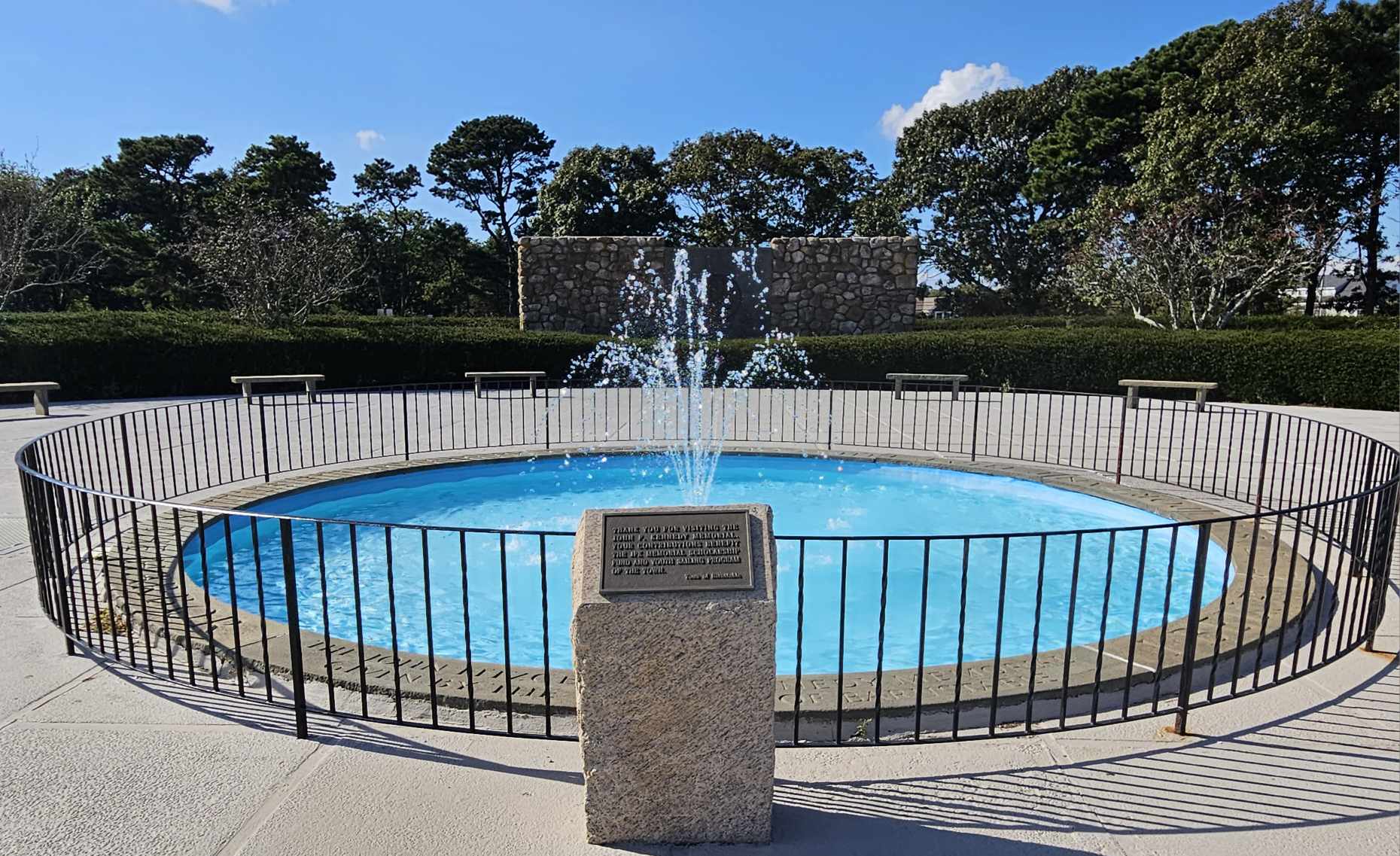
We stopped at the Veterans Memorial Park to see the JFK Memorial and the Korean War Memorial.


Since we were already there, we also walked down to Veterans Memorial Beach, which is almost empty at this time of year.


We stopped at the hotel long enough for me to go for a short run.  Then we went back into Hyannis to walk up and down Main Street and check out the shops.  Then we had dinner at an Italian restaurant near our hotel.

Thursday, October 12

We needed to drive back to Boston, but we had most of the day to get there.  That gave us time to spend half of the day in Plymouth.

Our first stop in Plymouth was Plymouth Rock, which may or may not have been the site at which the settlers of Plymouth Colony came ashore.


Next, we toured the Mayflower II, which is a replica of the original Mayflower.


This is the deck where 102 passengers and their animals all lived for 66 days.


We also went to the Plimoth Patuxet Museum.  This is an open-air museum which recreates the type of homes found in the abandoned Wampanoeg settlement of Patuxet, which is where the Plymouth Colony was founded.


There’s also a recreation of a 17th century English village, populated by actors in period costumes, going about their daily tasks.


When we were done in Plymouth, we continued to Boston, where we checked into a hotel near the airport.  Our flight wasn’t until Friday, so we were able to spend the late afternoon and evening in Boston.


Race statistics:
Distance:  26.2 miles
Time:  3:44:04
Average Pace:  8:33
First Half:  1:52:41
Second Half:  1:51:23
Lifetime Marathons/Ultras:  495
Boston Qualifiers:  155

Sunday, October 1, 2023

Non-Race Report: 2023 Twin Cities Marathon

This morning, I was scheduled to run the Twin Cities Marathon, which starts in downtown Minneapolis and finishes in front of the state capitol in St. Paul.  This would’ve been my 15th time doing this race.  Unfortunately, the race was cancelled.

This would’ve been my second of five consecutive weekends with marathons.  I don’t usually stack them this close together, but this is a hometown race, so it didn’t involve any travel.  It’s hard to resist when it’s one of your favorite races, and you get to sleep in your own bed.

This race usually has cool weather, but this year it was unusually hot.  The overnight low was in the upper 60s, but it was forecast to get up to 88 degrees in the afternoon.  I can’t remember a year that was warmer.  In 2007, the temperature climbed to 79 degrees during the race.  After the race, I heard a rumor that they were going to stop the race if the temperature hit 80.  That was the same day that the Chicago Marathon stopped their race.

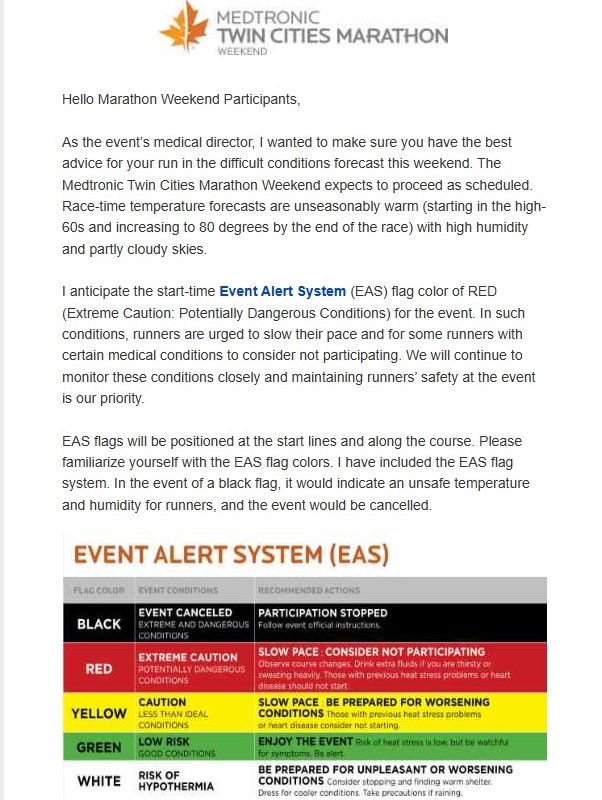
A few days before the race, I received an email to all runners from the race’s medical director.  Here’s an excerpt:


The letter went on to give tips for running in hot humid weather.  After reading this, my biggest concern is that the race would be cancelled if the temperature and/or humidity reached a certain threshold.

I’m of the opinion that a race should never be cancelled because of heat or humidity.  Three weeks ago, I ran 51 miles in hotter conditions.  Ultramarathons are never cancelled because of hot weather, yet marathon sometimes are.  I’ve also run marathons in Belize, Thailand, Jamaica, Costa Rica, Singapore, and other locations where everyone knew it would be hot and humid, because it’s always hot and humid.  Those races never cancel because of the heat.

That said, if you’re going to cancel a race for weather, you should do it before the race starts.  Once people start running, shutting down the race doesn’t do anything to make the runners safe.  It just leaves them stranded in unfamiliar neighborhoods without support and without a plan for getting home.  Everyone knows how they’re going to get home after finishing the race, but hardly anyone has a plan for getting home from some random spot along the route.

I had that experience in 2015, at the Rock ‘N’ Roll Savannah Marathon.  It was somewhat hot and humid, but no more so than it is every year.  We had conditions that were normal for Savannah at that time of year.  I actually felt surprisingly comfortable.  Then a runner who was doing the half marathon collapsed and died.  After that, someone in charge panicked and they pulled the plug on the race because of the unsafe conditions.  It’s tragic that a runner died, but I question whether it was related to the conditions.  The runner in had not run that far, and it was early enough in the day that it wasn’t that hot yet.

Once they made the decision to pull the plug, runners doing the half marathon still continued with their race.  Runners doing the marathon who had not yet reached the point where the courses diverge were forced onto the half marathon route.  Runners who were beyond that point continued along the marathon route, but they removed two out-and-back sections.  We all still had to make our way on foot to the finish area, but instead of running 26.2 miles, we only ran 20 miles.  I don’t see how that made anyone safer.

Getting back to the events of this weekend, I went to the expo on Friday.  At the expo, I saw a sign describing the Event Alert System.  The wording for “black flag” conditions was different from the email I received on Wednesday.  Instead of saying participation would be stopped, it said the race wouldn’t start in black flag conditions.  That subtle change in wording seemed encouraging.

When I got home from the expo, I saw another email from the medical director.  This one clarified that they would only start the race if they were confident that the conditions would be red flag (or better) for the entire race.  I got the impression that they wouldn’t stop the race once it had started.

The letter also said they still expected that they would be able to hold the race.  That was encouraging, although I was a little surprised.  Earlier in the week, the forecast high for race day was 83 degrees.  By Thursday, it had been revised to 85 degrees.  By Friday, it had been revised to 88 degrees.  I didn’t know exactly what combination of heat and humidity would be considered unsafe, but this was going to be much hotter than 2007.

The letter told us what measures they were taking to help keep the runners safe in hot conditions.  Among other things, they were going to have more water than usual at the aid stations, and they were going to have cooling or mist stations.  I was happy to see that.  When the Chicago Marathon was shut down in 2007, a major contributing factor was aid stations running out of water.  It was up to the runners to pace themselves appropriately for the conditions, but having plenty of water is one of the main things the organizers could do.  This letter also told us how many medical personnel they were going to have along the route.  They were planning to have enough that they would have eyes on every part of the route to look for runners in distress.

When I woke up on Saturday, I saw an email that had been sent out the night before.  It told us that the Saturday running events, which included a 5K and a 10K, would take place.  I got the impression the final decision on whether the marathon would take place was going to be made Saturday evening.  We were told to expect an email by 8:30 PM.  I didn’t want to see the race cancelled, but if you’re going to cancel, that’s the appropriate time to do it.

After dinner, I waited to get what I assumed would be the final word on the weather.  At 8:20 PM, I got an email saying they still expected to hold the race, but they would keep monitoring the weather and send another update at 5:30 AM on Sunday.  This email also suggested that they could still cancel the race at any time if conditions changed.

I slept well at first, but I woke up at 2 AM, and I couldn’t get back to sleep.  After laying awake in bed for the next hour and a half, I finally got up and had an early breakfast.

I got dressed for the race, but I wasn’t going to leave the house until I received the expected email.  When it arrived, I was shocked.  Here’s the email:


What made this so shocking to me is that the forecast had not really changed since the night before.  Maybe, they were already expecting to cancel based on the previous forecast, but they were hoping it would get better.  More likely, I think, is that the race officials sincerely believed they would be able to hold the race, but one of the cities forced them to cancel.  Race organizers are always at the mercy of the city governments.  They can only hold the race if the cities will grant permits, and the cities can always rescind those permits.

One reason I believe this is that they didn’t just cancel the marathon.  They also cancelled the 10-mile race.  There was absolutely no reason for that.  The marathon wasn’t scheduled to start until 8:00 AM, but the 10-mile race was scheduled to start an hour earlier, when the temperature was still dropping.  An hour into the race, it would only be 66 degrees.  By the time the temperature got back into the 70s, almost everyone would be done.  Even someone who walked the whole way would be done before it got out of the low 70s.  There’s just no way you can make a compelling argument that conditions were dangerous for the 10-mile race.

I find it hard to believe that the race organizers would be so callous as to cancel the 10-mile race just because it would be inconvenient to still hold one race after cancelling the other.  It’s far more believable that one of the cities pulled their permit, and that forced the cancellation of both events, since they took place on the same morning using many of the same streets.

I was already up, and I was ready to run.  Since I couldn’t run a marathon, I figured I might as well get out for a training run.  I was tracking a friend who was running the Spartathlon in Greece, so I waited to see his result before starting my run.  I got started a few minutes after 8:00, which is about the same time the marathon would’ve started.

As I started running, I was surprised how cool I felt.  Where I live, it was 68 degrees, and there was a strong breeze.  After about five miles, I started to notice the humidity.  It was sticky, but no worse than any day during the summer.

I didn’t run a marathon distance.  There was no reason to run that far If I wasn’t racing.  I ran 11.25 miles, which is just a little farther than my average training run.

The rationale for cancelling today’s race was that conditions were dangerous.  I don’t believe that.  I ran far enough this morning to conclude that conditions weren’t going to get any worse today than they did for most of my training runs.  I live in the Minneapolis/St. Paul area, so I’m pretty familiar with our weather.  Was this an unusually hot day for October?  Yes.  Was it as hot and/or humid as the weather in July or August?  No.  Not even close.  Anyone signed up for these races who lives in this area would’ve done the bulk of their training during the summer, when conditions were worse.  They should’ve known what these conditions feel like and how they affect their bodies.  If they were doing long training runs in August, they should’ve known how to pace themselves in these conditions.

I’ve run more than 50 ultramarathons, and most of them were summer races.  I’ve run 100-mile races where the temperature got into the 90s.  I’ve run at least one 50-mile race where it got up to 100 degrees by the time I finished.  I’ve run 12-hour and 24-hour races with temperatures in the 90s and high humidity.  In one of those races, the heat index was well above 100 degrees.  Was the race cancelled?  No.  Were any of the runners hospitalized?  No.  Ultrarunners know how to take care of themselves in the heat, and they’re running much farther than a marathon.

Maybe some significant percentage of marathon runners are too inexperienced to make good decisions when racing in hot weather.  Alternatively, maybe the people making decisions to cancel races just don’t give the runners enough credit.  I’m sure every city official who issues a permit wants to avoid a situation like Chicago in 2007, but that isn’t really aa fair comparison.  At that race, the aid stations ran out of water.  That was an avoidable situation.  The race officials knew it was going to be hotter than normal, and they should’ve realized thar runners would be using more water, yet they had the same amount of water that they had other years, when it was cool.  Once they ran out of water, runners started dropping like flies.  So many needed to be taken to hospitals that the emergency rooms were overwhelmed.  We’ll never know what would’ve happened that day if they had an adequate amount of water for all the runners.

Since large marathons in hot humid climates never need to be cancelled and smaller races also never seem to get cancelled, I really think the problem with the large urban marathons is city officials who are overly cautious.  Maybe part of the problem is also a need for more education within the running community.

I ran the Boston Marathon in 2012, when it was 89 degrees and sunny.  That race didn’t start until 10:00 AM, so we were running through the hottest hours of the day.  The race officials knew all week that it was going to be hot.  What did they do?  They were well aware of what happened in Chicago in 2007, so they had four times as much water as they normally would.  All week long, they were encouraging the runners to adjust their goals and just run at an easy pace.  During the race, there were road signs with flashing messages telling us to slow down.

Another thing the Boston Marathon organizers did was to give runners the option to defer their entry to the following year.  It’s tough to get into that race, and they were justifiably concerned that some runners might feel compelled to run in conditions they weren’t prepared for, because it might be their only chance.

There were some runners that year who tried to run too fast and struggled in the late miles.  Most runners, however, managed the heat appropriately.  They probably had more runners than usual needing medical attention after the race, but it wasn’t a disaster like Chicago in 2007.

Because I didn’t have to travel, the only thing I lost out on was the opportunity to run another marathon.  I ran one last weekend, and I’ll run one next weekend, so it’s not that big of a deal.  I feel bad for the runners who traveled from out of state just to do this race.  They not only lost an opportunity to run a marathon, but they’re still out all the money they paid for airfare and hotels.

After the race, I read comments online from a few runners who will never do this race again.  That’s a shame, because it really is a good race.  Unfortunately, it’s now a race that carries the risk that if could be cancelled if it happens to be unusually hot.  There are races I’ll never do for the same reason.  It’s just not a risk you want to take when you’re traveling to a race.  I can handle the weather.  I just want to have the opportunity to do the race.