Saturday, August 26, 2023

Race Report: 2023 Mt. Nebo Marathon

On August 26, I ran the Mt. Nebo Marathon.  This race starts near Mt. Nebo in western Utah and runs through Payson Canyon, finishing in Payson, UT.

The nearest major airport is Salt Lake City.  I flew to Salt Lake City on Friday and drove to my hotel in Provo.  I chose to stay in Provo rather than Payson, because Provo is a larger city, so it has more hotel and dining options.  At the time, I didn’t know where packet pickup would be.  I assumed it would be somewhere in Payson.  Two weeks before the race, I found out packet pickup was at a mall in Provo that was only half a mile from my hotel.

When I rent car, I generally go with whatever type of car is cheapest.  Usually, it’s an economy car.  This time, it was a “sporty” car.  I wasn’t quite sure what to expect.  It turned out to be a black Dodge Challenger.  With the right detailing, it could’ve passed for the Batmobile.

The drive to Provo took about an hour.  After checking in at my hotel, I went to pick up my race packet at Provo Towne Centre.  Then I went back to the hotel to do some strength training exercises before dinner.

From anywhere in Provo, I could see mountains to the east.  One of them had a white “Y.”  It reminded me of the “M” in Missoula.  The “Y” represents Brigham Young University.


I had an early dinner and got to sleep early, but I was only able to sleep for about two hours before waking up again.  I spent the next several hours resting in bed before finally getting up.

This is another one of those races where you have to get up really early to catch a bus to the start.  I had to drive 15 miles to Park View Elementary School in Payson.  Buses to the start left the school starting at 4:00 AM, with the last bus leaving at 4:30.

I knew the easiest place to park was at the school, but I didn’t know how early that parking lot would fill.  There were other nearby parking areas, but I didn’t want to drive around looking for parking lots in the dark.  I got to Payson a little early to make sure I would easily find parking.

When I got there, it was too early to board a bus.  There were two port-o-potties across the street, so I made a bathroom stop before getting in line to board a bus.

While waiting to board a bus, I bumped into my friend, Gwen, and we both got on the first bus.  Gwen is also from Minnesota, and she’s also a member of the 50sub4 club.

As soon as we got out of town, we were on a narrow two-lane road.  It was dark, but we could tell there were lots of turns.  We could also tell that we were constantly climbing.

After about 45 minutes, we saw what looked like the start area.  Then the driver told us that was where the half marathon started.  At first, I thought he was joking.  He wasn’t.  It was another 30 minutes before we reached the start area for the marathon.  By the time we got there, I was really glad I made a bathroom stop before boarding the bus.

Because we were on the first bus, we were able to get in the bathroom lines before they got long.  There were six port-o-potties for about 200 runners.  By the time the last bus arrived, the lines were long.

There were three 50sub4 members at this race.  After we each had time to make a bathroom stop, we took a group picture.


This race invites comparison with the Deseret News Marathon, which I ran five weeks ago.  Both races start in the mountains, descend through valleys, and finish in a city.  Unlike the Deseret News Marathon, which was steepest in the first few miles, this one is steepest in the second half.  It starts at a higher elevation, so there’s a bigger temperature change during the race.


When we left Payson, it was 60 degrees.  Because of the elevation difference, I was expecting it to be about 30 degrees colder where the race started.  They have a gear check, so I was able to wear extra layers while I was waiting for the race to start.  Even after checking my gear bag, I still needed warm enough clothes for the freezing temperatures during the early miles of the race.  Some layers I could remove during the race, but I had to commit to wearing tights for the entire race.  I knew I was likely to get hot in the late miles, but my legs don’t respond well to cold temperatures, and I thought it would be freezing for at least half of the race.

As it turns out, it wasn’t as cold as I thought it would be.  It was chilly, but
I didn’t need all the layers I brought.  I wore my jacket in the start area, but I took it off before the race started.  I wasn’t sure if I really needed the tights, but I had already committed to wearing them.

The elevation at the start was about 9,200 feet.  In the first half of the race, there was 1,300 feet of net descent.  That’s an average of 100 feet per mile, but it’s worth noting that it wasn’t all downhill.  There were uphill sections, and at that elevation, running uphill is really tiring.

My goal for the entire race was to break 3:50.  That’s the Boston qualifying standard for my age group.  I knew I wouldn’t be able to keep up that pace in the first half of the race.  My goal for the first half was to keep my time as close as I could to two hours.  If I could do that, I was confident I could run the second half fast enough to break 3:50.

When we started, it was still dark.  There was just enough light that I could see the pavement where I was running, but I couldn’t see far enough ahead of me to see if it was uphill or downhill.

As I started running, the road felt flat, but it quickly turned downhill.  It wasn’t very steep.  I sped up a little, but then I suddenly felt myself slowing down as the road turned slightly uphill.  As it turns out, there were three brief uphill sections in the first mile.

There were traffic cones dividing the right and left lanes.  We were instructed to stay in the right lane.  The other lane was open to traffic.  In the first mile, a few cars went by in the other lane.  Each time, I was temporarily blinded by the headlights.  That made it even harder to see changes in the slope of the road.

I finished the first mile in 9:30.  I was pleased with that pace for a mile that had a few uphill sections.  I knew some miles would be slow.

As I started the second mile, I crested a hill and began a long downhill section.  To my right, I could see the sunrise across the canyon.  Just above the mountains on the other side, there was a red orange glow.  I wanted to take a picture, but I would’ve needed to take off my gloves to use my phone.  I didn’t want to come to a complete stop for that long when I was just starting to run at a faster pace.

The second mile was all downhill.  I ran that mile more than a minute faster than the first mile.  The next two miles were mostly downhill, but they had occasional uphill sections.  Those miles weren’t quite as fast, but I was pleased with my average pace so far.

The next time I had a good view across the canyon, the color of the sunrise had changed.  Now, instead of red-orange, it was more of a yellow-orange.  By now, there was plenty of light to see the road.

There were seven places where we had to cross cattle guards.  The race organizers put sheets of plywood over them on the side of the road where we were running.  If you’ve ever run over a cattle guard without anything placed over it, it’s not fun.  You could easily twist an ankle.

As I started the fifth mile, I could see that we were starting a longer hill.  There were a few turns, so I couldn’t see the entire hill.  When I reached the start of the hill, I saw a green sign.  This was the first of three hills that had names.  That’s never a good sign.  I forget the native name, but it translated to “Skunk.”  The sign said it was a 200-foot rise.

I saw another runner walking the hill, but I was determined to run it.  I was willing to take it slow, but I wanted to limit the damage.

The hill wasn’t steep, but it was long.  Because we were still at high elevation, it was unusually tiring.  I started to get warm climbing this hill, so I took a short walking break, so I could take my gloves off and stuff them into my fanny pack.

More than once, I thought I saw the top of the climb.  Then I would make it around a bend, and I would see that the road kept going up.  I eventually had to take another walking break.  I walked for about 30 seconds and then forced myself to run the rest of the hill.  “Skunk” went on for most of the fifth mile.  In that mile, I slowed to 10:20.

Mile six was mostly downhill, but it also had a named hill.  This one was called “Rabbit.”  It was much shorter, but it was steep.  “Rabbit” was a 73-foot rise.  Because we were still at high elevation, this hill also forced me to take a walking break.  Overall, however, that mile was reasonably fast.  I ran it in 8:30.

Midway through the next mile, I saw another hill up ahead.  Then I saw the people ahead of me turning onto a different road.  At first, I was relieved that we didn’t have to go up that hill.  Then I saw a runner coming back from the road I was about to turn onto.  I was about to start an out-an-back section.  Eventually, I would still need to run up the hill I saw in front of me.

The out-and-back section was on a dirt road.  This was the only part of the road that wasn’t paved.  There were rocks embedded in the road, so I had to watch my footing carefully.

There was a steady stream of runners going out, but I only saw a few runners coming back.  That told me this section was long.  The runners I saw coming back were the runners who were near the front of the race.  They were spaced farther apart than the runners in the middle of the pack.  That suspicion was confirmed when I saw Gwen coming back.  Gwen is much faster than me.  At this point in the race, she was probably at least a mile ahead of me.

The out-and-back section was at least a mile each way.  It may have been closer to a mile and a half.  Going out it was slightly downhill.  That meant coming back it would be slightly uphill.  When I finally reached the turnaround, I knew it would be tiring coming back.  The grade wasn’t at all steep, but the elevation was still well above 8,000 feet.  At that elevation, running uphill for more than a mile is tiring.

My split for mile eight was 9:30.  That mile included some of the downhill running before the turnaround, so it wasn’t all uphill.  I wasn’t looking forward to seeing how much slower I would be in the next mile, which was all uphill.

I wanted to run this whole section, but I was eventually forced to take a short walking break.  I continued to limit my walking breaks to about 30 seconds.

When I finished the out-and-back section, I turned back onto the paved road.  It was downhill at first, but only briefly.  Then I reached the start of the hill I had noticed earlier.  This hill also had a name.  It was called “Eagle.”  It was another 200-foot climb.

I was just beginning to climb “Eagle” when I got my split for mile nine.  It was another 10:20 mile.

“Eagle” was the most tiring climb, partly because I was still tired from the uphill half of the out-and-back.  I ran until I was getting out of breath, and then I took a 30-second walking break.  Then I ran until I was getting out of breath again and took another 30-second walking break.  I repeated this process until the hill leveled out enough that I could run the rest of the way to the top.  I forget if I needed three or four walking breaks.

Before the race, we were told that there would be hills for the first nine and a half miles, but after that it would be downhill the rest of the way.  When I reached the top of “Eagle,” my watch read roughly 9.5 miles.  I could see a fairly long downhill section ahead, so I assumed I wouldn’t have any more hills.  I was wrong.  As I started mile 10, the road seemed to turn slightly uphill again.  The grade was subtle, but it definitely seemed to be uphill.  I saw other runners taking walking breaks, so I know it wasn’t just me.  I didn’t need to do any walking on that hill, but it was disconcerting to think it would be all downhill now and then having to do another small climb.

After that, it really was all downhill for several miles.  Then, in the middle of the 12th mile, the grade got a little steeper.  It seemed I was finally getting to the fast part of the course.

I ran miles 12 and 13 faster than most of my previous miles.  I reached the halfway point in 1:58:55.  It was a pleasant surprised to get there in less than two hours.  The first half was tougher than I thought it would be.

To break 3:50, I needed to be at least nine minutes faster in the second half.  On paper, that seemed easy.  In the second half of the race, we would descent about 250 feet per mile, and there wouldn’t be any more uphill sections.  Still, my previous two miles made me question whether I could it fast enough.  I ran the previous two miles in 8:32 and 8:33 respectively, even though they were all downhill.  I thought the grade in those miles was similar to the average grade in the second half, yet my pace in those two miles wouldn’t quite be fast enough for me to run the second half in 1:50.  I needed a pace in the low 8:20s.

Right on cue, the road turned more sharply downhill.  I ran miles 14 and 15 in 8:04 and 8:09, respectively.  My goal now was to run each remaining mile in 8:20 or faster.  I had no idea how easy that would be.

In the next mile, I saw a road sign indicating a hairpin turn.  There had been lots of turns so far, but none of them were actual switchbacks.  This signaled the beginning of the steepest part of the course.  I ran mile 16 in 7:20.  That was the first of seven straight miles that were all faster than eight minutes.

With about 10 miles to go, I felt the sun hitting me for the first time.  The sun had risen much earlier, but we were always in the shadows of the mountains.  Now the sun was finally high enough in the sky that it sometimes shone over the mountains.

Earlier, my hands would get cold whenever there was a breeze.  Now, for the first time in the race, I felt hot.  Thankfully, I only felt the sun occasionally.  More often than not, I was still between mountains that provided adequate shade.

As I continued descending through the canyon, sometimes my ears would pop.  Each time, I would suddenly start to hear my surroundings more clearly.  Over time, my hearing would gradually diminish.  I wouldn’t notice it was happening until the next time my ears popped.  Then I could hear clearly again.

With about eight miles to go, I started to feel some discomfort on the bottom of my left foot.  I wear orthotics, so I have to wear replacement insoles.  When I run downhill with wet shoes, my insoles can slip forward within my shoe.  What I was feeling was the insole in my left shoe sliding forward and bunching up under my foot.  There wasn’t anything I could do about it during the race.  I just had to live with that discomfort for the rest of my race.

I didn’t realize before how much I was sweating.  The perspiration on exposed skin evaporated quickly in the dry air.  Inside my shoes, however, my socks were probably drenched with sweat.

With seven miles to go, I got my first view of the Utah Valley in the distance.  I could see how much farther I still needed to go to get there.  I could also see that I was still at a higher elevation than the valley floor.

As I continued descending, I noticed it was getting warmer.  With five miles to go, I started to feel hot, even when I wasn’t in the sun.  Now, I was finally conscious of how much I was sweating.  The tights on my legs didn’t help.  Fortunately, I only had five miles to go.  I just had to tough it out.

With about four miles to go, it seemed like I was getting closer to the end of the canyon.  The road leveled off for a while.  I also felt the sun on me.  For the rest of the race, the heat of the sun was going to be a big factor.

The guy just ahead of me started walking, but I kept running.  I wasn’t going to take a walking break on a flat section.  Instead, I picked up my effort.  I tried hard to avoid slowing down any more than I had to.  I wasn’t able to run that mile faster than eight minutes, but I kept it under 8:20.  I managed to do that for the rest of the race.

I started to notice more people ahead of me who were walking.  It seemed everyone ahead of me was walking now.  I had caught up to the back of the pack of the half marathon.  That race started 30 minutes after the marathon, but they started at our halfway point, so they had a big head start.

After that mile, there was more downhill, but it was no longer constant, and if was no longer steep.  Downhill sections alternated with flat sections.  To keep my pace close to eight minutes, I had to work harder.  With only a few miles left, I was determined to do that.

I saw a sprinkler set up over the road, and I ran under it.  That’s out of character for me.  I don’t usually like to get my clothes wet during a race.  At this point in the race,
I was desperate to cool off.  After running under the sprinklers and getting my clothes wet, the breeze immediately cooled me off.  The effect didn’t last long, but it momentarily rejuvenated me, enabling me to keep running hard.

With about a mile and a half left in the race, I finally left the canyon and got onto the streets of Payson.  From here on out, it was going to be flat, and it was going to be hot.  By now, the temperature had risen into the upper 70s, and I was overdressed.

I ran the 25th mile in 7:55.  That was a pleasant surprise.  That mile started out downhill, but flattened out as I got into town.  I was working hard to keep up my pace, but I didn’t know if I could do that for another mile.  The next mile wasn’t going to have any downhill sections.

As I started the next mile, I saw another sprinkler set up over the road.  Running through that rejuvenated me again.  It was what I needed to prepare me to fight hard for one more mile.

Five weeks ago, in the Deseret News Marathon, I came in second in my age group.  I kept that in mind as I ran the last mile through town.  I looked for anyone who might be in my age group.  I didn’t see any men who might be in my age group.  In fact, I didn’t see any men at all.  I had passed a number of men over the past several miles, but now I only saw women.  I saw women walking who were probably doing the half marathon.  I saw a few women running, but I didn’t need to complete with them.  I passed a few of them, but only because I was trying to run the last mile as hard as I could.

There were a few turns going through town.  Each time I came around a corner, I looked to see if there was anyone I needed to pass.  There never was.

When I got my split for mile 26, it was 8:03.  That wasn’t as fast as the previous mile, but this one was flat, and I was struggling with the heat.  Under the circumstances, I was happy to keep one more mile under 8:20.

When I made the last turn, I saw the finish line, and I accelerated.  I finished in 3:42:30.  After finishing, I had a few beverages, and then Gwen spotted me.  Gwen showed me where I could retrieve my gear bag and where I could look up my official result.  I won my age group.

As soon as I had a chance to sit down, I took off my left shoe, so I could adjust my insole.  Even after fixing my shoe, I still had discomfort on the bottom of my left foot.  I assumed I had developed a blister.

There were three 50sub4 members at this race, and all three of us won our age groups.  After the awards ceremony we posed together with our finisher medals and our age group medals.


I didn’t eat much food in the finish area.  I was mostly thirsty.  By the time I got back to Provo, I was starving.  I don’t usually eat a meal until I get cleaned up, but there was an Arby’s right next to my hotel, so I went through the drive-through to get a fast food lunch, and I ate it when I got back to the hotel.  That won’t stop me from having a celebratory dinner later.

When I took my shoes and socks off, I discovered that I not only had a blister in the arch of my left foot, but it had ripped open.  I was not prepared for the sting when it came in contact with hot water.  It doesn’t hurt as much now, but training runs may be uncomfortable for a while.

This was my second Utah marathon in two months.  The Deseret News Marathon brought me closer to completing my fourth circuit of marathons or ultras in every state.  This race helped me make progress toward an eventual fifth circuit.


Race statistics:
Distance:  26.2 miles
Time:  3:42:30
Average Pace:  8:30
First Half:  1:58:55
Second Half:  1:43:35
Lifetime Marathons/Ultras:  492
Utah Marathons:  5
Boston Qualifiers:  153

Sunday, August 13, 2023

Race Report: 2023 Boulder Rez Marathon

On August 12, I ran the Boulder Rez Marathon in Boulder, CO.  Deb likes the Denver area, so Deb and I built a short Colorado vacation around this race.

Wednesday, August 9

We flew to Denver in the early afternoon.  We stayed at a hotel in Broomfield, which is about halfway between Denver and Boulder.

We had dinner at Beau Jo’s.  Beau Jo’s is a restaurant Deb discovered on one of her previous visits to the Denver area.  They have what they call mountain-style pizza.

Thursday, August 10

The race wasn’t until Saturday, so we had two days to do fun things in the area.  On Thursday, we did things in the Boulder area.  On the drive into Boulder, there’s a scenic overlook where you can get a nice view of the mountains.


On our way into Boulder, we made the obligatory tourist stop at the house that was used for exterior shots for the “Mork & Mindy” TV show.


Next we went to the Pearl Street Mall.  We got there before the shops started opening, so we started out by walking up and down the four-block pedestrian mall to view the flowers and statues.


They have a train that goes around the mall.  It’s meant as entertainment for children, but Deb was in touch with her “inner child.”


When the shops opened, we window shopped until we were ready to stop for lunch.  For lunch, we went to the Boulder Dushanbe Teahouse.


After lunch, we visited two city parks.  First, we went to Boulder City Park and explored the Boulder Creek Path.


Next, we went to Chautauqua Park, where we got a view of one of the Flatirons.  There are trails into the mountains from here, but it was getting to be too hot to go hiking.


After Chautauqua Park, Deb dropped me off at the hotel, so I could go for a run.  While I was running, Deb went grocery shopping for fruit and beverages.

I ran a little over six miles.  I knew my route would have me starting uphill, but I wasn’t quite prepared to run uphill continuously for the first two miles.  The elevation in Broomfield is about 5,400 feet, and I did 500 feet of climbing in the first two miles.  At this elevation, I tire quickly going uphill.

After that, I had about a mile of downhill running, followed by two miles that were rolling.  That was a little easier, but I never recovered from those first two miles.

With about two miles to go, I was starting to heading back toward our hotel.  I could see dark clouds to the west, and it looked like it was raining just a few miles away.  I had doubts about whether I could make it back to the hotel before the rain started.

With just under a mile to go, I started feeling drops.  The last mile to the hotel was downhill, so I did my best to pick up my pace.  My concern was getting my shoes too wet.  I needed to wear the same shoes for the race on Saturday, so I didn’t want them to get so wet that they wouldn’t dry in time.

The rain and wind picked up a little as I was running through the hotel parking lot, but I finished before getting my shoes soaked.

Later in the afternoon, we returned to Boulder.  Deb wanted to visit an antique jewelry store in the West End.  Then we had dinner at a farm-to-table restaurant in the West End.

Friday, August 11

We went for a scenic drive through a canyon to get to Nederland.  Most of the time we were driving alongside a stream.


When we got to Nederland, we started going north on the Peak to Peak Scenic Byway.  After a few miles, we had to stop, because Deb was having difficulty with the elevation.  Her allergies were causing her to be congested, and when you’re congested, your ears can’t adjust to differences in air pressure.  We were at an elevation of about 8,200 feet.  Had we continued on the scenic byway, we would’ve gone higher.  Already, her head felt like it was in a vice, so we turned around and went back.

On our way back, we stopped by Boulder Falls.  We parked the car, and I hiked in a short distance to get a view of the falls.


After taking a brief rest break at the hotel, we had lunch at a brunch spot in Louisville called The Huckleberry.  If you’ve never been to Louisville, CO, it feels more like a small town than the surrounding communities.

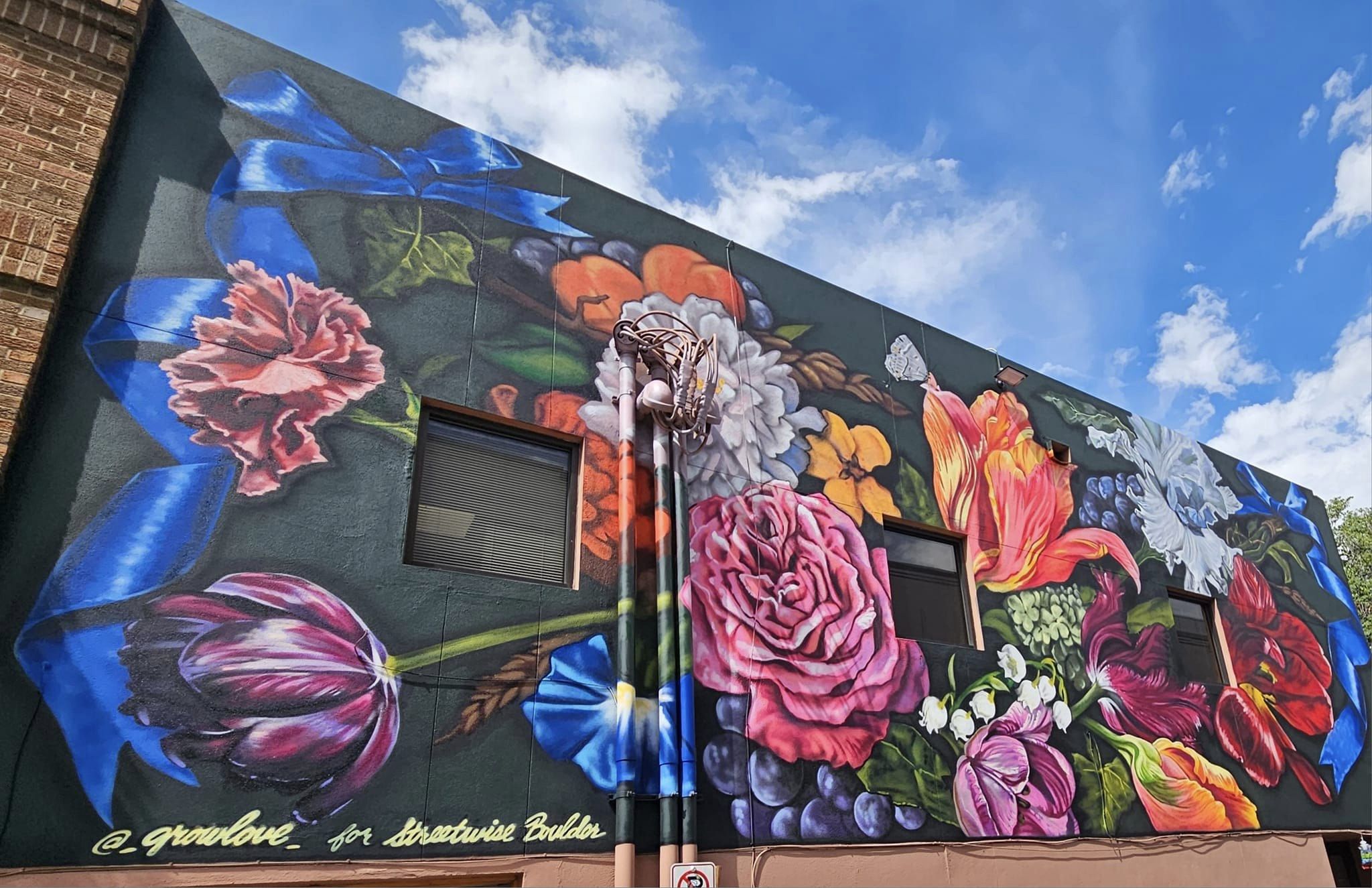
Between the elevation and the intense afternoon sun, Deb needed to spend the afternoon relaxing at the hotel.  I drove back into Boulder to locate as many of the murals as I could.  There are at least 90 murals in Boulder.  I focused on the ones near downtown, so I could park the car in one place and walk around.  Some are in alleys, so you really have to go out of your way to look for them.


When I got back to my car, I drank a full bottle of water.  Everywhere we went, Deb and I had water bottles with us, but no matter how much I drank, I always felt dry.  I’ve run other races at similar elevations, but I usually arrived the day before the race and flew home the day after.  Being in the area for two extra days, meant I had two extra days to get dehydrated.  Drinking enough was a continual challenge.

When Deb and I were in Louisville for lunch, we noticed other restaurants that looked good.  I was planning to go to a pizzeria in Louisville for dinner, but it was impossible to find a parking space anywhere in the downtown area.  There was a street festival of some type going on, which didn’t help.  I eventually gave up and had dinner at a pizzeria I had driven by earlier.

Saturday, August 12

Saturday was race day.  The course was four laps around the Boulder Reservoir.   The marathon started at 7:15 AM, but I needed to get there earlier for packet pickup.  It takes about 30 minutes to drive to the reservoir, so I had to leave by 6:00 to ensure I had plenty of time to get ready for the race.

Before this race, I had never heard of this race, so I didn’t know how large it would be.  As I got within a mile of the reservoir, I started to see signs for the race.  Then there were volunteers showing us where to park.  There were apparently enough runners that we needed to park in a large field rather than in the parking lot for the reservoir.  From where I parked, it was a five-minute walk to the start/finish area.

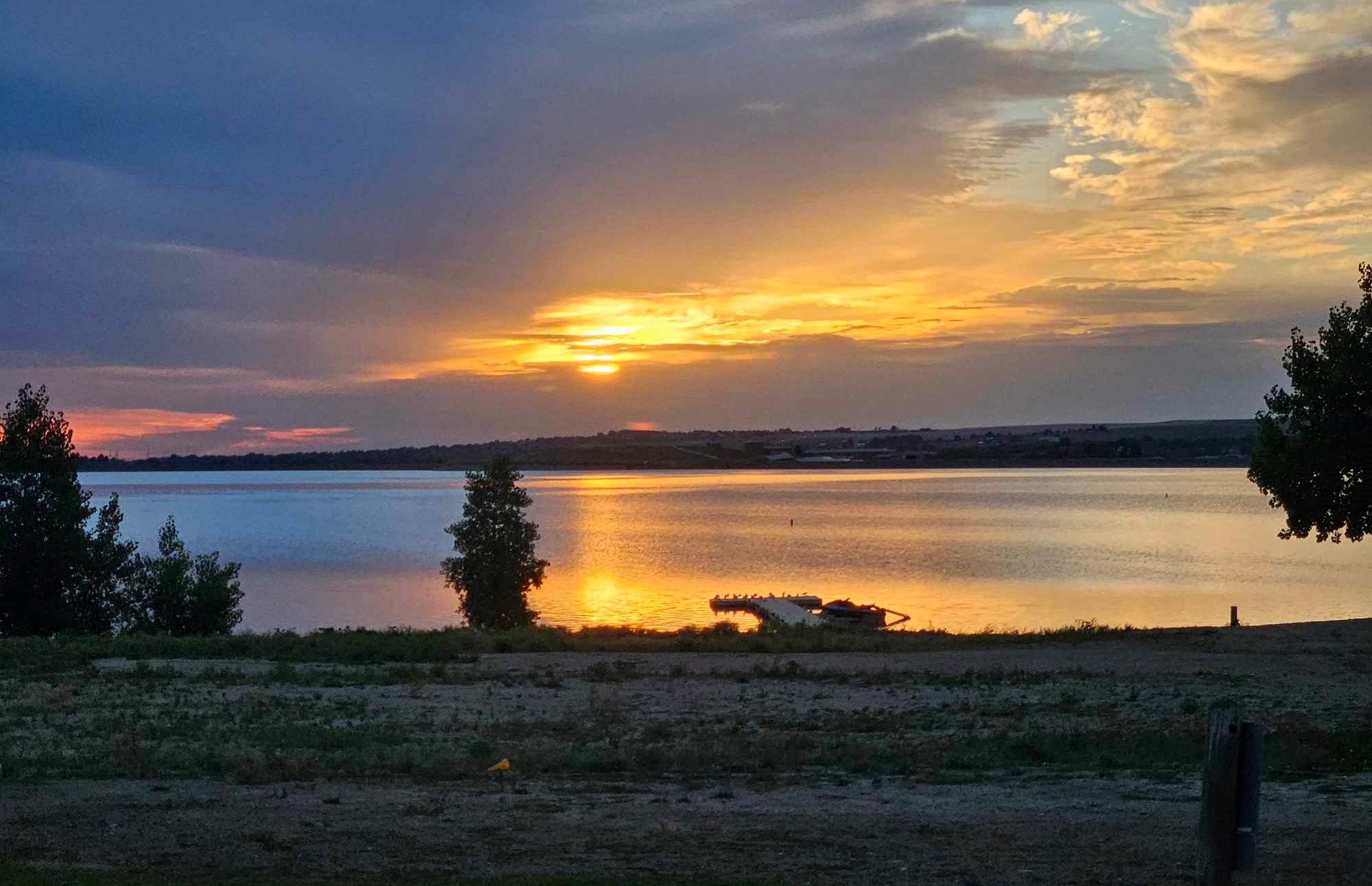
When I finished picking up my race packet, it was just after sunrise.  I saw the sun over the reservoir, and I also the mountains in the glow of the morning sun.


I don’t usually drink much before a race.  This race was an exception.  I brought two bottles of water with me.  By the time the race started, I had finished one bottle and started in on the second one.

In all, there were five race distances.  The 5K race had an out-and-back route that only went partway around the reservoir.  The 10K race did one full lap around the reservoir.  The half marathon, ¾ marathon and marathon all ran a modified version of the loop.  To make the distance come out right, we had to do a short out-and-back in the middle of the loop.  The longer races did this modified loop two, three, or four times.

About a quarter of the loop was paved.  The rest was a combination of dirt road and dirt trail.  The route has a few hills, so I wasn’t expecting a fast time.  Even on a flat course, running at this elevation will slow me down by 5-10 minutes.  On a hilly course, I expected to be much slower.  It’s on hills that I really feel the effects of the elevation.  My training run on Thursday was a reminder of that.

It's rare that I do a race without bumping into someone I know.  This was one of those rare occasions.  Although I didn’t know anyone, I still struck up conversations with a few of the other runners.  One of the runners I met before the race was Josh.  I didn’t know it at the time, but this was his first marathon.

Another runner I met before the race was a local runner who was doing the ¾ marathon as a long training run.  When I mentioned how much difficulty I had been having staying hydrated, she said the humidity was actually much high than usual.  Normally, the humidity is only about 10%.  Lately, it’s been about 40%.  To her, it felt humid, but to me it felt dry.

On the elevation profile, I noticed two large hills.  One was near the end of the first mile, and the other was near the end of the second mile.  She assured me that those hills aren’t as bad as they look on the elevation profile, and after that, the rest of the lap is fairly easy.  Since she lives at this elevation, I had to wait and see how my body would react to the hills.

The temperature at the start was in the 60s, but if I learned anything from the previous two days, it’s how quickly it warms up once the sun comes up.  By the time I finished, it would be in the 80s.  I also expected the sun to be intense.

I didn’t feel like I had a realistic chance of breaking four hours, so I chose to start the race at a pace that felt relaxed.  I wasn’t trying for a fast time.  I just wanted to finish the race and save my best effort for the next one.  I lined up near the back.  When I started running, I kept the pace nice and slow, even though I felt like I could be going faster.

We started out on pavement, but almost immediately turned onto a dirt road.  The first mile seemed to have a slight downhill trend, but I didn’t allow myself to pick up speed.

Lately, I’ve been training in the afternoon, and I’ve often run with temperatures in the 90s and high humidity.  That has forced me to run at a nice relaxed pace, so I’m not in danger of overheating.  I started this race at the same relaxed pace.

Toward the end of the first mile, I saw a hill and realized this must be the first of the two big hills.  It wasn’t as bad as I thought.  It was slightly more tiring, but at the pace I was going, it wasn’t going to wear me down.

Just before the top of the hill, I finished the first mile.  My pace was just under 10 minutes.  That surprised me.  I felt like I was starting slower than that.

After cresting that hill, I had a nice long downhill section before the road leveled off.  Then I reached an aid station.  There were five aid stations in each lap, including one in the start/finish area.  The aid stations had water, Gatorade, and gel packets.  I drank Gatorade at every aid station.  I wasn’t too concerned about my time, so I slowed to a walk while I drank.

It was during the second mile that I saw a faster runner go by.  He looked like he was fast enough to win the race, so I wondered why he was behind me in the first place.  My initial thought was that he must have been late for the start.

Toward the end of the second mile, I encountered the second of the two largest hills.  This one seemed longer than the first one, but it still wasn’t that big of a deal.  After the two-mile long hill at the beginning of my training run on Thursday, these hills weren’t a big deal.  It was a relief to know that.

Before the top of the hill, I reached the two-mile mark.  This mile was faster than the first one, but it’s worth noting that much of this mile had been downhill.

During the third mile, I reached the out-and-back section.  By the time I finished the out-and-back, two more fast runners passed me.

Next, we turned onto another dirt road that went along the north edge of the course.  We were well north of the reservoir, and there was farmland on either side of the road.  The road on this side was nice and flat.

As more fast runners passed me, I finally realized where they came from.  The ¾ marathon started just five minutes after the marathon, and the half marathon start wasn’t too much after that.  I was seeing all the fast runners from the shorter races.  I would continue to see them go by for the rest of my first lap.

At the northeast corner of the loop, we turned onto a paved road, which was also nice and flat.  Here, I inadvertently sped up.  After running the third mile in 10 minutes, I sped up to roughly 9:30 in the fourth mile.  After that, I settled down again.

Next, we left the road to turn onto a gravel trail.  The trail was initially serpentine and had a small hill.  For the first time since those two early hills, I was breathing harder.

This trail brought us across a levee on the east side of the reservoir.  It occurred to me that it was the first time I had seen the reservoir since leaving the start/finish area.

A runner next to me noticed my sunglasses and asked me if they were the Goodr Boston Marathon sunglasses.  They were.  That started a long conversation.  Her name was Angela, and we run the rest of the race together.  Like me, Angela has run the Boston Marathon several times, and she also does ultramarathons.

The last part of the loop was on a paved road, which eventually brought us around a building and back to the start finish area.  I forgot to check my watch at the end of the first loop, but I knew my average pace was under 10 minutes.

In the second lap, we continued at the same pace until we reached the first hill.  Angela wanted to walk the hills, and I saw no good reason not to.  At this point, I could’ve easily run up the hills, but I was enjoying our conversation.

Other than walking the hills, we ran the second lap slightly faster than the first one.  I was much more comfortable than I thought I would be.  I was expecting the sun to get hot, but it was staying cloudy.

At the halfway point, we were still averaging less than 10 minutes per mile, but we started to slow down in the third lap.  The biggest difference was taking more time at aid stations.

In the fourth lap, we slowed down substantially.  We sometimes got as slow as 11 minutes, even in miles that didn’t have hills.  This was also the first lap where I felt like I was breathing harder, even on flat sections.  Maybe is just took time for the higher elevation to take a toll on me.  Or perhaps it was the heat.  It was still cloudy, but the temperature was climbing.

About halfway through that lap, we came to an aid station, and someone said, “Are you David?”  At first, I thought it was one of the volunteers, and I wondered how he knew my name.  Then I saw it was Josh.  I didn’t notice him at first, but he had been sitting down at the aid station.  One of the volunteers said he had been sitting there for an hour.

Angela was able to persuade Josh to get up and start walking.  We both walked with him.  Knowing how long Josh had been sitting there, I assumed he was still on his third lap.  When I asked him, he said he was on his last lap.  That meant he only had to hang in there for about three miles.  It also meant he must’ve started much faster than we did.

After we turned onto the paved road, Angela suggested Josh try running for short distances.  There were traffic cones separating the driving lanes from the shoulder.  We ran until we passed two cones and then walked until we passed the next two cones.

We kept this up for a few minutes, but then Josh needed to just walk the rest of the way.  He told us to go ahead, and he assured us that he would be able to power walk the rest of the way.  We said everything we could to encourage him, and then we went on our way.

In the last two miles, we were going slower than before, but I was still breathing hard.  We eventually finished, but that last lap was slow.  I finished the race in 4:30:56.  Angela crossed the line right next to me.

At the finish line, volunteers were handing out bottles of water and Gatorade.  I don’t usually want to drink more Gatorade after a race, but the Gatorade was in a larger bottle, and I thought I should drink as much as I could.  Even though I drank at every aid station, I still felt dry.

While I was drinking my Gatorade, I saw Angela go over to the timing truck.  The guy in the truck looked at her bib number, but said he only had splits for her first two laps.  I told him we finished at the same time and asked him to look up my time.  He didn’t have a time for me either.  It turns out an ethernet cable had come loose.  Times were getting recorded at the finish line, but they weren’t making it to his laptop.  After he restored the connection, we learned that Angela had placed second in her age group, and I had placed third in mine.  Our awards were tumblers with the same artwork as the finished medals.


Post race food included sub sandwiches from Jimmy John’s.  They had turkey sandwiches and veggie sandwiches.

After we ate our sandwiches, Angela and I both went to start watching for Josh.  We watched for a long time, but we didn’t see him.  It had stayed cloudy the whole time we were running, but now it was sunny, and it felt much hotter if you were in the sun.  I felt bad for the people who were still on the course, including Josh.

Angela and her husband had to leave, but I kept watching.  When I still didn’t see Josh, I felt conflicted.  I wanted to keep watching, but it had been 30 minutes since I finished, and I wanted to call Deb to let her know I was done.  My phone was in my car.

I walked back to the car, so I could call Deb.  I was sitting in the car with the windows open when I heard the finish line announcer calling Josh’s name.  He finished in 5:09.

I rushed back to the finish area, so I could find Josh before he left.  I congratulated him on finishing his first marathon.  He introduced me to his family and told them that I had helped him get moving again.  Angela actually deserves most of the credit.  She was the one who persuaded Josh to get out of the chair and start moving again.

Had I known before the race that this was Josh’s first marathon, I probably would have given him advice.  First on the list would be not starting too fast.  He ran the first 23 miles in three hours, sat for an hour, and then ran the last three miles in about an hour.  That’s not ideal, but the important thing is that he didn’t give up.

This was my fifth marathon or ultra in Colorado.  I’m still working on my fourth circuit of marathons in every state, but I’m also making progress on my fifth circuit whenever I can.

Later in the day, I had dinner with my friend Chavet and her husband Tim.  We talked for about two hours.  I enjoyed that conversation as much as the one I had during the race.


Race statistics:
Distance:  26.2 miles
Time:  4:30:56
Average Pace:  10:20
First Half:  2:09:18
Second Half:  2:21:38
Place in age group:  3rd
Lifetime Marathons/Ultras:  491
Colorado Marathons:  5

Monday, July 24, 2023

Race Report: 2023 Deseret News Marathon

On July 24, I ran the Deseret News Marathon in Salt Lake City.  This is the oldest race in Utah.  It’s part of the Pioneer Day festivities, which celebrate the arrival of Brigham Young and his followers in 1847 and their decision to settle here.

I flew to Salt Lake City on Sunday.  When I arrived, I had an aggravating experience picking up my rental car.  There were 20 people in line ahead of me and only two employees at the counter.  They were taking several minutes for each person.  I was in line for an hour before I got my car.  I’ve had similar experience at two different airports with Payless, which is why I no longer rent from them.  This was the first time I had a bad experience with Dollar.  I’ll make a note never to rent from them at this location.

After checking in at my hotel, I drove to Rice Eccles Stadium to pick up my race packet.  Local runners were encouraged to pick up their race packets on Saturday, but packet pickup was available Sunday afternoon for runners who were arriving from out of town.

At packet pickup, I asked how early they start closing streets for the marathon.  I’m glad I asked.  Besides closing streets for the marathon, they also close the streets along the parade route for the Days of 47 Parade.  Those streets are closed all night, so I had to make a point of avoiding them in the morning.

After packet pickup, I still had enough time before dinner to go to the fitness room and do some core and leg exercises.  I was feeling a bit stiff after my marathon on Saturday.  I think this workout helped me to work out any residual soreness.

When I left the hotel to walk to dinner, it was 98 degrees.  The restaurant was only five blocks away, but I felt like I was inside an oven.  Walking back, it was even hotter.  It was 102 degrees.  I knew it wouldn’t get that hot during the race, but it still got my attention.

I had to get up early on Monday, so I went to bed as early as I could.  I was able to get to sleep early, but I woke up after a few hours and had trouble getting back to sleep.

This is a point-to-point race.  It starts at Big Mountain and follows the route of the pioneers through Emigration Canyon before finishing in downtown Salt Lake City.  To get to the start, we had to park at Rice Eccles Stadium and take a bus.  The race starts at 5:30 AM, with buses leaving from 3:45 to 4:15 AM.

Whenever I do a race like this, I have a “what was I thinking?” moment when I realize how early I need to set my alarm.  I set my alarm for 2:30, so I could be ready to leave by 3:30.  I was awake an hour before the alarm went off.

It was another hot day, but thankfully not as hot as Sunday.  When I woke up, it was 87 degrees.  The temperature was forecast to bottom out at 80 degrees before rising again.  The forecast high was 102 degrees.  I knew it wouldn’t get that hot before I finished, but 90 seemed likely.

It’s normally cold at the start, but I had to wonder what the temperature would be on such a hot day.  Would I need warm-up clothes?  I certainly wasn’t going to wear anything extra as I left the hotel, but I brought a space blanket, just in case I needed something to stay warm in the start area.  They had a gear check at the start, but I didn’t want to bother with that, so I didn’t bring any clothes that I wasn’t willing to discard.

I didn’t know how long it would take to get to the stadium, since I was going out of my way to avoid the parade route.  I got there early, but people were already getting onto buses.  I was on one of the first buses to leave.

The bus I was on made a stop at a hotel to pick up some elite runners, but we still got to the start area more than an hour before the race started.  When I got off the bus, it didn’t feel the least bit cold.  The bus was air conditioned, so it was actually warmer outside.  It felt like it was about 70 degrees.

I made a bathroom stop while there weren’t any lines.  Then I took a picture of the historical marker.  I also took a picture of the lights of the city, which were visible over the mountains.


Most of the other runners were milling about in the start area.  Then I saw a runner who found a bench to sit on.  Sitting sounded better than standing around for an hour, so I joined him.  The bench was cold, but I was able to sit on my space blanket.

The other guy sitting on the bench was Jacob.  He’s 21 years old, and this was his first marathon.  He asked me if I had any advice for him.  I told him what I knew of the course.  I also told him he would need to pay attention to how he felt as it got hot in the late miles.

While we were talking, another runner came over.  He said, “I’ve got good news and bad news.  The good news is, it’s not cold in the start area.  The bad news is, it’s not cold in the start area.”

Typically, it’s freezing in the start area, but it’s still hot at the finish.  It was nice that I didn’t need warm clothes in the start area, but it didn’t bode well for later.

This race is mostly downhill, with roughly 3,000 feet of net descent.  I generally run well on downhill courses, so it made sense to go for a fast time.  The most obvious goal was 3:50, which is what I need for a Boston qualifier.  I had three reasons, however, to question whether I could run that fast.

First, the course isn’t all downhill.  I was talking to another runner who has done this race, and he mentioned going downhill and then uphill, before going downhill again.  I had to take a close look at the elevation profile to see it.  The first several miles are downhill, but then there’s a section that has at least 250 feet of ascent.  It’s spread out over a few miles, so it’s fairly gradual.  Still, when you’re 6,000 feet above sea level, even a gradual hill can feel tiring.  I couldn’t expect to maintain a fast pace over this section.

Second, it was going to get hot as I descended toward Salt Lake City.  I might not feel it until the second half of the race, but I expected the heat to slow me down in the late miles.

Last, but not least, this was my fourth marathon in a span of seven days.  I did a good job of holding back on Tuesday and Wednesday, but I ran faster than I planned on Saturday.  With only one day off between races, I questioned whether I had recovered sufficiently for an all-out effort.

With all that in mind, I had to take each section of the course as it came.  I had to pay attention to how I felt and wait until late in the race before deciding what was a realistic goal.

I don’t usually drink much before a race.  I’ll have a cup of tea when I wake up, but I won’t drink anything else until after I start running.  Today, I made an exception.  After the National Anthem, while everyone else was lining up to start, I dashed over to the tent with water and Gatorade, and I drank a cup of Gatorade right before lining up.  As usual, I also drank at every aid station on the route.

When we started running, I was surprised by how steep the grade was.  It was sharply downhill, and there were a lot of switchbacks.  I ran this section the same way I always run downhill courses.  I kept my stride short and focused on maintaining a rapid turnover.  When I do that, I don’t need to put any extra effort into running fast.  Gravity takes care of that.

I ran the first mile in 7:54.  I was actually surprised that it wasn’t faster.  In the next two miles, I sped up to about 7:30.  Those miles didn’t seem any steeper, and I wasn’t putting any more effort into them.  I think the first mile wasn’t as fast because there were so many runners in front of me at the start.

As we descended through the valley, I sometimes felt a cold draft.  I didn’t know where that cold air was coming from, but it made the early miles feel more comfortable.

The fourth mile wasn’t as steep as the first three.  At first, I found the pace to be tiring in this mile.  Then I realized I was still running with the same fast cadence.  As long as I did that, I would maintain the same fast pace, but it took more effort when the road wasn’t as steep.  I recalibrated my gait until I found a stride that didn’t take much effort.  It wasn’t as fast as the first three miles, but the goal was to run only as fast as I could without working too hard.

In the next mile, the road briefly leveled off.  For the first time, I was comfortable coming to a stop, so I could take a picture of the valley.  Stopping briefly also gave me a chance to recalibrate my stride again.  I didn’t want to keep running with the same rhythm.  I needed to constantly adapt to the road.


Early in the next mile, as I was pausing to drink at an aid station, I saw that the road was about to turn uphill.  I knew there would be an uphill section, but it started earlier than I expected.  Going uphill, I went at a pace that didn’t feel too tiring.  I knew it would be mostly uphill for the next few miles.  I didn’t care if I slowed down.  My only priority was to get through this section without wearing myself out.

As I got around the next bend, I saw switchbacks going up to a pass in the distance.  Then I noticed there was also a road that went to the left.  That road seemed to go downhill.  Would we take the high road or the low road?  As I got closer, I could see runners on both roads.  We started with the road on the left, but it was just a short out-and-back section.  Then we had to climb the switchbacks up to the pass.


The out-and-back was downhill going out, but uphill coming back.  On my way out, I saw a pace group on their way back.  It was the 3:30 group.  After making the turn myself, I saw another pace group that was a short distance behind me.  It was the 3:45 group.

Because of the switchbacks, I couldn’t see the whole climb.  I focused on one segment at a time and kept my effort manageable.  Surprisingly, I still noticed a cold draft.  I had been worried that I would start to get hot as I ran uphill.  The cold draft was a pleasant surprise.

It was steepest in the last mile of climbing.  In miles six and seven, I slowed to about 9:30.  I was happy with that.  I expected to be slower.  In mile eight, I slowed to 10:20.  As I reached the eight mile sign, I could see that I was almost to the top.  As soon as I started descending again, it got much easier.

As I began descending, it occurred to me that the 3:45 pace group was still behind me.  I thought they would pass me on the climb.  I didn’t expect to stay ahead of them for the whole race, but it was nice to still be on that pace with the hardest section of the course behind me.

Before long, the descent got steep enough that there were switchbacks going back down.  After a couple turns, I saw the pace leaders of the 3:45 group coming alongside me.  There were two of them.

Running downhill, I have to go at the pace that feels right, depending on how steep it is.  By chance, my pace on this section was the same pace that the 3:45 group was running.  I ran with them for the next two miles, and we started talking.

One of them asked me what my goal was.  I told them I would be very happy if I could break 3:50, but I didn’t know yet if that was realistic.  At some point in our conversation, I learned that they were wearing pace bands, but they weren’t trying to run at a consistent pace.  Their pace bands were tailored to this course.  They ran faster in the downhill miles and slower in the uphill or flat miles.

Somewhere in the 10th mile, we saw a long row of port-o-potties on the shoulder.  Just past them, we reached a timing mat.  My first thought was that this must have been the start area for the half marathon.  Then it occurred to me that we were still a few miles short of being halfway.  As we continued running, one of the pace leaders recalled that the marathon and half marathon would have different routes once we got into the city.  We would have an extra out-and-back section.  Then it made sense.  Right on cue, we saw the one mile sign for the half marathon.  What we saw earlier was definitely where they started.

When the grade got steeper, I found myself running ahead of the pace group.  When it leveled off a bit, they caught up to me.  Then I found myself having to work harder to keep up with them.  I still had 15 miles to go, so it didn’t make sense to put extra effort into trying to keep up with the 3:45 group.  I didn’t even know if 3:50 was a reasonable goal.  I eased back to a pace that felt right, and I gradually fell behind the group.

For the first time, I started to notice the sun was coming out.  Before the race, other runners were commenting that it would be cloudy.  If the sun was on us, it would feel hotter.  I looked up and saw mostly blue sky.  I wasn’t feeling hot yet, but I started to worry about it.

When I reached the halfway point, I was still on pace to break 3:45.  I had lost contact with the 3:45 group, so they were obviously ahead of their pace.  That made sense, since they were pacing for the course, rather than running a uniform pace.  The first half of the race is the easier half.

I expected to be slower in the second half.  The uphill section was behind me, but there wouldn’t be nearly as much descent in the second half.  I also expected to get hot as I got closer to the city, and I assumed the heat would force me to slow down.

As I continued descending, I started to feel a cold draft again.  It wasn’t always there, but it felt nice.  Sometimes, I saw a nearby pond.  Other times, I saw a stream.  The water was probably ice cold, and any breeze blowing over it was going to feel cool.  I didn’t realize it at the time, but it also started to get cloudy again.

Somewhere between 15 and 16 miles, I saw a pace group ahead of me that I didn’t remember seeing before.  They were walking.  As I got closer, I realized this was a pace group for the half marathon.  They were the first half marathoners I had seen.  We finally caught up to the back of the pack of that race.

I didn’t quite catch up to them before I reached the point where the marathon and half marathon diverge.  They went straight.  We turned left to begin the extra out-and-back section.  Based on where we had seen the half marathon start, I realized this section would be at least three and a half miles.

An out-and-back section isn’t going to have any net elevation change.  At best, it would be flat.  At worst, it would be rolling.  As soon as I made the turn, I started up a hill.  It was short, but it was steep enough to force me to slow down.

When I reached the top of the hill, I could see some of the downtown buildings.  They were below us, but not by that much.  Most of the descent was behind me now.  As I got closer to the city, I expected to feel much hotter.  I knew the temperature had to be in the 80s by now.  I felt warmer, but not that much warmer.  I kept waiting for the other shoe to drop.

After cresting that hill, I began a section that was slightly downhill and surprisingly long.  I had mixed feelings about that.  A long downhill now meant a long uphill later.

After a while, I realized I wasn’t seeing any runners coming back from the other direction.  This wasn’t a true out-and-back.  We went out on one street, but we would come back on a different street.

Eventually, the road leveled off and turned uphill again.  I picked up my effort so I wouldn’t slow down too much.  When I reached the next mile marker, I expected that mile to be slow.  Descending through the valley, my pace was pretty close to 8:30.  This mile was 8:32.  That was a pleasant surprise.  It really felt like I was slowing down.

To break 3:50, I needed to average about 8:45 per mile.  All of my recent miles had been faster than 8:40.  The longer I could keep doing that, the better my chances of breaking 3:50.  I still expected to slow down as the course flattened out and it got hotter, but I felt more optimistic that it just might be possible.

I put more effort into my next mile.  I couldn’t tell if it was flat or uphill, but I was working harder.  When I finished my 18th mile, I was disappointed with my time.  It was 8:59.

After two quick turns, we were on our way back.  The street we were on was straight enough that I could see at least half a mile ahead of me.  What I could see was downhill.  Then I noticed that I could still see the two 3:45 pace leaders, who were both wearing orange shirts.  They weren’t as far ahead of me as I expected them to be.  They were only about two and a half blocks away.  Knowing I was that close to the 3:45 group gave me renewed confidence that I could stay on pace for 3:50.  I picked up my effort.

In mile 19, I sped up to 8:22.  It was downhill, but not as much as most of the earlier miles.  I was working harder.  Now I was closer to the 3:45 group.  They were only about a block ahead of me.

The next mile was slightly uphill, but I was motivated to try to gain on the 3:45 group.  By the end of the next mile, I was getting close.  We crossed a chip mat, and I realized we had probably merged with the half marathon course.  I didn’t notice exactly where it happened, because I wasn’t seeing any of the runners from that race.  Because of the extra miles we ran, they were all well ahead of us.

I caught up to the 3:45 pacers at the next aid station.  I had less than six miles to go, and I was on pace for 3:45.  Breaking 3:50 not only seemed realistic, but likely.

The sun came out again.  For the first time, it was high enough in the sky that I immediately felt warmer.  I started talking to one of the pace leaders.  I told him I was surprised that I wasn’t suffering more in the heat.  It had to be in the 80s, but it really didn’t feel that hot.  Then I asked him if the air was dry.  It was.  I’m used to 80 degrees with much more humidity.  I wasn’t suffering because the air is much dryer than what I’m used to.

Next, I asked him what his pace band said for the remaining miles.  He said we would be running a 9:00 pace the rest of the way.  I had worked hard to catch him, but staying with him felt really easy.  I could keep up that pace easily, but I questioned whether it was really fast enough to stay on pace for 3:45.

We were almost to the 21 mile sign.  When we got there, I looked at my watch.  We ran the first 21 miles in three hours.  That gave us 45 minutes for the last 5.2 miles.  If we averaged nine minutes per mile, it wouldn’t be fast enough to break 3:45, but it would easily be fast enough to break 3:50, which was now my primary goal.

We turned onto University Avenue, which is downhill.  When I saw Rice Eccles Stadium ahead of us on the right, I knew where we were.  I was able to pick up the pace on this section.  I decided to let myself get ahead of the 3:45 group.

After the next turn, the road immediately leveled off, but I was almost to the 22 mile sign.  I followed the runners ahead of me.  I had to work harder on level ground, but I noticed it was cloudy again.  I didn’t have to contend with the heat of the sun, and I was confident I could handle a dry 80-something degrees.  It wasn’t going to be as bad as I previously thought.

The road started to turn slightly uphill again, but then we turned, and it was downhill.  I figured this was probably the last downhill section before it leveled off for good, so I picked up my pace again.

Just before I finished mile 23, I recognized the half marathon pace group I had seen earlier.  It was the 3:30 group.  I assumed that was the time limit for the half marathon, because I never saw anyone behind them.

I went through an aid station and drank a cup of Gatorade.  One of the volunteers offered me another cup of Gatorade.  Another offered me a cup of water.  I thanked them both, but one cup of Gatorade was enough.  Then another volunteer said I still looked strong.  It occurred to me that I probably did look strong.  It was downhill here, and I had a nice stride.

In the late miles of a race, the path of least resistance is to simple follow the runners ahead of you and match their pace.  Now that some of the runners ahead of me were doing the half marathon, I had to be careful not to drift into a slower pace.  When I could, I tried to gain ground on anyone ahead of me and eventually pass them.

I passed a few runners.  Then I tried to gradually catch up to a runner that had been within sight for several blocks.  I was almost to the 25 mile sign when I started to come alongside him.  He looked over his shoulder.  Then he looked over his shoulder again.  He reacted to seeing me there by speeding up.  He took off like the two of us were racing for first place.

Earlier, I was trying to catch him, but now he was going much too fast.  He was pulling away from me.  I didn’t know why he was so intent on staying ahead of me, but he wanted to beat me more than I wanted to catch him.  I maintained my same effort.

With about a mile to go, we turned onto 2nd Street East.  Now we were on the parade route.  The parade had not started yet, but there were crowds on both sides of the street.  Before the race, another runner said that some people were already there at 3:30 AM.  It was now after 9:00.  I wasn’t going to catch the runner ahead of me, and I was easily going to break 3:50, so I stopped one last time to take a picture.


We had a narrow lane that was marked with traffic cones.  I wasn’t expecting to turn until 8th Street South, but the cones went around the corner at 7th Street.  I started to round the corner when someone said I had to keep going to 8th.  I went outside the cones and into the street.

When I turned on 8th, I was still on the parade route.  There were thick crowds on both sides of the street for as far as I could see.  They were waiting for the Days of 47 Parade.  The sweaty runners going by were just the warm-up act.  It was exciting to see such big crowds after so many lonely miles through the canyon.

I had to make two more turns before the finish.  When I made the last turn, I saw the 26 mile sign right in front of me.  In the distance, I could see the finish line.  The guy who sped away from me earlier was almost there.

I eventually finished in 3:46:44.  After crossing the line, I turned around to look for the 3:45 pacers.  I couldn’t see either of them.  They had fallen off their pace.  The last time I saw them, I don’t think any other runners were with them.  They had all fallen off the pace earlier.

The finisher medal design features downtown buildings with the mountains in the background.  It was appropriate for this course.  The T-shirt had the same design.


The finish area was in Liberty Park.  As I entered the park, I was handed a box with a Crumbl Cookie.  I saved that for later.  I was more interested in something to drink.  I saw a cooler with ice and cans of pop, and I found a can of Dr. Pepper.  As I started drinking that, I saw a table where they were handing out ice cream bars.

I looked around for the guy who raced away from me earlier.  When I found him, I asked him about it.  He said I looked like I might be in his age group, and he wasn’t going to take any chances.  Competing for an age group award was the last thing on my mind, but it turns out we were both in the same age group.  If he edged me out for an award, he deserved it.  He had a strong finish.  There’s no way I could have kept up with him over that last mile.

When I was done eating and drinking, I took out my phone to see how hot it was.  It was 86 degrees, but it was a dry 86.  It didn't bother me nearly as much as I thought it would.

To get back to where I was parked, I had to take a bus.  When I was ready, I made my way over to the pick-up point.  When I sat down on the bus, I realized I was across the aisle from the guy who out-raced me in the last mile.  He looked at me and told me I should go get my medal.  He had won our age group and he was sure I must’ve been second.  I realized he had to be right.  Only one runner finished between us, and that was a woman.

The bus was just starting to move when I told the bus driver I needed to get off.  I went back to Liberty Park and found the results table.  I told one of the volunteers I thought I placed second in my age group.  She printed my result.  Then she said, “Yes you did, and you also qualified for Boston.”


She directed me to the table with the awards, and I got this medal for second place in my age group.


I went back to the bus pick-up point and boarded the next bus.  After getting dropped off at the stadium, I drove back to my hotel, making a point of taking a route that took me around the marathon route and the parade route.

This was my fourth marathon or ultra in Utah.  I was originally planning to run the Sun Marathon last January, but I was too sick to run.  I’ve now run at least four marathons in 48 states.  To finish my fourth circuit of marathons in every state, I just need to run marathons in West Virginia and Oklahoma.


Race statistics:
Distance:  26.2 miles
Time:  3:46:44
Average Pace:  8:39
First Half:  1:51:47
Second Half:  1:54:57
Lifetime Marathons/Ultras:  490
Utah Marathons:  4
Boston Qualifiers:  152