
This is the fourth time I’ve
done this race. I also ran it in 1989,
2011, and 2018. I was signed up for the
race in 2012, but it was cancelled that year because of Hurricane Sandy. This is the only race where I’ve experience
cancellations in two different years.
Every time I’ve done this
race, I’ve stayed at a different hotel, but it’s always somewhere in Manhattan. This year, I was at a hotel that was one
block north of the Empire State Building.
It was a convenient location. I
was close to the Herald Square and within walking distance of Penn Station, which
gave me quick access to multiple subway lines.
I was also within half a mile of the library, where I would need to
board a bus to get to the start.
In the past, I’ve always
taken a taxi from the airport. This
year, I used public transportation. I
had to take a bus and then transfer to the subway. One of the trains had to divert to different
tracks because of an unauthorized person on the tracks. I wasn’t sure what stops that train would go
through, so I got off at a station where I could switch to a different train
that I knew would go to Herald Square.
It took a little longer than I expected, but it was still faster than
the taxi ride would’ve been. It was also
less expensive. Using trains and buses
for the whole weekend cost less than a one-way taxi ride. I got to my hotel around 4:00.
To enter restaurants and most
other indoor venues in New York City, you have to show proof of
vaccination. The state of New York has
an app for that, but it’s tied directly to the state’s vaccination records, so
it’s of no use to visitors from out of state.
The city has their own app, called NYC COVID Safe, which I downloaded
before the trip. It’s fairly
simply. You upload pictures of your
vaccination card and your ID and use the app to show them whenever you enter a
building where proof of vaccination is required. It can also be used to store test results.
I had dinner at a
pizzeria in Brooklyn with some friends who live nearby. I’ve been to several pizzerias in Manhattan,
but this was the first time I had pizza in Brooklyn.
After getting back to
Manhattan, I stopped at a taproom near my hotel, where you can pour your own
beer from 40 different taps.
I have a long history of
insomnia. At home, I can keep the house
at a temperature that’s just right for sleeping. In a hotel room, there’s a little bit of
trial and error. The first night is
always the most difficult. A combination
of factors made it difficult to sleep. I
was still awake at 2:00 AM. After that,
I got some good sleep. I tried to sleep
in, but I woke up earlier than I needed to.
The expo was held at the
Javits Convention Center. Like other
public buildings, you had to show proof of vaccination to enter. Runners who weren’t vaccinated could make
arrangements to pick up their race packets in a tent outside the building, but
they had to show a negative test result.
To limit congestion at
the expo, we had to make an appointment to visit at a specific time. I chose to visit the expo between 9:00 and
10:00 Saturday morning. That left the
rest of the day open. The only downside
is that I couldn’t participate in the Abbott Dash to the Finish Line 5K, which
was taking place at the same time. I
most likely wouldn’t have done that anyway.
I usually rest the day before a race.
After picking up my race
packet, I looked at the official merchandise and then visited the booths of a
few other exhibitors. The expo was
scaled down quite a bit compared to previous years. There were only about 20 exhibitors. I made a point of stopping by the Marathon Tours
& Travel booth to find out about future international races. I also stopped by the booth for the pace
team, since I know some of the pacers.
After the expo, I went
back to my hotel to drop off my race packet.
Then I went to Times Square to meet other runners for a group photo. I saw several friends who I knew were doing
this race. I also saw a few that I didn’t
know were going to be here.

After the group photo, a
bunch of us went to lunch together. By the
time we left the restaurant, it was already 2:00. I stopped at my hotel to organize my clothes
for the race. Then I went to the upper
east side to make a pilgrimage to the Pony Bar.
If you’re familiar with the Untappd app, that’s one of the favorite
hang-outs of the founders of that app.
Each trip on the subway
meant going up and down multiple flights of steps. The steps weren’t bothering my knee, which
was a really good sign. Still, I was
spending too much time on my feet, so I went back to the hotel to rest. I’ve been to New York a few times before, so
I didn’t feel the need to go out and do a lot of sightseeing.
For dinner, I stayed
close to the hotel. I found a place just
down the block from my hotel that had pizza, good drinks, and a heated outdoor
seating area. I was pretty tired after
only sleeping for a few hours Friday night, so I went to bed early. Not sleeping well Friday night proved to be a
blessing in disguise, because it made it possible for me to get to sleep quickly,
and I slept well for most of the night.
Sunday was race day. I had to set my alarm for 4:30 AM, but it was
the day we set the clocks back, so it felt more like 5:30. I was already awake at 4:00, so I got up and
started getting ready.
From Manhattan, there are
two ways to get to the start on Staten Island.
One is to take a bus from midtown.
The other is to take the Staten Island Ferry. If you take the ferry, you still need to wait
for a bus to take you form the ferry terminal to the start village at Fort
Wadsworth. For that reason, I’ve always found
it simpler to just take the bus from midtown.
The buses load in front
of the New York Public Library, which is next to Bryant Park. From my hotel, that was about a 10-minute
walk. We had to sign up for when we
wanted to board a bus. For runners in my
wave, the only options were 5:15 or 5:45.
I opted for 5:45, which was still awfully early, considering I wouldn’t
start running until 9:55.
I got to the library at
5:35. There was a long line to board the
buses, but it moved fast. At 5:45, I was
on a bus, and we pulled away a minute later.
It took almost an hour to get to Fort Wadsworth. That still gave me more than three hours of waiting
in the start village.
The long wait in the cold
is the only part of the New York City Marathon experience that I don’t
like. I’ve done this race enough times that
I came prepared. I brought a space blanket
from another race, so I wouldn’t have to sit on damp grass. I also brought extra layers of clothes to
keep me warm. There’s no gear check at
the start, so any clothes that you’re not going to wear during the race need to
be left behind. Clothes left in the
start village all get donated.
When I arrived in the
start village, it was 40 degrees, but it warmed up several degrees before it
was time for me to start. By the time I
finished the race, it would warm into the 50s, but I still wore tights to keep
my legs warm in the early miles. I opted
for my signature cheetah tights, and also wore the matching shirt, hat, and
facemask.
I don’t usually keep my phone
with me when I run, but I rely on it to figure out which trains to take, and I
was planning to take the subway to get back to my hotel after the race. Since I had it with me, I also used it to
take pictures during the race. I also
took a few pictures in the start village.


I was dressed warm, but I
forgot to bring something to cover my ears.
Dunkin’ came to my rescue. They’re
a major sponsor, and they always have people in the start village giving out
coffee, bagels, and souvenir hats. I
picked up a hat, which gave me something to keep my ears warm. I still ran wearing the cheetah hat, but I
was able to fit the Dunkin’ hat in my fanny pack, so I could keep it as a
souvenir.

While I was waiting in
the start village, I recognized Claire, whom I met Saturday at lunch. She was doing her 100th marathon, and she was
wearing a small crown that said 100.
That made her easy to spot. Claire
was with a friend, and the three of us waited in the start village together. We found a patch of grass in the sun and
spread out my space blanket and some trash bags that Claire brought. She brought a whole roll, and she was giving
them to anyone who looked cold.

There were 33,000 runners
in this year’s race. That about 60% of the
pre-pandemic field size. Still, it’s by
far the largest race I’ve done since the pandemic started. To reduce crowding, they had more waves than
usual, and the start times for the waves were staggered by 40-45 minutes. By the time the runners in the last wave
started, the fastest runners from the first wave were already done.
They had a big screen
where they displayed instructions for when each group should head to the start
corrals. After the elite women started, we
got to watch the live TV footage as they ran onto the bridge. The coverage ended when they needed to display
more instructions, but then I heard people start cheering. I looked toward the bridge, and I could see
them on the bridge.
Jim Diego, who lives in
New York, sang the National Anthem before the start of the second wave. Besides finishing marathons in all 50 states,
Jim has sung the national anthem at races in all 50 states. He sang beautifully, but he was too far away
for me to take a picture.
Because the start village
is a fort, they can use a cannon as the starting gun. We heard the cannon blasts in the start
village each time a different group started.
When I got up onto the road myself, I was standing about 25 feet from two
cannons. I didn’t know which one they
were going to use, but I knew it would be loud.
Just before they fired it, I put my fingers in my ears to muffle the
sound.

I first did this race in
1989. Back then, the field was only 25,000
runners, but everyone started at the same time.
With five waves, there were only about 6,000 runners starting at one
time. As usual, each wave was divided into
three start group. As we started the race
and ran onto the Verrazano-Narrows Bridge, the blue start group used one side
of the upper deck, the orange group used the other side of the upper deck, and
the green group used one side of the lower deck. Each start group only had about 2,000
runners, so the start wasn’t any more crowded than a medium-sized race.
For the first time since
January, I ran the entire race. I’ve
done enough running to start gaining confidence in my knee, but not enough to
be in shape to run a fast time. Most of
my training has been in the form of race-walking. I didn’t have any goals other than to finish
and to enjoy the experience.
The first two miles of
the race are on the Verrazano-Narrows Bridge.
This is the biggest hill on the course.
The first half is uphill, and the second half is downhill. I wasn’t too worried about the uphill
half. I used that mile to get warmed up.

Which views you get
depend on which start group you’re in. I
was in the orange start group, so I was on the westbound lanes of the upper
deck. That gave me views of lower
Manhattan and the harbor.

It was the second mile
that worried me. My knee has been doing
fine on flat or uphill miles, but still gets slightly inflamed after downhill
running. To minimize the impact on my
knee, I took short rapid strides. I didn’t
worry if I sped up. By the end of the
second mile, I was right behind the 3:40 pace group. I knew their pace was way too fast for me,
but I could always slow down once I got off the bridge.
Each start group leaves
the bridge on a different ramp, so they have to take slightly different routes
before eventually merging together. Just
after getting off the bridge, we merged with the blue group. About a mile later, we merged with the green
group.
Now that I was on level
ground, I eased back into a more sensible pace.
I gradually fell behind the 3:40 group and before long they were out of
sight. I wasn’t paying any attention to
my pace. I decided not to look at my
watch until the halfway mark. Still, I
has reason to suspect I was still going too fast. The slowest pace group in my wave was the 3:50
group. The 4:00 group was in the next
wave, which wouldn’t start until 45 minutes after my wave. I really didn’t belong in this wave. I originally got into the race with a
qualifying time, and I was seeded according to that time. I knew I wouldn’t be that fast. My best guess is that my time would be
between 4:10 and 4:20. Even that seemed
optimistic. Some people were passing me,
but I was almost keeping up with the runners around me. As song as I was keeping up with most of the
runners around me, I had to be going too fast.
The crowds in Brooklyn
are mostly local residents. I often get
the sense that they take pride in being from Brooklyn more than New York City as
a whole. Beyond that, each neighborhood
has its own character.
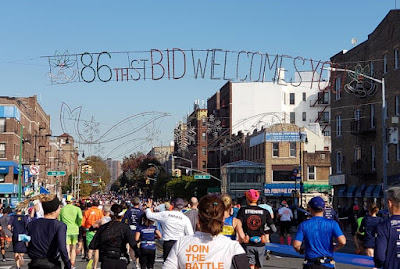
Over the next few miles,
I gradually moved back through the pack, but probably not as much as I should. In the back of my mind, I had this fear that
if I slowed down too much, I might fall off the back of my wave. Usually, in races with multiple waves, the
fastest runners from one wave will eventually catch up to the slowest runners
from the previous wave. After that, they
all blend together.
I wasn’t so sure that
would happen in this race. I was in wave
2, which started at 9:55. Wave three
didn’t start until 10:40. That’s a
difference of 45 minutes. If a runner in
wave 3 was going a minute per mile faster than me, they wouldn’t catch me before
the end of the race. If they were going
two minutes per mile faster, they wouldn’t catch me until late in the
race. If I fell off the back of my wave,
I’d be running all by myself, and it would feel like I was at the back of the
race.
That made me wonder what
it was like for the spectators. Would it
seem like there were five separate races, with long gaps between them? That’s not even counting the elite runners
and wheelchair athletes, who had earlier start times.
It’s getting more and
more common for spectators to hold up signs.
Some you see at every race. I
like the signs that are new or different.
My favorite sign in Brooklyn was one that read, “There’s No Vaccine for
Marathon Fever.”
About five miles into the
race, I started to notice some stiffness in the back of my neck. I’m not sure what was causing that, but it
never got better. It bothered me for the
rest of the race.
I’m not that familiar
with the major landmarks of Brooklyn. I
recognized this building, but I don’t know it’s called. I just know that when I get there, I’m about halfway
through Brooklyn.

Interestingly enough,
when I got there, I heard the lyrics, “Whoa.
We're half way there.” A local
band was playing “Livin’ on a Prayer,” I
enjoyed the timeliness of those lyrics.
About eight miles into
the race, I started to noticed some fatigue in my legs. That confirmed that I was probably going too fast. I also noticed some slight discomfort in my
right knee. I suspect that wasn’t from
my pace or the number of miles I had run.
More likely, that soreness was the result of the downhill running on the
second half of the Verrazano-Narrows Bridge, but it took several miles before I
started to feel it. Usually, if I
aggravate my knee by running downhill, I don’t notice it until the next time I
walk up or down steps.
While I don’t know the
landmarks of Brooklyn, I did recognize a few murals on building that we ran by.


The first spectators you
see in Brooklyn might welcome you to Brooklyn.
After that, the local spectators are more likely to welcome you to their
neighborhood. I heard a man with a
megaphone yelling, “Welcome to Williamsburg.”
The soreness in my knee
gradually faded away. The fatigue in my
legs did too. I think I felt that while
running slightly uphill. The next time I
reached a section that was slightly downhill, it got easier again. Now I seemed like I was keeping up with most
of the runners around me. I was even
passing a few.
There was one neighborhood
in Brooklyn where the crowds were unusually thick. It was between 11 and 12 miles. It was just for a few blocks, but people were
lined up five rows deep on either side of the street.
The halfway point of the race comes
in the middle of the Pulaski Bridge.
This draw-bridge over Newtown Creek is where we left Brooklyn and
entered Queens. For the first time in
the race, I looked at the watch. I was
on pace for 4:05. That was faster than I
originally expected to run, but it wasn’t surprising, considering I was keeping
up with the majority of the runners around me since the beginning of the race.

The Pulaski Bridge was
the first real hill since the Verrazano-Narrows Bridge. On the downhill side, I had to remind myself
once again to take short rapid strides.
My knee didn’t bother me on the bridge, but I started to notice it
shortly after leaving the bridge. The
discomfort didn’t last long, but it was a troubling sign.
The race visits all five
boroughs, but it does spend an equal amount of time in each one. Most of the race is in Brooklyn and
Manhattan. The start village was on
Staten Island, but once we started running, the first thing we did was to leave
the island. We were in Queens now, but
only for about two miles.
After the Pulaski Bridge,
I ran conservatively for about a mile.
The discomfort in my right knee faded quickly, and I got more
confident. I started to pick up the pace
to the point where I was starting to pass some of the runners around me. I don’t think I was going as fast as I was
earlier in the race, but now I was moving up in the field.
As with Brooklyn, most of
the spectators in Queens were local residents who come out to watch the race
every year. That point was punctuated by
one spectator who held up a sign that read, “I Waited 735 Days to Hold This
Sign.” That was a reference to the fact
that last year’s race was cancelled.
I’m only familiar with
one major landmark in Queens. That’s the
Queensboro Bridge, which would take us into Manhattan. With each turn, I was aware of where we were
in relation to the ramp onto the bridge.
The Queensboro Bridge is
the second largest hill on the course.
The Verrazano-Narrows Bridge won’t break you, because you run it with
fresh legs. By the time you get onto the
Queensboro Bridge, your legs are already getting tired. That’s particularly true if you ran too fast
going through Brooklyn. This is where
you start to pay for it. For that
reason, I know I’m not home free unless I get over this bridge comfortably.
We were running in the
traffic lanes on the lower level of the bridge, so our views of the East River
and Lower Manhattan were usually obstructed.
This was the best view I could get at first.

Later, there were a couple
of spots where it was possible to leave the roadway and go out onto the
sidewalk. I briefly left the course to
try to get a better picture of the Manhattan Skyline. My fingers were sweaty, and I had trouble
with the touchscreen on my phone. More
than once, I accidentally put my camera app into video mode, so I didn’t get
the pictures I thought I was taking. I
wasted a lot of time trying to take pictures, but not getting any.
Even when I wasn’t
stopping to take pictures, my pace slowed considerable on the uphill side of
the bridge. Most of the other runners
were passing me now. It was here that I
knew for sure that I would be slower in the second half than I was in the first
half.
As the bridge leveled
off, running got easier, and I was able to keep up with the runners around
me. As we began descending, I focused on
keeping my stride short and my cadence rapid.
That worked fine at first. Then
we turned onto the ramp that would lead us down to street level. There, the grade was uncomfortable. I started to notice my knee. Previously, it
only bothered me after running downhill.
This was the first time it bothered me while I was still running
downhill.
The ramp off the bridge
ended with a U-turn onto 59th Street, which led us down to 1st Avenue. We turned left and ran under the bridge. Then we crossed 60th Street and immediately
heard the crowd noise.
On this section of 1st Avenue,
most of the spectators are friends or family of runners. Most runners visiting from out of town stay
in Manhattan. For people staying in
Manhattan hotels, this is the first part of the course that’s easy to reach. It’s also convenient, because after seeing
runners here, they can walk over to 5th Avenue to see them again.
Here, there were
barricades to keep the spectators out of the street. Behind the barricades, there were rows of
spectators, and they were making noise.

The crowds on 1st Avenue got
me pumped up. I picked up my
effort. I don’t know how much I actually
sped up, but I started moving up through the field.

We would follow 1st
Avenue for about four miles, before eventually reaching the Bronx. I picked up my effort for a mile or two, but
eventually, I had to back off. There
were too many miles left to sustain that effort.
As I reached 74th Street,
I glanced to my left and saw a Neapolitan Pizzeria called Numero 28. I had walked right past this same pizzeria on
Saturday while I was on my way to the Pony Bar.
Some time after the 19-mile
mark, I saw a hill in the distance. I
recognized it as the ramp up to the Willis Avenue Bridge, which would take us
from Manhattan to the Bronx.

The bridges were the only
places where you generally didn’t see any spectators. This one was the exception. Halfway across the bridge, there was a guy
with a megaphone yelling, “Welcome to The Bronx. Just down the hill, it’s 20. 10K to go.”
Sure enough, after running down the hill, I turned left and saw the 20
mile sign.
We were only in the Bronx
for about a mile. As we were approaching
the bridge that would take us back into Manhattan, I saw this sign. I would’ve been disappointed if I didn’t.

As I ran onto the bridge,
I heard a spectator with a megaphone yell, “No more bridges, I promise you.” This is the last bridge, but it isn’t the
last hill. Later, in Central Park, there
are some rolling hills. As I came off
the bridge, I saw the 21-mile mark. With
5.2 miles to go, I felt confident I could maintain my effort the rest of the
way. That didn’t necessarily mean I
would maintain my pace. I had no idea how
fast I was running. It was entirely
possibly I would put in the same effort, but slow down nevertheless.
As we made out way south
on 5th Avenue, there was a group playing some music, and one of the runners
ahead of me stopped briefly to show off her dance moves. That got the crowd roaring. I wouldn’t have had the energy for that.
There’s a brief detour
off of 5th Avenue, where we go around Marcus Garvey Park. As I neared the southwest corner of the park,
I hear a spectator shout,” 4 miles to go.”
I never noticed the 22-mile sign, but that sounded about right. I can still remember it was at this same
point in the 1989 race that I started coming apart.
Whenever I run wearing my
cheetah outfit, I get lots of comments from the spectators. I don’t know how many times I was told I had
the best outfit. After we got back onto
5th Avenue, another runner came alongside of me and said I looked good. Unlike the spectators, she wasn’t just
talking about my outfit. She thought I
was running strong, and said she had been following me for the last 13
miles. I recognized her as the same woman
who stopped to dance earlier.
That motivated me to keep
up my effort for the last three miles. I
felt like I was accelerating, but I was probably just working harder to go the
same pace. In any event, I was now
passing most of the runners around me.
Around 24 miles, we
entered Central Park. The road we took
through the park was rolling. Going
uphill wasn’t bad, but I eventually reached a downhill section where I once
again had to worry about my knee. There
were so many spectators in the park that there was only one lane available for
the runners. That made it more difficult
to find room to pass people.
I passed the 25-mile mark
and made the turn onto Central Park South.
It was only three blocks to Columbus Circle, but these were long blocks. I knew at this point in the race I should be
able to put on a surge, but I couldn’t find the motivation. I hadn’t looked at my watch since the halfway
mark. I didn’t have any idea what my
time would be, nor did I have a goal. If
I was chasing a time goal, I would’ve worked harder to shave off a few
seconds. Instead, I just kept up my
effort.
I passed a sign that read
800 meters to go. That’s about half a mile. I didn’t think I sustain a faster pace for
that far. Soon, I re-entered the park at
Columbus Circle. I couldn’t see the
finish line yet, but I knew about how far it was. Finally, I found the energy to race to the
finish.

I finished in
4:12:42. That’s roughly what I
expected. I haven’t really trained to
run a marathon. Lately, I’ve been
training to walk marathons. It’s nice to
know I can run the whole way without the late miles getting difficult. Getting faster will take training, but I can’t
do that until my knee gets better.
I finished just a few
seconds after the woman who had made a comment earlier. She explained that she constantly heard the
crowd reacting to my cheetah outfit.
Hearing that extra energy from the crowd helped her too.
I know I get extra
shout-outs from the crowd when I wear this outfit, but I’ve never had the
chance to compare how the crowd sounds for me and how the crowd sounds for
everyone else. Apparently, there’s a noticeable
difference.
As I started moving
through the finish area, I received my medal and a bag with food and
beverages. The medals were larger this
year. I don’t know if that’s because it
was the 50th NYC Marathon, or if it’s because medals seem to be getting larger
at all races.

Next, I received my
poncho. For runners who opted not to
check a bag with warm clothes, the ponchos helped us stay warm as we made our
way home.


In past years, we had to
walk a long way before exiting Central Park.
This year, we were able to exit at 72nd Street. It’s the quickest I’ve ever exited the park
after the race. I made a quick bathroom
stop, and then made my way to the closest subway station.
My knee wasn’t bothering
me until I started walking down the steps in the subway station. From the first step, I noticed my knee. This was the first test of how my knee held
up. It wasn’t promising.
The quickest way back to
the hotel would’ve been to take the C train for one stop and then take a D
train from there to Herald Square. Unfortunately,
that would involve going up and down steps in the Columbus Circle station to
get to the platform for the D train. I
chose instead to just stay on the C train and get off at Penn Station. It meant walking a few extra blocks to get to
my hotel, but I wouldn’t have to do any extra stairs.
Ideally, I should’ve iced
my knee. I didn’t want to take the time
to get ice and make an ice pack, so I just took a warm bath and did some
stretching. That wasn’t enough. Later in the day, I noticed soreness in my
knee any time I moved around, not just on steps.
I could’ve gone anywhere
for dinner if I was willing to take the subway, but I wanted to avoid stairs
for the rest of the day. I opted to have
dinner at an Irish pub that was just around the block from my hotel.
Monday morning, I was
still noticing the knee. I took the
subway most of the way to the airport, so I couldn’t avoid going up and down
stairs. My knee felt worse on the steps
than it did on Sunday. The last few
times I felt knee discomfort after running, it went away within 48 hours. Only time will tell how quickly I recover
this time.


