Sunday, July 31, 2016
Race Report: 2016 Frank Maier Marathon
On July 30, I ran the Frank Maier Marathon in Juneau, AK. This was the first time I’ve done this race. I didn’t originally have any races scheduled between the University of Okoboji Marathon in mid-July and the Super Tunnel Marathon in mid-August. I waited to see how my legs were doing before deciding if I wanted to add another race to fill that five week gap.
I eventually decided to add a race on the last weekend of July, but there weren’t any local races that weekend. As I expanded my search, I mostly found rugged trail ultras that are beyond my current abilities. There were only two marathons that appealed to me. The first was the Frank Maier Marathon. The other was the Idaho Falls Marathon. I would either be doing my third Alaska marathon or my third Idaho marathon.
I was expecting the airfare for summer travel to Juneau to be too expensive, so I priced Idaho Falls first. Excluding flight times that didn’t really work for me, it was actually more expensive to fly to Idaho Falls.
The airfare to Juneau was reasonable, but I had to adjust my travel days to get the best airfare. Instead of flying home the day after the race, as I usually do, I stayed an extra day. I had to pay for an extra day for my hotel and rental car, but that was offset by the savings in airfare. I basically got a free sightseeing day in Alaska.
Hotels in downtown Juneau are expensive. To save money, I stayed at the Super 8 near the airport. It cost only half as much as the downtown hotels, but you get what you pay for. There wasn’t any AC, so I needed to open the window to cool the room down. With the window open, the highway noise was horrible.
Going into this race, my legs were well-rested. I usually rest the day before a race. That was Friday. On Thursday, I did some strength training in the morning, and then I spent the rest of the day traveling. That’s not unusual. It’s how I often taper for a race. What was unusual was that I also rested on Wednesday. I was originally planning to run anywhere from six to ten miles, depending on how I felt. After not sleeping well, having a stiff neck, and having dental work done in the morning, I wasn’t exciting about running. Because of thunderstorms, I would’ve had to run on the treadmill for a second straight day. When the Novocain wore off, and my tooth felt inflamed, I finally decided to skip my run that day, knowing it would mean three straight days off from running.
My legs were well-rested, but the rest of me wasn’t. My flight didn’t arrive until 9:30 PM, so I didn’t get to bed until 11:00. With the three hour time difference, it felt like 2 AM. I slept for a few hours and then couldn’t get back to sleep. I felt tired all day Friday, which isn’t a good sign. I never sleep well the night before a race, and this one was no exception.
After breakfast on Friday, I drove to Douglas Island, which is where the race took place. As I drove the course, it seemed fairly flat. In fact, it’s pretty much non-stop rolling hills, they none of them are steep. You don’t really notice this type of hill when you’re driving. Next, I familiarized myself with downtown Juneau, which is just across Gastineau Channel.
After lunch, I drove to Mendenhall Glacier. This is the most visited glacier in southeastern Alaska. It’s also the most accessible. You can park near the visitor center and get good views after just a view minutes of walking.
I wanted to hike to Nugget Falls, but the trail was closed because of high water. I had to settle for this distant view.
Packet pickup was at the Juneau Arts and Culture Center. It’s a small race, so packet pickup was only available from 5:00 to 6:00. I got there when it started, so I could eat an early dinner in hopes of getting to bed early.
Going to bed early didn’t work out as I hoped. With the window open, there was too much traffic noise. I had to shut the window, but then the room got too warm. I only managed to sleep for two hours.
The race started at 7:00, but there was an early start at 6:00 for people needing extra time. There was also an unadvertised early early start at 5:00. There were several runners doing another race in Wrangell, AK the next day. They needed to finish in time to get to the airport to fly to their next race. I felt like a slacker, only doing one race this weekend. I’m not ready for doubles yet.
I was already awake, so I decided to get to the race early so I could visit with people who were doing the early start. I knew quite a few of them. This is a popular race among long-standing members of the 50 States Marathon Club.
The course was out-and-back. We started at Savikko Park, which is next to Gastineau Channel. Before the race, we saw a cruise ship navigating the channel. We also had views of these waterfalls on the other side
From there, we ran alongside the channel to the north end of the island before turning around and coming back to Savikko Park.
You couldn’t ask for better weather. It was 53 degrees at the start and got up to about 58 by the time I finished. It’s easier to dress properly when there’s so little variation in temperature. We had light winds and cloudy skies, so direct sunlight also wasn’t a factor. There was a slight chance of a passing shower, but that never materialized.
Aside from finishing, I had one other goal. I wanted to break four hours if I could. Alaska was one of three states where I’ve only broken four hours once. The other two are Utah and Hawaii. More than a year ago, I set my sights on completing my second 50sub4 circuit. Because of injuries, I haven’t made any progress.
I wasn’t sure how lack of sleep would affect me. It’s easy to shake off a poor night’s sleep, but I was already feeling tired on Friday. I was worried I might feel sluggish. You never really know until the race is underway.
My fitness level has been a moving target, so I don’t have a good sense of pace. I wanted to start at a 9:00 pace, but I have trouble judging what that feels like. Shortly after we started running, I felt like my breathing was labored. It didn’t help that the first mile was mostly uphill. I backed off a little, but I suspected I might still be running too fast. I reached the first mile marker in 8:45, confirming my suspicion. That’s too fast for an uphill mile.
Mile markers were painted in the street. The first one was a “1” and a “25,” separated by a mile. Presumably that meant we were at the one mile mark, and runners coming back would be at 25 miles. That didn’t make sense to me. Since we started and finished in the same place, the one mile mark should correspond to 25.2 (i.e. one mile to go). Subsequent mile markers were 2/24, 3/23, 4/22, etc..
It wasn’t until after the race, while talking to other runners, that I learned why the mile markers seemed to be off. The first one was actually 1.1 going out and 25.1 coming back. Likewise, all of the mile markers were off by one tenth of a mile. Bearing that in mind, my first mile was much too fast, but I didn’t know that yet.
By the time we finished the first mile, we were going downhill. The next mile was all downhill. I eased up a little, so I would pick up speed. I was already going too fast. Despite my intention to throttle back my effort, I ran the second mile in 8:16.
In the early miles, we were running through West Juneau. Now and then we caught glimpses of downtown Juneau from across the channel.
Although we were always near the channel, there were times when we couldn’t see it. Instead, tall pine trees towered over us on both sides. Except for the start and finish, it felt like a wilderness race.
The next few miles had frequent undulations, making it hard to judge my pace. I gradually settled down, running a little bit slower in each mile. By my sixth mile, I was finally running the right pace. Then I clicked off several miles that were all between 8:51 and 9:01. After a fast start, my pace was now remarkably consistent, despite the hills.
Because I was going slower now, I was occasionally passed by a faster runner. I had to be careful to let them go by. I had to resist the temptation to stay with them.
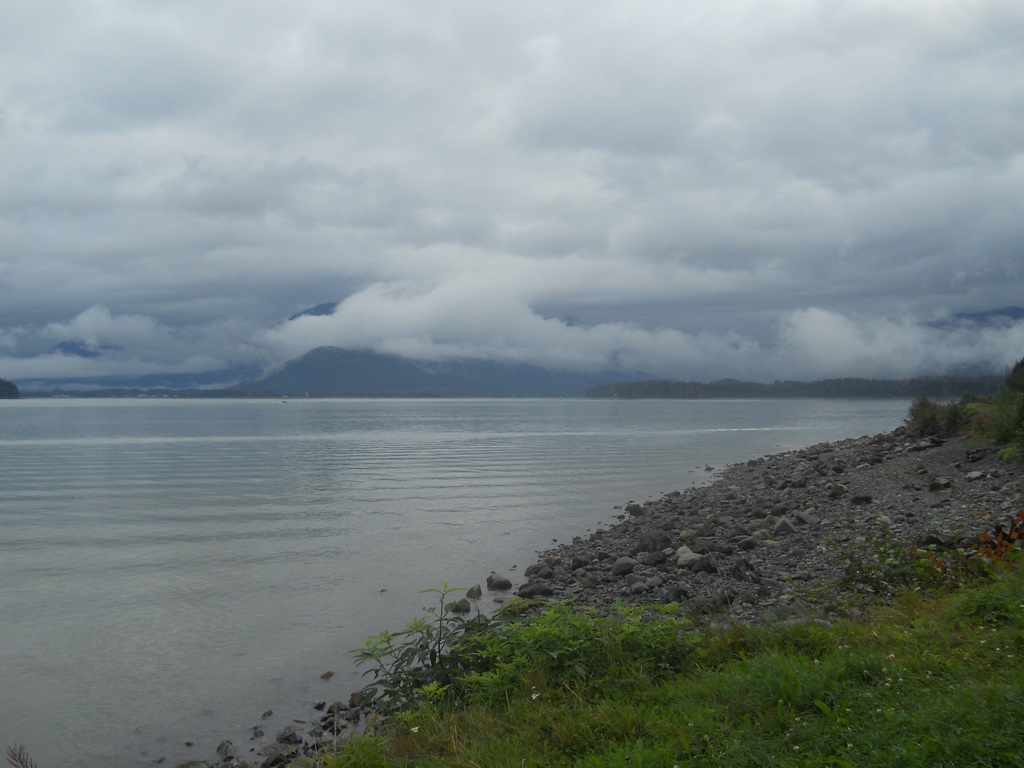
As we reached the north end of the island, we got getter views of the channel and Fritz Cove.
There was an aid station at the 11/15 marker with a Ghostbusters theme. They were playing the Ghostbusters theme, and three volunteers were dressed as Ghostbusters. When one asked me if I wanted water or Gatorade, I said, “What, no slime?”
When I drove the course on Friday, I saw a large pullout on the right with a couple of port-o-potties. The distance seemed about right, so I assumed it was the turnaround point. As I got within sight of this same spot during the race, it was obvious that it was short of halfway. The pullout was at the base of a hill that was steeper than anything we had run so far. As I got closer, I saw runners continuing up the hill. A runner coming back down told me the turnaround was at the top of the hill.
As I started up the hill, I couldn’t see the top. This was the first hill that forced me to slow down noticeably. It was also the first one that seemed to be wearing me down.
The “13” marker on the road was right at the turnaround. I now know this was actually 13.1 miles. My time for the first half was 1:54:40, but my time for the most recent mile was 9:22. Up to this point, my slowest mile had been 9:01.
Coming back down the hill gave me a chance to recover. I wasn’t trying to speed up, but my downhill mile was 8:40. The next mile was one of the few flat miles of the race. I was picking up my effort here. I was worried my effort might not be sustainable, so I was disappointed to see my time. I ran that mile in 9:20.
With 11.1 miles to go, I had a cushion of about six minutes. Even if I couldn’t sustain nine minute miles, I might be able to break four hours. At this point 9:30 was good enough. I worried, however, that the previous mile might be the beginning of a trend.
The next two miles each had tough hills. I challenged myself to run strong on the hills, so I wouldn’t slow down too much overall. That was risky. I haven’t been strong on hills in recent races, and I kept wondering if one of these hills might break me. I was encouraged to run a 9:12 mile, followed by a 9:05 mile. Now I had only 9.1 miles to go, and I still had a six minute cushion.
I spotted a runner ahead of me who had passed me in the first half of the race. I was starting to gain ground on him. That gave me a new incentive to pick up my effort. I wasn’t trying to compete with anyone, but it was one of those mental games you play to coax yourself into running harder.
I caught up to him going up a hill. Then we started a long gradual downgrade, and I continued to run hard. I ran that mile in 8:40. With 7.1 miles to go, I still had a cushion of six minutes. Now I was confident I would break four hours. I might slow down, but I probably wouldn’t slow down that much. I was almost to the point where a 10:00 pace would be fast enough.
There was also a half marathon. During the next mile, I reached the half marathon turnaround. Those runners started at 9:00, so many of them were just getting to the turnaround. Suddenly I was surrounded by runners who were going just a bit faster than me. I couldn’t keep up with them, but they still influenced my pace. Trying to chase them was another mental game that kept me pushing as hard as I could.
With 6.1 miles to go, I just needed to average 10 minutes per mile. I continued running nine minute miles, effectively adding to my cushion. I knew it would get harder in the last three miles. I remembered the long gradual hill that would top out just after 25. I didn’t remember that there was a shorter but steeper hill first.
The first hill took something out of me, but I was able to recover. I didn’t lose too much time. Then I started the last hill. Normally, I look forward to seeing mile markers. The 24 marker was somewhat disheartening. Although my pace for that mile was good, this last hill was already wearing me down, and I knew it was still more than a mile to the top.
Most of the hill was gradual, and I kept grinding out a good pace. Sometimes it would kick up briefly, and I would have to fight harder. When I reached 25 (actually 25.1), I was delighted to see I broke nine minutes on a mile that was entirely uphill. Overall, my time was now 3:43 and change. I had it, and it wouldn’t be close.
I still wasn’t to the top of the hill, but I could see the crest. I knew from there it would be downhill all the way to the finish. I worked the downhill as much as I could, and finished in 3:53:22. I broke four hours by a wide margin. I even took third in my age group.
In the first half of the race, I assumed I was running too fast. I was, but not by that much. In the second half of the race, I assumed I would blow up. I didn’t. I ran the second half four minutes slower than the first half, but it’s worth noting that I still broke two hours in the second half. I was still running fast enough to break four hours, even on that last hill.
After the race, there was a picnic under the park pavilion. They were grilling salmon, cheeseburgers and hot dogs. How many races offer grilled salmon as a post-race snack?
Later in the day, there was a pizza social at Bullwinkle’s Pizza Parlor in Juneau. Of course I had to do that. I saw some familiar faces, and also got to know a few of the local runners.
After the race, I could barely walk. After finally getting a good night’s sleep, I felt better. By Sunday morning, I was walking normally again. After doing some strength training exercises in the morning, I was ready to do some hiking.
Mount Roberts is a 3,918 foot peak that overlooks Juneau and Douglas Island. There’s a hiking trail that goes to the top. There’s also a tram that goes about halfway up the mountain. I hiked about halfway up the trail, to reach the top of the tram. It’s a strenuous hike, which took me about an hour and a half. It was too cloudy to get good views of the surrounding peaks, but I saw a few waterfalls during my hike.
Here’s the view of the harbor from halfway up the mountain.
At the top of the tram, there’s a restaurant, gift shop, and nature center. I had lunch at the restaurant. The trail continues all the way to the top, but that section of the trail was temporarily closed. That’s just as well. The round trip hike would have taken at least three hours, and it’s unlikely I would have been able to see much through the clouds.
After lunch, I took the tram back down. A one way tram ride costs $10, but I was able to ride for free by showing my receipt from the restaurant.
The tram station is right next to the cruise terminal. Not surprisingly, that’s also near the touristy part of town. While I was there, I spent a good part of the afternoon window shopping.
Tomorrow morning, I fly home. Then I need to get back to training. I’m encouraged by my strong run in this race, but I still need to shave off about 15 minutes to qualify for Boston. My next two races will both be on downhill courses. It’s time to really work on running downhill.
Saturday, July 16, 2016
Race report: 2016 University of Okoboji Marathon
This morning, I ran the University of Okoboji Marathon in Iowa. I’ve done this race three times before, so I had a pretty good idea what to expect. In particular, I knew the weather could range anywhere from “warm, but reasonable” to “stinking hot.”
When I entered this race, I was reluctant to make too many long-term commitments. I could drive to this race, so my only non-refundable expense was my entry fee.
The Okoboji lakes area is in northern Iowa. It’s a lake resort area. They hold lots of athletic events there, and somewhere along the way a few people got the idea of selling branded sportswear. They created a logo based on a fictitious university called the University of Okoboji.
They refer to the week of the marathon as homecoming week. Besides the marathon, they hold a 10K race, a half marathon, and a triathlon. My only major criticism of these events is that it seems like there’s too much going on at the same time.
I drove to Okoboji on Friday. It’s normally a three hour drive, but road construction added an extra 45 minutes. After checking in at my hotel, I drove a few miles further to Milford to pick up my race packet at The Three Sons. The Three Sons is the athletics store that sponsors the race.
I spent the rest of the afternoon hanging out by the lake.
I wasn’t sure where to have dinner until I drove by a restaurant called, “The Ritz.” Their sign said they had the best pizza on the lake. I had to find out for myself. I ended up having a taco pizza. Their smallest size was 12 inches, and the toppings were thick. I realize after one slice I wouldn’t be able to finish. I ate half. Enough toppings fell off that side of the pizza that I also had a “taco salad” on the side. Fortunately, my hotel room had a fridge and microwave, so I could save the other half for after the race.
After dinner, I started to feel sleepy. Big meals sometimes have that effect. Since my alarm was set for 4:00, I decided to go to bed early. I got some good sleep at first, but I woke up at 12:30 and couldn’t get back to sleep. At 3:30, I got up and started getting ready for the race.
I was ready early, so I drove to the start. The race starts and finishes by the Arnold
Park amusement park, where there’s a large parking lot. I couldn’t remember if the parking lot fills
before the race, so I wanted to make sure I could find a parking spot. For future reference, parking before the race
is not an issue. The marathon is fairly
small, and the other races have different start locations. By late morning, the lot gets full, but it’s
easy to find parking at 6:00.
It was 59 degrees, but the humidity was apparently high. There was a thick coating of dew on my windshield. I had to run my wipers as I drove, because it kept reforming a few seconds after it was wiped away.
A few minutes after I arrived, I bumped into a friend who told me the bathrooms were unlocked. That’s good, because my breakfast consisted of a 20 oz. bottle of Coke. I already needed to make a trip to the bathroom.
My fastest previous marathon time this year was 4:19. Based on recent training runs, I thought I was ready to break four hours. I didn’t know, however, how much heat and/or humidity would slow me down.
This year’s weather was in the “warm, but reasonable” category. The forecast high was 78. It was comfortable at the start, and I only expected
it to get into the low 70s by the time I finished. That’s warmer than ideal, but not bad for
July. Accordingly, I set a goal of
breaking four hours, even though I knew it was optimistic.
The course begins with a short out-and-back along the
eastern shore of West Lake Okoboji. After
about a mile, we crossed a bridge over the channel that connects West Lake
Okoboji to East Lake Okoboji.
After crossing the bridge, we ran about a mile and a half
along Lake Shore Drive before turning around.
The turnaround was right in front of The Inn at Okoboji. In these early miles, I was averaging about
nine minutes per mile. That put me on
pace for 3:56.
This part of the course had a number of small hills. In the fifth mile, I felt like the pace was
already getting tiring. Then I
discovered I sped up to 8:38 in that mile.
I probably sped up running down a hill and didn’t slow down again later.
After completing our out-and-back, we began a big loop,
taking us all the way around West Lake Okoboji.
For the next 15 miles, there weren’t as many hills. I got back onto the right pace, but I
gradually realized it wasn’t going to be sustainable. It’s not a good sign when you feel like you’re
working, and you haven’t run 10 miles yet.
As we ran around the north end of the lake, we spread
out. I could usually see only one or two
runners ahead of me. At 11 miles, I
passed another runner at a water stop.
After that, I didn’t see another runner for the next two miles. I had to watch closely for the course
markings. There are a few places where
you can make a wrong turn if you’re not paying attention.
When I reached the 13 mile mark, I checked my watch. I was almost to the halfway mark, and I would
get there in about two hours. As I got
closer, I could see lots of people milling about at the next intersection. I would turn there, and I thought I
remembered there being a water stop there.
It seemed like there were a lot of people for a water stop, but I
wondered if this was one that serviced both runners and bikers. There’s a section of the course where runners
are on a paved path, and bikers are next to them on the road.
The large crowd wasn’t because of bikers. There were hundreds of runners lined up in
the street. I heard a countdown. “7 … 6 …
5 …”
The half marathon was starting. My timing couldn’t have been worse. It was a much larger race than the marathon,
and they started just before I got there.
I had difficulty pushing through the spectators, so I could make the turn. Then I was behind a wall of runners. They were going too slow for me, and there
was no room to get through. I had been
slowing down in the past few miles, but it didn’t want to go this slow.
With constant shouts of, “excuse me – marathon runner coming
through,” I managed to work my way through the crowd. I slowed down a little, but at least I was
able to run.
I started to notice sweat dripping into my eyes. I was really perspiring heavily. We were on the west side of the lake, running
past cornfields. All that vegetation was
causing sky-high humidity. The
temperature had climbed several degrees, and I was starting to notice the sun.
There was no aid station at the half marathon mark. Maybe there would have been, if I didn’t get
there at the wrong time. I was getting
thirsty. Thankfully, there was an aid
station at 14 miles. I decided to drink
both water and Powerade.
By now, I had abandoned my “A” goal of four hours. I reach the halfway mark on pace, but I was
already slowing down, and I expected to suffer in the second half. My “B” goal was to break 4:19. That was my fastest time so far this year.
I eventually moved through the crowd of runners until I was
surrounded by runners who were going an acceptable pace. For the next few miles, I averaged 10 minutes
per mile. By the time I reached 16
miles, I only needed to average 11 minutes per mile for the rest of the race to
beat my “B” goal. I knew I’d slow down
some, but I was reasonably confident I would average better than 11 minutes.
Between 16 and 17 miles, I reached another aid station. I again drank both water and Powerade. After leaving the aid station, I regretted
not pouring a cup of water on my head. I
was starting to feel hot.
Shortly after that aid station, we ran through a tunnel
under the highway. For the next two or
three miles, we would be on a path on the opposite side. This section of the course isn’t as
accessible, so there aren’t any aid stations on that side of the highway. It’s also the most sun-exposed section. It’s also right next to all that corn.
I felt relieved when I finally saw the tunnel that would
take us back under the highway. After a change
in direction, I also started to feel a breeze.
I had to run another half mile before reaching an aid station.
At19 miles, we turned onto the road that would take us
around the south end of the lake. From
here, I knew the layout of the course well enough to segment it in my mind.
The 19th mile was a slow one. Not only was I no longer able to sustain 10
minute miles, but that one was slower than 11.
There were some small hills in that mile, and they wore me down. To break 4:19, I still needed to average
pretty close to 11 minute miles. I was no longer confident I could do it.
The next segment of the course was the road that took us
around the south end of the lake. It was
a little over a mile. Fortunately, it
was reasonably flat. I worked hard to
pick up my pace. When I could, I reeled
in slower runners. I was able to get back
on pace, but I had to fight for it.
With about six miles to go, we turned onto Lakeshore
Drive. This would take us alongside the
eastern shore of the lake. Eventually,
we would be on the same route as our earlier out-and-back, but that was still a
few miles away. In the meantime, I had
to get through the hilliest section of the course.
I missed the 21 mile mark.
When I got to 22, I was pleasantly surprised to see that I averaged 10
minutes per mile for those two miles. I
was once again confident I could break 4:19.
I would have to fight for it, but I was going to do it.
Mile 23 was the toughest of the race. It seemed like it was almost all uphill. I worked hard to keep up my pace, and ran it
in roughly 11 minutes. That was another
pleasant surprise. Now I had 38 minutes
to run the remaining 3.2 miles.
After a few more minutes, I reach The Inn at Okoboji. That was the turnaround point earlier in the
race. From here on, everything would
look familiar. I knew there were more
hills, but I also knew they wouldn’t be as bad as the previous mile.
Near the end of mile 25, I recognized the last significant
hill. It was followed by a short, but
steep downhill. Then we turned to cross
the bridge for the last time. Just
before crossing the bridge, I saw the 25 mile marker. My watch read 4:00 and some odd seconds. I had plenty of time.
The last mile was all about finishing. I was hot, I was tired, and I didn’t like how
my legs felt. I also knew I didn’t need
to fight for time. I just needed to keep
running.
I eventually finished in 4:12:56. While I wasn’t able to break four hours, it’s
still my fastest time this year. I’m
making progress.
I didn’t have to wait long to get my official time. Each race bib had a QR code we could scan to
get our individual result. When they
first added QR codes, they just took you to the web page for results. Going straight to your own result is much
faster.
This race has a 40 year history. I first ran it six years ago. At the time, I had a few criticisms. Since
then, I’ve noticed improvements each year.
Some are large; some are small.
The biggest improvement was when they changed the marathon course so it
starts and finishes in the same place.
Before leaving the finish area I ate a banana and drank a
bottle of Powerade. When I got back to
the hotel, I was starving. It’s a good
thing I had four slices of leftover pizza.
It’s been another successful homecoming week at the University
of Okoboji.
Thursday, June 30, 2016
Throwback Thursday: 2005 Patriots' Run
On September 11, 2005, I did a race called the Patriot’s
Run. This race is an annual event in
Olathe, KS. It’s always held on
September 11, regardless of what day of the week it falls on. It’s a fixed time race with a time limit of
nine hours and eleven minutes. It starts
at noon and ends at 9:11 PM. Some
runners go solo, and others are on relay teams.
They collect pledges based on their total mileage to raise money for the
families of first responders who have died in the line of duty.
At the time, I was working on running marathons or ultras in
all 50 states. I made an impulsive
decision to do this as my Kansas race, even though the race was only a few
weeks away. I was training for a fall
marathon, but hadn’t done any ultramarathon training in two years.
From 1998 to 2003, I ran at least one 12 or 24-hour run each
year. My training for those races always
includes three runs of six hours or longer, during which I paced myself like I
would during the race. When I entered
this race, I only had two weekends remaining before the race. I had recently done a 19 mile training run
and decided to add one training run of five or six hours as a dry run before
the race. It didn’t go well.
I set out to do my long training run on a 1.1 mile
loop. My plan was do use variable-length
walking breaks to keep my pace at 13 minutes per lap. That’s roughly 12 minutes per mile. I used to train at a slightly faster pace
when I was preparing for a 24-hour run.
This year, I had a much lower mileage base than in previous years. I was coming off a subpar year that included
a bout of Achilles tendonitis, and I was only running every other day. I didn’t spend as much time training in
summer heat as I usually do. It was an
80 degree day with sunny skies, and the heat wore me down. I stopped after running 24.2 miles in roughly
four hours. That was discouraging.
With only two weeks before the race, I didn’t have time for
another long training run. I wanted to
take it easy on the last weekend before the race. Realizing I couldn’t run as fast as I was
accustomed to running in 24-hour races, I adjusted my goals.
As race day approached, I realized it was going to be hotter
than it was for my long training run. On
race day, it was 90 degrees and sunny.
Since the race started at noon, I was going to be running through the
hottest hours of the day. I didn’t feel
prepared, but I counted on experience to get me through it.
Deb and I drove to Kansas the day before the race. I brought a number of supplies from home
including a large cooler. I mixed my own
sport drink from powder, using a brand that didn’t include any fructose. On our way to the race, we stopped to fill
the cooler with ice. Aside from taking
regular walking breaks, my plan for coping with the heat included filling my
hat periodically with ice from my cooler.
Deb was coming down with a cold, so after the race started, she went
back to the hotel to take a nap.
The course was a 0.72 mile paved loop around a city
park. There wasn’t much shade. My plan was to use variable-length walking
breaks to keep myself on a consistent pace.
Mindful of how my training run went, I started the race at a slower
pace.
In the early laps, there were several runners who were going
faster. I think some lapped me two or
three times in the first half of the race.
I didn’t worry about competing with anyone. My goal was to run enough laps for 50K and
then finish as many miles as I could without blowing up in the heat. In 24-hour races, I was accustomed to placing
in the top five, but I wasn’t as prepared for this race.
As soon as I started feeling hot, I started putting ice
cubes in my hat. I had learned from
other races that this was an effective way to cope with the heat. The first time I did it, it was
disconcerting. The sudden rush of blood
made me feel slightly short of breath.
If I didn’t know better, I would have thought I was suffering from heat
stress. By the time I finished my
walking break for that lap, the feeling had subsided.
Early in the race, I varied the distance I walked to keep my
lap times consistent. As I began to
tire, I noticed I wasn’t walking as far.
To stay on pace, I needed to switch back to running earlier in the lap. At some point, I realized that wasn’t
sustainable. I remember the furthest point
I had reached on a walking break and decided to walk to that same spot in all
subsequent laps. My pace slowed, but I
was keeping a more reasonable ratio of walking to running.
To complete a marathon I needed to run 37 laps. By the time I finished my 37th lap, I was
getting pretty ragged. I was suffering
in the heat. I wasn’t having fun. I just wanted the race to be over with. I had met the minimum requirement to count
this as my Kansas marathon, but I still wanted to do at least 50K. That’s the shortest common ultramarathon
distance. Since this was an ultra, I
felt I should at least run that far, if I could.
I did the mental arithmetic.
To get past the 50K mark, I needed 44 laps. That meant I still needed seven more
laps. Deb wasn’t back from here nap yet,
so I needed to wait for her regardless.
That gave me a little more incentive to keep running.
Those seven laps seemed to take forever. As I counted them down, I kept telling myself
I could stop after my 44th lap. I kept
looking for our car in the parking lot.
Deb wasn’t back yet.
When I finally finished my 44th lap, I asked the lap counter
how many laps the leader had. I wasn’t
planning to compete. I was just
curious. She flipped through her
sheets. Then she said, “Number 138 has 44
laps.” I looked down at my race bib. That’s the number I was wearing. I was shocked to realize I was in the
lead. Apparently the runners who were
way ahead of me earlier had all taken breaks because of the heat. I wasn’t moving very fast, but I was always
moving.
As much as I had been looking forward to stopping, I didn’t
want to quit if I had a chance to win. I
started another lap, so I could think about it.
Deb wasn’t back yet, so I couldn’t go back to the hotel yet anyway.
As I plodded slowly through another lap, I made some
decisions. First, I wasn’t going to stop
running as long as I was in the lead.
You can’t quit when you’re winning!
Second, I would fight to maintain my current pace. If someone was going to pass me, they would
have to earn it. I wasn’t giving the
race away. Finally, if anyone did pass
me, I would stop. I didn’t have enough
fight left in me to keep going if I lost the lead.
When I finished that lap, I saw Deb standing near the finish
line. She was excited. She knew I was winning. That was good for both of us. She still wasn’t feeling well, so it helped
that she had a reason to be excited. I
was struggling, so it helped to have her cheering for me.
After my next lap, I stopped briefly to ask the lap counter
how many laps the second place runner had.
I now had 46 laps, and he had 44.
As I started my next lap, it occurred to me that my 46th lap had just
been counted. I don’t know how long ago
he finished his 44th lap. My lead could
be anywhere between one and two laps.
That didn’t seem like a safe lead.
There was still a lot of time left in the race. About this time, I started experiencing
cramps in my calf muscles. They were
sudden involuntary contractions that felt like electric shocks. They made me jump. It was painful, and it took effort to even out
my stride, but I fought through the pain.
I immediately suspected that I had an electrolyte
deficiency. I had been taking Succeed
S-Caps once per hour. I started taking
them every half hour. The cramps never
went away completely, but they gradually got less severe.
There was a single aid station at the pavilion where we
started and finished each lap. They had
a variety of food and beverages, but I just kept drinking the fluids I
brought. I never had any food or
beverage from the aid station. I was
completely self-sufficient. Everyone
else took breaks. Aside from bathroom
stops, I always kept moving. If you’re
moving – even slowly – you’re competitive.
During one of my laps, I was talking to one of the local
runners. He was currently in third
place, and he knew the runner in second place.
I got the impression I had a lead of two or three laps, but I didn’t
slow down.
As it got closer to the end of the race, I was mindful of
how much time I had left. I paid
attention to my lap times. After each
lap, I estimated how many more laps I could do.
It always seemed like I would easily finish 66 laps, but I wouldn’t have
time for a 67th lap. During my 65th lap,
I made a decision. After that 66th lap,
I wouldn’t take a walking break. I could
squeeze in an extra lap, but only if I ran the whole thing. I thought I had a safe lead, but if I was
going to win, I wanted to have as good a total as I could.
As I finished my 65th lap, Deb asked me if I had time for
another lap. I said, “I think I have
time for two.” I heard another runner
say, “Oh, come on!” He must have thought
that was over the top.
I did indeed have time to finish a 67th lap. That brought my total for the day to 48.06
miles. Then I stood by the finish line
to watch the last few runners come in.
Only completed laps counted, so they had to beat the clock.
There was a volunteer giving massages during the race. I asked if I could still get a massage or if
I was too late. I was able to get a
massage while results were being tabulated.
As he started, he said, “This is going to feel like I’m exfoliating your
legs.” He wasn’t kidding. As my sweat evaporated, it left a thick layer
of salt crystals on my legs.
The top prizes were announced in reverse order. First I heard the name of the third place
runner. As they announced the second
place runner, I was surprised to hear his mileage. He was only one lap behind me. That extra lap meant the difference between
clear first and a tie for first.
I received two awards.
One was for first place male. The
other was for first place overall. The
awards were made from model cars mounted on small blacks of wood. One was a police car, and the other was a
fire truck. That was a nod to the
purpose of the race.
I didn’t come into this race well-conditioned. At least, I wasn’t as conditioned as I was in
prior years, when I did 24-hour races.
Experience carried me through. I think
I was the only runner who was using ice to keep cool. I was also the only runner to keep moving for
the entire nine plus hours. Everyone
else had to stop and take breaks because of the heat.
By the time we left, it was already dark. I had some food before leaving the park, but
that was the only dinner I ate. After
getting back to the hotel, I showered and immediately got ready for bed. I didn’t realize it yet, but I was in for a
scary night.
I climbed into bed, but couldn’t get comfortable. I turned onto my back. With my feet pointing into the blankets, they
started to cramp. It was painful, but I
couldn’t get the cramping to stop until I got out of bed.
I had to lie down on the floor next to the bed. The room was air conditioned, and I was in my
underwear, yet I started to sweat from head to toe. I felt slightly nauseous. I was badly dehydrated, but I didn’t think I
could make it to the bathroom to get a glass of water. I also didn’t know if I could keep any fluids
down. When I realized I was probably still
hyponatremic, I regretted leaving my bottle of S-caps in the car. There’s no way I could make the trip to the
car myself, and Deb was already asleep.
Lying there on the floor feeling sick, I wondered if I
needed to go to the hospital. I tried to
wake Deb. She had taken a medication
that made her drowsy. She mumbled that I
was on my own and fell back to sleep.
She was out like a light.
I could have called 911, but I didn’t know where they would
take me. When Deb woke up, she wouldn’t
know where I was. I decided to wait
until morning. I spent the whole night
lying awake on the floor.
When Deb eventually woke up, she went to the vending machine
to get me something to eat. They had
white cheddar Cheez-Its. That might be
the saltiest snack food ever invented. I
ate a few at a time. Then I was able to
drink some water. Some Cheez-Its, some
water, some Cheez-Its, some water. I
gradually rehydrated. When I felt like I
was stable, we checked out.
We went to a Sonic drive-in for breakfast. I wanted something salty, so I ordered a
bacon cheeseburger toaster sandwich. I
also had a large Coke. The breakfast
helped. Deb did most of the driving on
the way home. I rested and
recovered. By the time we got home, I
was OK.
This race was memorable for several reasons, but what I remember
most was the rule I established that day.
You can’t quit when you’re winning.
This was the first time I ever won a race, and I won only because I
wouldn’t let myself quit.
Subscribe to:
Posts (Atom)


