Showing posts with label Recovery. Show all posts

Monday, June 27, 2022

The aftermath of FANS

It’s been three weeks since the FANS 24-Hour Race.  Going into that race, I had two concerns.  My first concern was my lower back, which has been bothering me since last November.  The other was a sore spot at the top of my left leg, where my hamstring connects to my pelvis.

I’ll talk about my back first.  For the first 16 hours of the race, it wasn’t an issue.  After midnight, I wasn’t doing as much running, so I had to put more effort into my power walking to keep my overall pace from slowing down too much.  I was able to do it, but I started to notice fatigue all the way across my lower back.  If I only had discomfort on one side, I would’ve been more concerned.  Instead, I attributed what I was feeling to tired muscles.  I wasn’t used to power walking for so many hours.  I didn’t really train for that.  Before FANS, my longest walk of the year was only nine miles.

In the last few hours of the race, I was beginning to slow down, so I put much more effort into my walking.  That’s when I started to notice discomfort on the right side of my lower back.  That was a bigger concern than the fatigue I felt earlier, but I was committed to getting to 100 miles, so I ignored the discomfort and just plowed through it.

Late in the race, I started leaning to my right.  Here’s a picture that was taken in the last 20 minutes of the race.

I didn’t have any idea I was leaning until my friend Mary said something after the race.  I later learned that I already looked like this at 3:30 AM.  I was leaning to my right for at least four and a half hours.

Immediately after the race, my lower back was so painful I could barely move.  It didn’t help that I also had delayed onset soreness in my quads.  Earlier in the year I strained a muscle on the right side of my lower back.  I was worried I might have done the same thing again.

Here’s the good news.  I took it easy for the next week, and my back felt a little better each day.  A week after the race, my back felt about the same as it did before the race.  After two more weeks of recovery, my back feels better than it’s felt at any time since November.  While it’s still not 100%, it doesn’t seem as though the race did any lasting damage.  What I felt right after the race was just the soreness you can get after running 100 miles.

If my back was the good news, my left hamstring was the bad news.  During the race, I barely noticed it.  I occasionally felt some minor soreness, but only on the laps where I was walking fastest.  It didn’t bother me while I was running, and it didn’t bother me when I walked at a more moderate pace.

I waited several days after the race before starting to run again.  When I resumed running, I initially ran at a relaxed pace.  My hamstring didn’t bother me.  It was only when I started to pick up the pace of my training runs, that it started to feel sore.  After a couple runs at my marathon race pace, I realized it was quickly getting worse.  Since then, I’ve had to emphasize rest.

In the last 10 days, I’ve only run twice.  The other days I get exercise by doing lots of walking, but all at a casual pace.  I’ve noticed improvement, but I still feel it when I run.  I also feel it walking, if I’m putting in extra effort at the beginning of a hill.

Over the July 4th weekend, I’m going to be running the Firecracker Triple: three marathons in three days.  When I’ve done this series in the past, I’ve competed for the overall win.  I won the triple in 2011 and again in 2014.  I’m probably not in good enough shape to compete for the win this year, but I would’ve given it my best shot if I was healthy.  Instead, I’ll probably take it easy and just run to finish.

There’s one other piece of good news.  Before FANS, I was carrying some extra weight.  I wanted to lose at least six pounds before trying to bring my marathon times down.  The day after the race, I weighed myself, and I was down almost three pounds.

I initially took that with a grain of salt.  I probably burned off a pound of fat during the race, but I was skeptical about losing more than that.  The rest could be water loss.  Indeed, for the next two days, I seemed to be gaining the weight back.  Then something amazing happened.  I started losing weight again.

Since FANS, my activity level has been fairly light, but my weight has been going doing a little bit each day.  This morning, I weighed in almost five pounds lighter than I was before FANS.

I noticed something similar the first time I did a 24-hour race.  My metabolism was elevated for the next week or two.  It’s pretty cool to be able to lose five pounds without any significant change in diet and without increasing my activity level.  I know from past experience that my metabolism will gradually get back to normal, but I’ve already lost most of the weight I wanted to lose.

Thursday, March 11, 2021

A Progress Report on My Recovery

A little over a year ago, I met Meb Keflezighi at the Atlanta Marathon.  At the time, I was reading his book, “Meb for Mortals.”  I told him how much I liked the first chapter.  It's called “Think Like Meb,” and it’s about setting goals. One point he makes is that once you establish a goal, it’s important to periodically evaluate your progress.


I’m currently recovering from a knee injury that has plagued me since last August.  My long-term goal is to recover from this injury and to regain the fitness level I had last summer.  This goal has three components: recovering from the injury, losing the weight I gained while I was inactive, and getting back in shape.  So how am I doing?

I haven’t run since January 31.  That was the day of my last marathon.  I don’t have any other races scheduled, so I’m taking as much time off from training as I need for my knee to heal.

In early February, after taking a week off, I resumed my physical therapy.  In addition to my exercises, I was walking a minimum of one mile a day and doing five minutes of low-resistance spinning every other day.

At first, my knee was actually getting worse.  For the first time since I injured it, it sometimes bothered me even when I was just walking to the bathroom.  I began to wonder if I injured it more seriously in my last race.  I was getting discouraged, but I decided to give it another week or two before going back to the doctor.

Then I had an epiphany.  One night, I got up during the night to go to the bathroom, and my knee hurt.  As I climbed back into bed, it occurred to me that it didn’t hurt before I went to bed.  Then I realized the only times it hurt while walking on level ground were in the morning or during the night.  I had been assuming I was aggravating my knee by something I was doing during the day.  I was actually aggravating it while sleeping.

I usually sleep on my stomach, so my knee is pressed against the mattress.  Rolling over during the night with all my weight on it probably wasn’t doing it any good.

After that, I made an effort to sleep on my side.  I didn’t sleep as well, but it made a difference.  After that, my knee never hurt while walking around at home.

Over the next few weeks, my knee got better, but the change was gradual.  My knee still bothers me going up and down steps, but I’m not as dependent on using a railing.  I’ve been going a little longer each time I ride the stationary bike.  This morning, I was spinning for 18 minutes.  Finally, I’ve increased my walking to four miles a day.

On Monday, I had my annual physical.  Naturally, I asked my doctor about my knee.  After my exam, I told me he was pretty sure nothing was torn, but he ordered an MRI, just to be sure.  The MRI showed some fluid in my knee, but there’s no damage to the joint, and all the ligaments are intact.  This is still an injury that will heal with rest, ice, and physical therapy, but it’s going to take time.  My doctor thought it would be another month before I could resume running.

Today, I had another physical therapy appointment.  For now, my therapist wants me to limit my walking to four miles a day and keep my stationary bike workouts between 15 and 20 minutes.  In a few weeks, we’ll reevaluate.  In the meantime, I have several new exercises to do.  A few are for my knee, but others will help me maintain strength in my legs until I can resume running.

This brings us to the second part of my goal: losing the weight.

Last summer I was doing at least two workouts per day.  On an average day, I was doing the equivalent of 19 miles of running.  That burns a lot of calories.  After the Running Ragged 20in20 Series, I cut way back on my training.  Unfortunately, I didn’t cut back way back on my eating.  By the end of the year, I gained six pounds.

In January, I made a half-hearted effort to curtail my eating, but I still gained another pound.  Naturally, I was concerned.  At least in January, I was running every other day.  Now, I’m not running at all.

Since the beginning of February, I’ve been keeping track of everything I eat.  I have a strict upper limit for how many calories I’ll eat.  My hope was to limit the damage, but I’ve actually managed to lose a couple pounds.  It helps that I’m burning a few calories by walking.

Dieting has a psychological component.  What works for one person won’t work for someone else.  I’m motivated by measurable progress.  That’s why I got into running in the first place.  I got excited when I could see that I was getting faster.  In the case of sticking to a diet, it really helps to know that I’m making progress.  That keeps me motivated.

To get back to my “racing weight,” I’ll also need to burn more calories.  That won’t happen until I can run again.  In the meantime, losing any weight at all is an accomplishment.

The longer I’m sidelined, the longer it will take to eventually get back into shape.  This won’t be the first time I’ve had to get back into marathon shape after a long period of inactivity.  I had to do the same thing five years ago.  I’m getting more exercise now than I did then, so I’m hopeful.  It’ll take time, but I know I can get back into shape once my knee is completely healthy.  I’m hoping to resume running marathons by August.  I don’t have to be fast.  I just need to be able to finish them.  Getting my speed back will take much longer.

Saturday, October 3, 2020

How Did I Do That?

I recently completed a series of 20 marathons on 20 consecutive days.  A few people have asked me how it’s possible to do something like that.  I promised I would write a post on that subject.  Here it is.
Running marathons on consecutive days isn’t as mind-blowingly difficult as most people think it is.  You don’t have to have superhuman abilities to do it.  Like anything else that’s difficult, you need to have a good plan, and you need to prepare yourself for it.  I’m going to try to explain it from three different perspectives.
1) It’s more psychological than physical
It’s been said that running a marathon is as much psychological as it is physical.  With something like this, the psychological component is even larger.
Before you can do something, you first have to visualize yourself doing it.  If you tell yourself something is impossible, then you’re right, it is impossible.  You’ll never be able to do it if you don’t even try.  That’s one of the things I admire in most of the ultrarunners I’ve met.  They never ask themselves, “Can I do this?”  They skip right over that part and instead ask, “HOW can I do this?”
More than 20 years ago, I met a runner from Minnesota named Burt Carlson.  Burt was almost twice my age, but he was running marathons every other weekend and also doing 24-hour races.  This was long before clubs like Marathons Maniacs were founded.  I had never met anyone else who did that many marathons.
One time, I bumped into Burt at a race in Wisconsin.  He was wearing a T-shirt from a race in South Dakota that was held the previous weekend.  I knew he was also planning to do the Twin Cities Marathon the next weekend.  That’s three weekends in a row.  I asked Burt, “How do you run marathons so often?”  He replied, “When you see a race on the calendar that sounds interesting, you sign up for it.  Once you’re signed up for it, it’s gonna happen.”  The simplicity of that answer blew me away.  He was right, though.  Once you decide to do it, you’ll find a way to make it happen.
When I was working on running marathons in all 50 states, I knew there were runners like Burt who would do two marathons in one weekend.  They called it a “double.”  It was a way of saving on travel expenses, but I couldn’t imagine doing two marathons in one weekend.  Then I found out there was a marathon in Rhode Island the day before a marathon in Connecticut that I was already signed up for.  They were only 20 miles away from each other.  I didn’t even need to change my flight.  That was so convenient that I had to give it a try.  It was difficult, but it wasn’t nearly as tough as I thought it would be.
After doing two “doubles,” I was ready to try a “triple.”  It went much better than I expected.  After two “triples,” I tried my first “quadzilla.”  Eventually, I did a five-day series, where each race was in a different state.  Even after doing three of those, I never dared to try a longer series.
The Running Ragged 20in20 series was originally going to be three separate series that happened to be back-to-back.  The Heartland series was seven days, the Summer Camp Series was six days, and the Prairie Series was seven days.  If you did all three, you could run marathons for 20 straight days.  I had no intention of doing that.  My original plan was just to do the Summer Camp Series.  Even that seemed intimidating, since they were all trail races.
It was only after the three series were combined into one, with all the races within a short driving distance of each other, that I decided to do all 20 races.  I really didn’t think I could do it, but I suspended my disbelief and signed up.  As Burt would say, now it was gonna happen.  The moment I signed up for it, I knew I would somehow find a way to get through it, even though I still didn’t know how.  The commitment came first.  Then I figured out how.  That’s how it works.  The body will do what the mind tells it to do, but first you have to believe.
2) It’s all about pacing
The farther you run, the slower you have to go.  For distances slower than a marathon, it’s pretty obvious how that works.  In a 200-meter sprint, you go as fast as you possible can.  If you’re running a mile, you have to hold back a little.  If you run the first lap as fast as you can, you’ll be out of breath before the second lap.
It’s the same for a 5K, a 10K, a half marathon or a marathon.  Those are all distances where you can run non-stop the whole way, but the farther you go, the slower you have to go.  Ideally, you want to pace yourself so that you can run the whole race at the same pace.  It’s been said that if you run one minute too fast in the first half of a 10K race, it’ll cost you two minutes in the second half.  In longer distances, starting too fast can be even more costly.
My understanding of how to pace myself for longer distances changed dramatically when I trained for my first 24-hour race.  Before that, my longest race was a marathon, and my longest training run was 32.5 miles.  I always tried to run non-stop.  If I walked during a race, it’s because I was already overwhelmed with soreness and fatigue.  I walked only when I was ready to give up.  I always equated walking with failure.
There’s a race in Minneapolis called the FANS 24-Hour Race.  Every year, I saw this race on the calendar, and it just seemed crazy.  “Nobody can run for 24 hours,” I thought.  Actually, I knew people actually did races like this, and I knew that some people could even run 100 miles in a race like this.  I couldn’t understand how.
In 1997, I went out to watch the race.  I showed up after people had already been running for about eight hours.  I was only there for about an hour, but after talking to some of the people who were familiar with the race, I was intrigued.  I decided to give it a try the next year.
My original goal was to run 100K.  Doing it in a 24-hour race meant I effectively wouldn’t have to worry about time limits.  I would run for as long as it took to finish 100 kilometers.  Then I would stop.
I didn’t know how to pace myself for 100 kilometers, much less 24 hours.  When I did training runs that were farther than a marathon, I always got slower and slower in the late miles.  Even if I ran at the slowest pace that I could comfortably run, it wasn’t sustainable for 100 kilometers.  At some point, I would have to walk.  After that, I didn’t expect to complete more than three miles per hour for the rest of the race.
I pondered whether it would be possible to keep going for the full 24 hours.  At some point, even walking would be difficult.  I fully expected if I was still moving at night, I might only be able to cover two miles per hour.  As I estimated how far I could run/walk in 24 hours, I never came up with anything higher than 80 miles.
About six months before the race, I met two runners who had done it before.  They both ran at least 100 miles.  When they explained how they paced themselves, it opened up a whole new world for me.
To run 100 miles in 24 hours, you need to maintain an average pace of 14:24 per mile.  I couldn’t actually run that slowly.  At some point, running at a slower pace becomes so inefficient that you’re using just as much energy as you would running faster.  To achieve a slower pace, you need to alternate between running and walking.
I had never done that before.  I had never even considered it.  Armed with this knowledge, I did training runs of as much as 40 miles where I never ran long enough to get tired before taking a nice long walking break.  In the race, it worked great.  I’d run only to the next aid station.  Then I’d walk for several minutes.  By the time I started running again, I felt as good as when I started.  If I did enough walking, I could go for several hours and still feel fresh.
 Before I knew how to pace myself with walking breaks, running 100 miles in 24 hours seemed impossible.  Once I knew how, I had no doubt I could do it.  I ended up running 111.2 miles in my first 24-hour race.
After that, I came to a whole new understanding of how far I could run.  I’m now of the belief that there’s no such thing as a distance that’s too far, provided you go at the right pace.  For any given distance, there’s a pace that makes it sustainable.  You may need to alternate between walking and running.  If it’s a long enough distance, you may need to add sleeping breaks.  The longest organized race I’ve every heard of is a 3,100-mile race.  I have a friend who has finished that race.  Any distance is possible with enough time.
My approach to running marathons on two, three, four, or five consecutive days was always to go a little slower than I would if I was just doing one race.  The first time I did a “triple,” my average pace was about 30 seconds per mile slower than my pace in a single all-out marathon.  By the third day, I had sore muscles, but I could dig deep and get through it, knowing it was the last day.  In my first five-day series, I slowed my pace by at least a minute per mile.  It got harder each day, but it was sustainable for five days.  It probably wouldn’t have been sustainable for six days.
For my 20-day series, I needed a new approach.  I couldn’t just slow down a little.  I needed to slow down a lot.  I couldn’t afford to have each day feel more difficult than the day before – not for 20 days.  Instead, I tried to find a pace that felt so easy, I could wake up every morning feeling like all I did the day before was my daily training run.  In this case, my daily runs were almost five hours long, but it was five hours of easy running mixed with walking.
I didn’t know at the start of the series how slow I would need to go.  On the first day, I paced myself much like I would in a 24-hour race, except I stopped after only five hours.  With each passing day, I found I could go just a little bit faster, and still feel fine the next morning.  My pace on the first day was conservative enough that I actually went faster each day for the first eight days of the series.
I eventually found that the right pace had me finishing each race with an average time of about 4:40.  For comparison, the last three times I ran road marathons that weren’t part of a multiday series, my times were 3:41, 3:46, and 3:42, respectively.  During this series, I was running my races about an hour slower than I normally would.  I slowed down by more than two minutes per mile.
I referred to my pace as the “Goldilocks pace.”  I was going slow enough that it didn’t leave me feeling sore or fatigued, yet still fast enough that I still had most of the day to recover and rest up for the next race.  Some people were walking the whole way, with the result that it often took them more than nine hours to finish.  That gave them far less recovery time.  I actually think what they were doing was more difficult than what I was doing.
3) I had 19 hours of recovery time for every 5 hours of running
Even though I was going at a slower pace than I would in a single race, I still finished each race within five hours.  That meant I had 19 hours to recover before the next race.  That’s almost four hours of recovery for every hour of running.  I had the luxury of eating and drinking enough to replenish myself, icing anything that might be inflamed, taking a hot bath, stretching, and massaging my legs, all before dinner.  I could relax for an hour or two after dinner and still go to bed early.
I often got eight or nine hours of sleep, yet I was still up at least three hours before the next race.  That gave me time to eat a normal breakfast, and do more icing, bathing, stretching, and massage before the race.
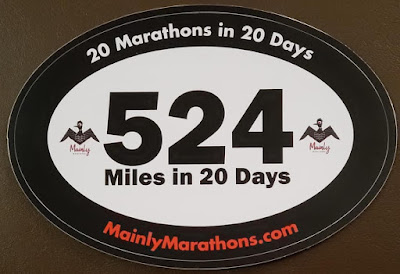
I ran 524 miles over a span of 20 days.  That’s extreme, yet it’s not all that impressive when you compare it to what people do in multi-day races.  I know people who have covered that many miles in a six-day race.  They didn’t have the luxury of a full-night’s sleep.  At best, they could grab a short nap each night.  The rest of the time, they had to keep moving.
Most people have the perception that it takes weeks or months to recover from a marathon.  There are two reasons for that.  The first reason is that elite runners give themselves months of recovery time before doing another marathon.  They do that because they need to be at their absolute peak on race day.  It’s not enough to be healthy and fit enough to simply finish a marathon.  If your livelihood depends on winning races, and you’re competing with the best runners in the world, you can’t afford to be slow by even a minute or two.  I wasn’t trying to compete at that level.  On average, I was running times that were a full hour slower than what I would do in a standalone race.  If necessary, I could’ve slowed down even more.
The second reason people think it takes a long time to recover from a marathon is because of the way most people train.  Most people never run farther than 20 miles in training.  On race day, they’re pushing their bodies way beyond what they’re used to.  Your body adapts to what you do frequently in training.  If you don’t routinely run 26.2 miles in training, then it’s only natural that running that far in a race is going to leave you feeling like you got run over by a truck.
When I started running marathons, I trained just like everyone else.  The day after a race, I could barely walk down a flight of stairs.  The turning point came when I joined Marathon Maniacs.  That's a club that's all about running marathons frequently.  I was skeptical about running marathons every week or two, but I gave it a try.  It took about six months to adapt to it, but once I did, I found I could run a marathon and feel just as good the day after a race as I did the day before.  Marathons became my long training runs.  The more often I ran them, the less they took out of me.
The notion that you can only run one or two marathons a year is a reality for most people, but only because of the way they train.  It’s a self-fulfilling prophecy.
I know some people will say I can do this, but they never could.  I ran faster than the other people who completed all 20 marathon, but it’s worth noting that I was also one of the youngest runners.  In fact, of the eight runners who finished marathons every day, only Trisha was younger, and she ran every race carrying an American flag for 26.2 miles.

I think I’m also at the Goldilocks age.  I’m old enough to have a lot of experience, and I’m retired, which allows me to devote more time to training.  Still, I’m young enough that I don’t have any major health problems.  I've slowed down some with age, but I haven't slowed down dramatically.

Saturday, December 23, 2017

I Feel Like I Dodged a Few Bullets.


It’s been a week since the Hawaii Bird Conservation Marathon.  I think I can now safely say that I dodged a few bullets.  I’m feeling like this right now.


Going into this race I had a lot of concerns.  First and foremost, I didn’t know if I could do this race without injuring my back.  After my back surgery in June, I was instructed not to do any high impact activities (including running) for 12 weeks.  That’s how long it takes to build up enough scar tissue for a disc to heal.  Before that, you’re at high risk of re-herniation.

The last instructions I received were to resume normal activities, as tolerated.  The next day, I did a trail marathon.  I told myself I would hike the whole thing, but I ended up doing a mixture of running and walking.  Over the next two weeks, I was running twice a week.  Then I started to notice some discomfort in my chest.  It was similar to the discomfort I had at the end of May, but it was on the opposite side of my chest.  I realized I must have re-herniated the disc.

Ninety percent of the time, these injuries heal on their own without surgery.  I kept up my walking, but stopped running.  After a few weeks, I felt normal again.  Since then, I’ve only run a few times.  I’d wait a few weeks, and then test the waters with a seven mile run.  Usually, I felt OK.  One time, I felt some inflammation in the middle of my back.  It went away within 24 hours, but the message was clear.  I wasn’t ready to run yet.

That was at the beginning of November.  I was still planning to run the Hawaii Bird Conservation Marathon in December.  I only ran one more time before the race.  I risked being undertrained, but I knew I had to give myself every possible chance to be fully healed by race day.

Before this race, my longest continuous run since the surgery was only seven miles.  Could I handle running 26.2 miles?  More importantly, could I handle running downhill for 26.2 miles, descending nearly 4,000 feet?  That’s a lot of impact for my spinal column to absorb.  I took a chance.

I didn’t have any back discomfort during the race.  Since then, a week has passed.  I haven’t had any inflammation in my back or any other symptoms that would suggest a nerve impingement.  I think I can finally conclude that I didn’t re-injure my back.  That’s a huge relief.

My second concern was that I might not be in good enough shape for this race.  I knew I was taking a risk by running it.  My only reason for taking that risk was to give myself a chance to break four hours in a Hawaii race, so I could finish my second circuit of 50sub4.  That was a goal that had eluded me for 2½ years.  I was doing almost 100 miles per week of race-walking, but I had run fewer than 100 total miles since May.  I was pretty sure I wasn’t in good enough shape to break four hours on a more typical marathon course.  I was counting on this course being fast enough that I could break four hours here, even without optimal training.  My worst fear was that I wouldn’t be able to break four hours, but I would injury my back by trying.

Neither fear came to pass.  It wasn’t close.  After only a few miles, I realized I would break four hours.  I ended by breaking 3:30.  The downhill course obviously helped, but I may have been in good enough shape to break four hours even on a flat course.  That taught me two lessons:

1.   Race-walking is good cross-training for running
2.   Mileage matters, even if it’s race-walking mileage.

Those were my two pre-race concerns.  I developed other concerns during or after the race.  First among those was the risk of an injury, such as Achilles tendonitis.  The first time I did a steep downhill race was the Revel Rockies Marathon in Colorado.  I had a fast race, but developed a bad case of Achilles tendonitis, most likely as a result of over-striding.

Early in this race, I felt some tightness in my left Achilles tendon.  As the race progressed, I also noticed some tightness in my left calf.  I reminded myself to take short rapid strides.  That probably helped keep it from getting worse, but it wasn’t going to get any better.

After the race, I still had a tight Achilles tendon and a sore calf muscle.  Maybe they would feel better after a few days.  Maybe this was the first symptom of an injury, and they would feel worse after a few days.  At the time, I didn’t know which way it would go.  I curtailed my hiking plans, avoiding anything with uneven footing.  I also curtailed my training when I got home.  For the next few days, I limited my walking to a casual pace, rather than my usual fast pace.  I got better each day.  Now, I’m back to normal training, and both the tendon and the muscle feel fine.

My last concern was my left adductor.  I didn’t notice that until after the race.  As I was moving my legs in different ways to try to loosen up my left calf, I started to notice soreness in my left adductor,  Once I noticed it, the discomfort wouldn’t go away.  I tried to massage the muscle, but it still hurt.  I just had to hope it would feel better after a few days.  I injured this muscle two years ago, so I knew it bad it could get.  It’s the sort of thing that could force me to take several weeks off to let it heal.

As with the Achilles tendon, my adductor felt better after a day or two of taking it easy.  Within a few days, it felt normal again.  Now, it’s not a concern at all.

I had a race that exceeded my wildest expectations, I didn’t re-injure my back, and I didn’t develop any new injuries.  I’m definitely counting my blessings right now.

Saturday, July 8, 2017

I'm Making Progress on My Walking, but ...


It’s been 10 days since my sutures were removed.  At the time, I mentioned I had hopes of possibly walking the first race of the Prairie Series.  At the time, my longest walk since my back surgery was four miles, and I was increasing that by only a quarter mile each day.  The race was only 17 days away.  Do the math.  I wasn’t going to get there unless I ramped up my walking at a ridiculous rate.

Then Deb reminded me there was also a half marathon.  I was registered for the marathon, but I could always switch to the half.  I originally registered for that race so I could make progress toward my long-term goal of doing every marathon in Minnesota.  Doing the half marathon wouldn’t help with that goal, but it would still be an important stepping stone toward walking the Helsinki City Marathon four weeks later.  Ramping up to a half marathon was still an ambitious goal, but it was much more realistic.

There’s a reason this blog is named, “Goal-Oriented Runner.”  Everything I do is goal-oriented.  Having goals gives me a sense of purpose.  I don’t just have goals for races.  I have goals for each workout.  Being able to associate a workout with how it will help me in my next race sometimes makes the individual workouts almost as exciting as the races.

For now, I can’t run at all.  I can only do one form of exercise: walking.  I’m walking with zeal because it gives me a sense of purpose.  I can’t understate how important that is to my psyche right now.  For most people, their identity is tied closely to their careers.  That’s never been the case for me.  I’m retired now, but even when I was working, I hated my job.  It’s what I was good at, but it was never what I enjoyed.  My identity has always been defined by my running.  Now that I can’t run, it’s identified by my walking.  It’s all I have.

With the half marathon in mind, I started increasing the length of my daily “long walks” by a half mile.  Then I start increasing them by a mile.  Ideally, I wanted to do the half marathon distance on my own before I did it in the race.

Because I was ramping up my “long walks” so quickly, I didn’t do as many short walks.  I didn’t want my total daily mileage to increase too quickly.  As a result, my “long walks” made up a larger proportion of my total mileage.  Here’s a bar graph of my daily mileage in the three weeks after surgery.  The blue portion of the bars represents my longest walk of each day.


At first, I was doing all my “long walks” on a treadmill.  That allowed me to be disciplined about my pacing.  I always did the entire walk at the same pace.  I started at 3.0 miles per hour (20:00 per mile).  A few days later, I picked it up to 3.1 mph.  If the pace felt too easy one day, I would nudge it up again the next day.

On Monday, I walked seven miles at a 16:13 pace.  Then on Tuesday, I decided to do my “long walk” outside.  I assumed that would make the miles less monotonous.  By now my “long walks” were taking about two hours.  That’s a long time to walk on a treadmill.  I also assumed I would have to go at a slower pace.  I thought walking on the treadmill was making it easier to maintain my pace.  My first assumption was correct.  My second assumption was wrong.  The treadmill was actually holding me back.

I set out to walk eight miles.  At first, I was going slower than my indoor walks, but I gradually accelerated.  I was doing multiple loops, and each one was faster than the one before.  I ended up walking eight miles in 2:70:30.  That’s an average of 15:56 per mile.

On Wednesday, I walked outside again.  This time, my goal was nine miles.  Emboldened by Monday’s walk, I started much faster.  Through the first seven miles, my pace was fairly uniform.  My time after seven miles was more than 13 minutes faster than it was on Tuesday.  It occurred to me that if I could speed up just a bit more, I might be able to finish nine miles in less time than it took me to walk eight miles the day before.

In my eighth mile, I lit a fire under myself to walk faster, if I could.  Up until now, in all of my walks, I had been simply walking at a fast pace.  As I told myself to go faster, I found myself occasionally slipping into race-walking.  It’s a different gait, which includes noticeable rotation of the pelvis.  It felt much more fluid than my previous gait.

I walked that mile in 13:36.  I had one more mile to go.  Realizing I could beat my eight mile time from Tuesday, I continued to lift my effort.  I did that last mile in 12:59.  My total time for nine miles was 2:06:17.  My average pace was 14:02!  I wasn’t expecting to get that fast so soon.

Some of my friends were understandably concerned that I was race-walking.  Knowing I’m recovering from back surgery, they cautioned that I shouldn’t be rotating my pelvis, because it would cause my back to twist.  I’m supposed to avoid bending or twisting my back.  That’s the reason I’ve been careful to keep my shoulders square and avoid excessive arm swing.

The next time I walked on the treadmill, I briefly experimented with a race-walk gait, so I could watch my belly.  I could see the side-to-side movement.  If my belly was moving, my lower back was moving.  After that I avoided race-walking.

After my fast nine mile walk on Wednesday, I noticed painful blisters on the heels of each foot.  It was a hot, humid day, and I was working up a sweat.  The blisters were painful, and they forced me to take it easy on Thursday.  I only walked seven miles that day, and my longest walk was only four miles.  It was the first time since my surgery that I didn’t increase the length of my “long walk.”  It was more important to give myself an easy day, in hopes that my blisters wouldn’t be as painful on Friday.

On Friday, I found that I could walk without pain if I kept the pace casual.  Anything faster than a 20:00 pace would hurt.  For my “long walk,” I went outside again.  My goal was 10.5 miles.  I didn’t want to do the whole thing at a casual pace, but I quickly realized that anything faster would hurt.  The faster I walked, the more it would hurt.

Under the right circumstances, I can suppress a great deal of pain.  There are two ways to do it.  The first is physiological; the second is psychological.  The physiological method is to exert yourself hard enough to produce endorphins.  Endorphins are natural painkillers.  The psychological method is to distract yourself.  For example, if I was focused completely on my effort and my mechanics, I would stop noticing the pain.  Either way, I had to walk fast.

I started out at a fast enough pace that I could tune out the pain.  Almost from the start, I had a race-walk gait.  I looked down at by belly.  I could barely notice the movement.  Then I reached behind me and touched my lower back. My hand was right at the bottom of my lumbar spine.  I could feel the movement.

Next, I moved my hand up an inch or two.  Now the movement was barely noticeable.  Finally, I moved my hand up to the middle of my back, so it was just a few inches below my incision.  I couldn’t feel any movement at all.  That was a relief.

If I had a lumbar surgery, any movement in my lower back would have been alarming.  My surgery was on the upper back.  My upper back wasn’t moving at all.

At this point, I had a choice.  To tolerate the blister pain, I had to walk at a fast pace, but there are only two ways to increase your pace.  You can increase your stride length, or you can increase your stride frequency (i.e. your cadence).

When you run, you’re airborne until your lead foot strikes the ground.  You can increase your stride length by “flying” farther.  When you walk, you always have at least one foot on the ground.  You can only increase your stride length by rotating your pelvis to reach farther forward with your lead foot.  That’s what I was doing.  It’s a big part of the distinction between a conventional walking gait and a race-walk gait.

The other way to increase your pace is in increase your stride frequency.  You have to get your legs to turn over faster.  When I was 30 years old, I flirted briefly with race-walking.  I went so far as to attend a clinic held by a member of the US Olympic team.  One of the drills was to try walking without moving your arms.  We tried and tried, but nobody could do it.  That was the point.  When you move one leg forward, you move the arm on the same side backward.  You have to do that to maintain your balance.  Picture a toddler taking his or her first steps.  They’re wobbly, because they’re still learning how to keep their balance while moving forward.  Before long, it becomes second nature.  You can’t not do it.

Then she taught us a mental trick.  Sometimes, the easiest way to move your legs faster is to focus instead on moving your arms faster.  If your arms move faster, your legs will move faster too.  You can’t not do it.  That’s the mental trick that enabled me to walk a mile in 8:43 and 5K in 29:38 with only three months of training.  I could walk fast, but I had a vicious arm swing.

I had three choices.  First, I could rotate my pelvis, knowing it would cause some rotation in the lowest part of my back.  Second, I could have a vigorous arm swing, knowing it would cause rotation of my upper back.  Finally, I could do neither, which would limit me to walking no faster than 15:00 per mile.  I could live with that, but that in turn would probably make it impossible for me to ignore the blister pain.  Then I’d be limited to a pace of 20:00 per mile or slower for a really long time.  Given those choices, I opted for a small amount of movement in my lower back.

I was again doing multiple loops of a route through our neighborhood.  I started at a pace that was noticeably faster than my last “long walk.”  I was going noticeably faster than 14:00 per mile.  That effort proved to be unsustainable.  I slowed down a bit in the second half, but still managed an average pace of 13:50.

The Helsinki City Marathon has a time limit of six hours.  That’s an average of 13:44 per mile.  I’m already getting close, and that race is still five weeks away.

After my walk on Friday, the blisters on my heels were worse.  Going forward, that may be my biggest obstacle.  Today was another easy day.  I’m not sure if I can do another long walk tomorrow.  I have to figure out how to cope with the blisters.

Why am I pushing so hard to walk farther?  Why am I pushing so hard to walk faster?

Running marathons is my whole life.  It’s who I am.  It’s what I am.  When I was told I couldn’t run for 12 weeks, it just about killed me.  I’m clinging to walking as a substitute.

I knew I couldn’t run the Bighorn Trail 100.  That was my most important race of the year, but I accepted that.  I knew I had to cancel the Firecracker Quadzilla.  I love those races, but I accepted that.  The Prairie Series doesn’t have time limits.  That means those races are walkable.  Ideally, I’d like to walk at least one of those marathons.  I’ve willing to settle for walking one of the half marathons.

Looking farther out, I’m scheduled to fly to Europe in August to do the Helsinki City Marathon in Finland and the Solidarity Marathon in Poland.  The Helsinki City Marathon has a time limit of six hours.  That’s possible, but it will take some work.  The Solidarity Marathon has a time limit of five and a half hours.  That’s a real stretch.  Ideally, I’d like to walk them both.  I’d settle for walking one of them.

I’m scheduled to do the Moose Mountain Marathon in early September.  By then, I should be able to run again, but I won’t have any training.  It’s a rugged trail marathon that might be as difficult as any marathon I’ve done.  I won’t be in shape to run it, and it’s not a race I can walk.  Even if I could, it probably wouldn’t be wise.  For the time being, I shouldn’t do anything that rugged.  I can accept that.

I have another marathon scheduled in late September and two more in October.  I won’t be in shape to run the whole way, but if I’m in shape to walk a marathon, it wouldn’t take much running to be able to beat the time limits.  Do you see why the walking is so important to me?