Sunday, February 6, 2022

Race Report: 2022 Surf City Marathon

On February 6, I ran the Surf City Marathon in Huntington Beach, CA.  I’ve done this race several times.  It’s one of the few winter races where I can count on comfortable temperatures for running.

I usually fly into LAX, but last time I had a bad experience picking up my rental car there.  This time, I flew into the John Wayne airport in Orange County.  There weren’t any flights on Saturday that would get me there in time for packet pickup.  On Friday, by contrast, I could get a late morning flight.  I had this view from the airplane as we approached the airport.

I arrived just before noon, so I went straight to lunch from the airport.  After lunch, I checked into my hotel.  I stayed at the Doubletree Club in Santa Ana, which is just a few miles from the airport.  I’ve stayed at this hotel several times.  They have a race package that includes free parking plus race day transportation.  In my experience, they also treat all the runners like VIPs.  I would recommend this hotel to anyone doing this race.

Next, I went to Huntington Beach to pick up my race packet.  As usual, packet pickup was in a large tent set up in the beach parking lot.  This year, most of the merchandise vendors were set up in the parking lot just outside of the big tent.  In the past, I always bumped into people I knew.  This year, however, I went a day earlier.  Most people traveling for the race probably picked up their race packets on Saturday.


My hotel had an outdoor pool and hot tub.  It was a warm enough day that I decided to spend part of the afternoon relaxing in the hot tub.  I was able to massage my lower back by positioning myself in front of one of the jets.

There’s a neighborhood in Costa Mesa called SoBeCa.  It was originally an entertainment and cultural arts district, but there are also restaurants and breweries there.  I never realized Orange County had so many breweries.  There were four just in the SoBeCa district.

SoBeCa is about two and a half miles from my hotel.  It was a pleasant day, so I decided to walk there and back.  Besides eating dinner and sampling some beers, I got in five miles of walking.

I spent Saturday morning relaxing at the hotel and doing a few exercises in the fitness center.  Then I drove back to Huntington Beach, where I had lunch and visited the expo again.  I already had my race packet, but I wanted to hang around to look for people I know.  While I was there, they were having a classic VW bus show.


When I got back to the hotel, I took another dip in the hot tub.  I also stopped by the marathon desk to get a wristband for the race shuttle.  It was included in my room rate, but I had to sign up for it.

For dinner, I once again took advantage of the nice weather and walked to a restaurant that was two and a half miles away.

On the morning of the race, the hotel had a continental breakfast for the runners, starting at 4:30.  I got up at 4:00 so I could be ready.  Getting up early on the west coast is much easier than getting up early on the east coast.

Our bus to the start left the hotel at 5:30.  The bus ride took about 30 minutes.  We were dropped off in front of the Hyatt Regency.  Most of the runners walked around the block to get to the start corrals.  I went through the hotel, so I could stop to use a bathroom in the lobby.  Then I made my way through the hotel to a pedestrian bridge leading to the beach.  I got there just in time for a group picture.

The temperature was in the upper 40s, but I expected it to warm up to 70 by the time I finished.  The afternoon high was forecast to be 81 degrees, making it the warmest day of the weekend.  I dressed for the warmer temperatures, knowing my legs would be cold in the early miles.

I ran my last marathon in 4:06:57.  That was on a course that had several miles of dirt road, and I felt like the soft footing was slowing me down at times.  This course is almost entirely paved.  Here, I thought I would be closer to four hours if I had a good race.  With that in mind, I looked for the 4:00 pace group and lined up near them.

I don’t like running in the middle of a pace group, because I often feel like I’m boxed in.  I chose instead to run just in front of the group.  That gave me plenty of run to find my own stride, but there was the danger that I might get too far ahead of them.  That’s exactly what happened.  By the end of the first mile, I found myself right behind the 3:50 pace group.

There was a cold breeze, and my hands were cold, even though I was wearing gloves.  When I’m cold, I have trouble relaxing, so I tend to start faster than I should.  For the time being, I was comfortable running behind the 3:50 group, but I wasn’t going to pass them.  If I felt boxed in, I had to slow down and stay behind them.

I continued to run behind the 3:50 group until we reached the first turn, which was between two and three miles.  There was an aid station just before the turn.  That caught me off guard, because the tables were on our left, but I had already moved to the right in anticipation of the right turn onto Seapoint Street.  I chose to skip that aid station, but I knew it would be important to drink at all the others.  I was cold in the early miles, but it was going to get hot later.

It was near that aid station that I heard music for the first time.  There was a sound system playing “Gangnam Style.”  That’s not surf music, but it’s an energetic song that always gets me pumped up.

For the next few miles, I continued to run near the 3:50 group.  At times, the pace felt fast, and I dropped back a little.  Other times, the pace felt easier and I caught up to them again.

In the fifth mile, we went down a hill.  By the bottom of the hill, one of the 4:00 pacers caught up to us.  That shocked me.  We had been averaging 8:36 per mile.  To run a 3:50 hour marathon, you need to average 8:45, so we were starting kind of fast.  To run a four hour marathon, you only need to average 9:09.  That 4:00 pacer was going ridiculously fast.  That’s no way to lead a pace group.

In the next mile, we entered Huntington Central Park.  The next two miles had lots of turns.  At times we were on a narrow path.  I sometimes had to slow down a little to stay behind the group.  At other times, the pace leaders would pull away, and I’d find myself working harder to keep up.

I really shouldn’t have stayed with the group once the pace started taking more effort.  The longer I stayed with them, the more tempted I was to try to keep up that pace for the whole race.  It was optimistic, to say the least, but 3:50 happens to be the time I need for a Boston qualifier.  That’s something I’ll shoot for any time it seems possible.

While we were in the park, we passed a high school band that was performing for us.  They set up in the same spot every year.

After leaving the park, we ran back up the same hill we ran down a few miles earlier.  This race is mostly flat, but this is a hill that I always find tiring.  It seemed like the 3:50 pacers were taking the hill without slowing down.  As I followed them up the hill, I found myself really huffing and puffing.

There was an aid station at the top of the hill, and I took my time having a drink.  I fell behind the group, but over the next mile I gradually caught my breath.  By the nine mile mark, I had caught up to the group again.

Just before the 10 mile mark, we finished the inland portion of the course and turned back onto the Pacific Coast Highway.  The rest of the race consisted of two out-and-backs.  First, we would run out-and-back along the highway.  Then we would do another out-and-back on a bike path between the highway and the beach.  This is a race where it’s easy to spot your friends.

It was about two and a half miles to the turnaround of the first out-and-back.  As I started this section, I finally felt warm enough to take off my gloves.  Within a few miles, I would start feeling hot.

At first, I was keeping up with the group, but it was taking more effort.  By the time we reached the turn, I was losing contact with them.  The halfway mark was about half a mile after the turnaround.  By the time I got there I had lost contact with the 3:50 group, yet I was actually on pace to finish in 3:48.

Now that I was on my own, I had to start paying more attention to my pace.  I read my time at each mile marker.  I was still keeping up the pace I needed for a 3:50 finish, but it got more difficult with each mile.  I was pretty sure I wouldn’t be able to sustain the pace for the rest of the race.  I probably shouldn’t have tried.

I was starting to experience other problems besides find the pace more difficult.  Shortly after the turnaround, I started to notice some chafing.  I was sweating enough that my clothes were getting salty.  As they rubbed against my skin, a few sore spots started to sting.  I neglected to put Aquaphor on my legs before the race, so it wasn’t surprising that I had chafing there.  I also had chafing in areas that have never been a problem before.

Around 15 miles, I started to feel some rumbles in my intestines.  I had an unsettled digestive system since getting up.  I thought I got it all out of my system before the race, but I started to wonder if I could make it through the race without a bathroom stop.

I fought to stay on pace until we turned onto the bike path.  Before I got to the turn, I saw the 3:50 group on the bike path.  I did a time check and determined they were ahead of me by about 1:40.  I already knew I wasn’t going to catch them, but now I knew how far back I was.

As I made the U-turn onto the bike path, the wheels came off.  I immediately realized I couldn’t sustain my pace any longer.  I waited too long to back off.  Now I was going to slow down dramatically.

I was no longer keeping up with anyone around me.  I had to retreat into my comfort zone and find a pace that would be sustainable for the next 10 miles.  My new goal was to break four hours.  It’s a goal I could no longer take for granted.

The out-and-back on the bike path is longer than the out-and-back on the highway.  It’s almost five miles each way.  I’ve run this course enough times to know how long it feels when you’re fighting to sustain an ambitious pace.  It feels even longer when you’ve blown up, and you’re struggling just to finish.  The rest of the race was unpleasant, but I had only myself to blame.  I had no business trying to pace for 3:50.  I realized that several miles earlier, but I didn’t have the sense to back off.

At 17 miles, I got my first time-check since slowing down.  That mile was 9:03.  That was easily fast enough to keep me on pace for four hours, but I didn’t know how much more I would slow down.

There are several public bathrooms along the beach.  I reached one just as someone was leaving the bathroom.  I was tempted to stop, but I was afraid my legs would be too stiff when I resumed running.  I decided to hold out as long as I could.  The longer I held my current pace, the more likely I was to finish in four hours.

Miles 18 and 19 took 9:28 and 9:27 respectively.  I didn’t know exactly what pace I needed the rest of the way, but I knew that was still fast enough.

There was a band set up alongside the highway.  The bike path passed close enough that I could hear the music.  The first time I went by, they were playing an instrumental version of “Music to Watch Girls By.”  I used to have that on a 45.  It’s one of my favorite instrumentals from the late 60s.

I was putting more effort into keeping up with the runners around me, but I continued to slow down.  Mile 20 took 9:42.  At first, I was too tired to do the mental arithmetic and figure out what pace I needed the rest of the way.  Then I realized I still had more than 63 minutes before the four-hour mark.  With 6.2 miles to go, I only needed to average 10 minutes per mile.  I was still doing that.

In the next mile, my friend Stefanie passed me.  She started slow and was running negative splits.  I started too fast and was on my way to positive splits.  At this point in the race, I couldn’t keep up with her.

Just before the turnaround, I saw the 21 mile sign.  I looked at my watch, but the time didn’t seem possible.  I suspect the sign was facing the wrong way.  We weren’t supposed to reach 21 miles until after the turn.

Just after making the turn, I saw one of the 4:00 pace leaders.  It’s the same one who briefly caught up to the 3:50 group earlier in the race.  I knew I would have to work to keep my time under four hours, but I was still ahead of that pace.  This guy shouldn’t have been catching up to me this soon.  He was still going too fast.

Physically, I was just barely hanging on, but I got a psychological lift from knowing I was finally on the way back toward the finish.  I still had five miles to go, but I was headed in the right direction now.

At mile 22 my time made more sense.  In the previous two miles, I averaged 9:45.  Those were the last two miles that were faster than 10 minutes.  Mile 23 took exactly 10 minutes.  At first that was demoralizing, but then I realized I now only needed to average about 10:30 per mile.

I started to notice some discomfort in my right knee.  That knee has been a problem for a year and a half.  It’s healed sufficiently that I can do training runs, but a marathon can still make me notice it.  It usually feels fine within 24 hours.

The good news is that I never noticed any discomfort in my lower back.  It was bothering me both Friday and Saturday, even though I didn’t do anything to aggravate it.  On the day I subjected my back to the impact of 26.2 miles of running, it felt OK.  Go figure.

When I went past the band again, they were playing “Pipeline.”  At a race called Surf City, you expect to hear some surf music.  Hearing that lifted my spirits.

Mile 24 took 10:11.  I was getting slower with each mile, but the pace I needed to average the rest of the way was also getting slower.  The only thing that would keep me from breaking four hours was a bathroom stop.  I had to hold out until after the race.

It was right at 24 miles that the 4:00 pacer passed me.  I was surprised it took that long for him to catch me.  He was right behind me at the turn, and I was slowing down.  I suspect he realized he was going too fast and now he was giving time back time by taking walking breaks.  It’s worth noting that there weren’t any other runners with him.  He lost his whole group by going too fast earlier.

I looked ahead across the beach and saw the Huntington Beach Pier.  The finish line is only a few blocks past the pier.  That’s the good news.  The bad news is that the pier was much farther away than it appeared to be.  It looked like it was only about six blocks away.  In fact, it was almost two miles away.

I held the same pace in mile 25 as I did in mile 24.  I now had more than 13 minutes to finish the last 1.2 miles.  I fought to keep from slowing down.

In the last mile, we returned to the Pacific Coast Highway.  I started to feel more rumbles in my intestines.  Maintaining my pace was no longer my biggest concern.  I was more worried about making it to the finish before needed a bathroom stop.

As I passed the pier, I came within sight of the 26 mile sign.  Then I spotted the finish line.  I kept pushing and finished in 3:58:35.  I ran positive splits by more than 10 minutes.  That’s what I get for starting at a pace that never seemed sustainable.

Before the race, I would have been happy to finish within four hours.  I did it the hard way, but I still broke four, despite poor pacing.

This race always has cool finisher medals.  They’re a little different each year, but it’s usually a surfboard.

They always have lots of food and beverages in the finish area.  I knew I was dehydrated, so I grabbed a bottle of water and started drinking.  I also picked up a banana which I ate immediate, and an energy bar which I saved for later.  There were other snacks, but that was all I needed.

When I got through the finisher chute, I went straight to the port-o-potties for a long overdue bathroom break.  They had washing stations, so I was able to use a damp paper towel to wipe areas that were chafing.

I waited in a long line for the ID check to get my wrist band for the beer garden.  Each runner got one free beer or seltzer.  I opted for a Longboard Lager.  Aside from being the best beer they had, it was also the most appropriate.

I stopped at the results tent to find out my official time, and then I made my way to the Hyatt to wait for a bus back to Doubletree.  They had two pickup times.  The first one was at 11:30.  If I missed that, I would have to wait until 12:45.  I kept an eye on the time and made sure I caught the 11:30 bus.

When we got back to the hotel, the staff was lined up in the lobby to give us an ovation.  They were making noise by banging pots and pans.  They do this every year.  I know what to expect, but I love seeing the reaction of runners who have never stayed here before.

In the lobby they had water bottles and Doubletree cookies for us.  When I got back to my room, I found a surprise.  The Director of Sales left this tin of Doubletree cookies in my room.  I don’t know if she did that for everyone or if I got special consideration because I’ve stayed here six times.

I took a quick shower to rinse off the sweat and then went outside to soak in the hot tub.  On Friday and Saturday, I was the only one in the pool area.  Sunday was a warmer day, and a few other runners had the same idea.  After about 20 minutes in the hot tub, I took another shower to rinse off the chlorine.

A few things about the race weekend felt different this year.  There wasn’t a big group dinner the night before the race.  There wasn’t a “beer & bacon station” set up by spectators along the bike path.  The last thing that felt different was after the race.  This race is usually held on the first Sunday in February.  In the past, that was always Super Bowl Sunday.  Watching the game in the hotel lounge was a post-race tradition.  This year, the NFL added an extra week to the season.  As a result, the Super Bowl won’t be played until next weekend.  I missed being able to watch the game while recovering from the race.


Race Statistics
Distance:  26.2 miles
Time:  3:58:35
Average Pace:  9:06
Lifetime Marathons/Ultras:  449

Sunday, January 16, 2022

Race Report: 2022 Daufuskie Island Marathon

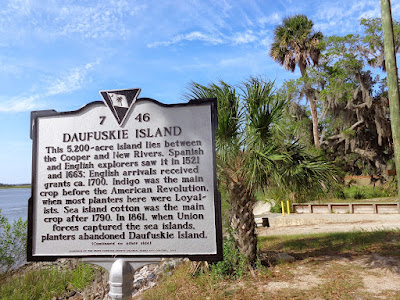
On January 15, I ran the Daufuskie Island Marathon.  Daufuskie Island is a coastal island in South Carolina.  It’s just southwest of Hilton Head Island.  There’s more lodging on Hilton Head Island, so that’s where I stayed.


I was originally scheduled to run the Charleston Marathon this weekend.  Nine days before the race, I was notified that the race was cancelled.  Like many cities, Charleston has been experiencing a surge of COVID-19 cases since the arrival of the Omicron variant.  The city felt their resources were already stretched too thin to provide the necessary services to support a large marathon in the city.

As I searched for other marathons, I discovered the Daufuskie Island Marathon was the same day as the Charleston Marathon.  I had already booked flights to Charleston, but the drive time from Charleston to Hilton Head Island was only about two hours.  The Savannah airport would’ve been closer, but keeping my existing flights was less expensive than rebooking to fly into Savannah.

Some people who were originally signed up for the Charleston Marathon opted to do the Jekyll Island Marathon in Georgia.  On Wednesday, I learned that the Jekyll Island Marathon was cancelled, because of severe weather that was going to bring thunderstorms and strong winds.  My race was a day earlier, so it wasn’t going to be threatened by the storms.

I flew into Charleston on Thursday and spent one night at a hotel in North Charleston.  That evening, I got an email from Delta advising me that my flights home might be affected by the storms.  At this point, there wasn’t much I could do about it.  There weren’t any flights I could catch on Saturday that would get me home the same day.  I just had to wait and hope for the best.

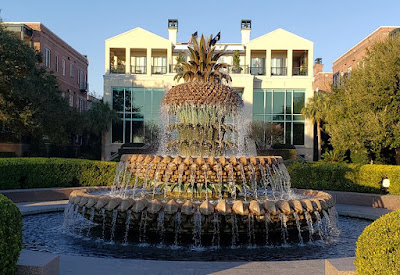
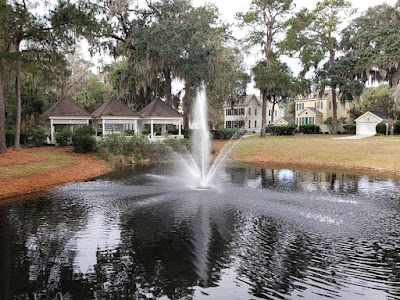
I didn’t need to get to Hilton Head Island until Friday afternoon, so I was able to spend Friday morning doing some sightseeing in Charleston.  I started at Waterfront Park.


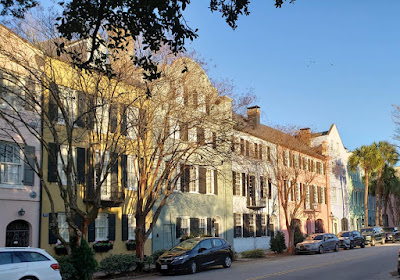
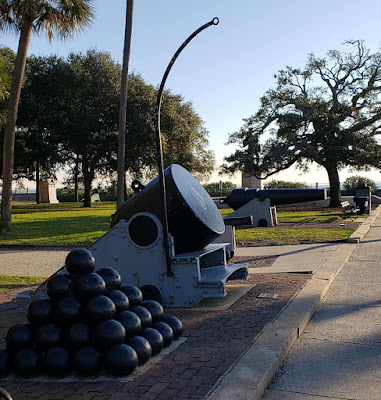
Next, I went to the Old Exchange and Provost Dungeon.  I walked past Rainbow Row and followed the waterfront down to The Battery.


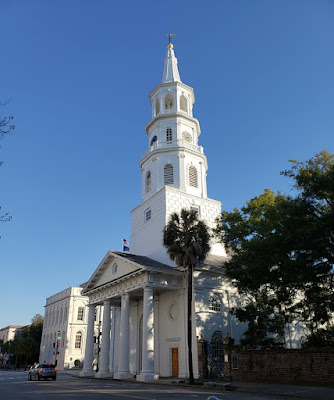
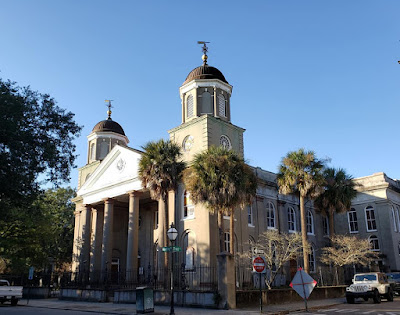
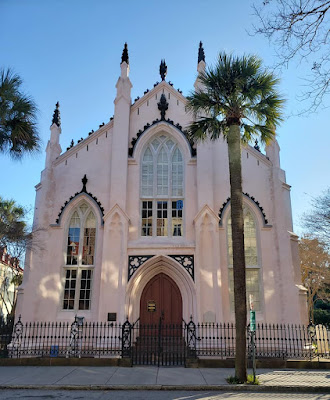
After that, I gradually circled back.  Along the way, I walked past several historic houses, municipal buildings, and churches.


When I was done with my self-guided walking tour of Charleston, I drove to Hilton Head Island.  Along the way, I stopped for lunch.

After checking into my hotel on Hilton Head Island, I drove to the Haig Point Embarkation Welcome Center to pick up my race packet.  My route took me over the Coligny Beach Bridge.  This brought back memories of running across this bridge when I ran the Hilton Head Island Marathon two years ago.  Thankfully, the race I was doing this year didn’t have any monster climbs.

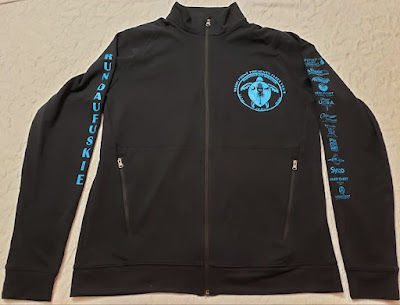
My race packet included this warm jacket.  The material was more like a sweatshirt, but it has a zipper and pockets.


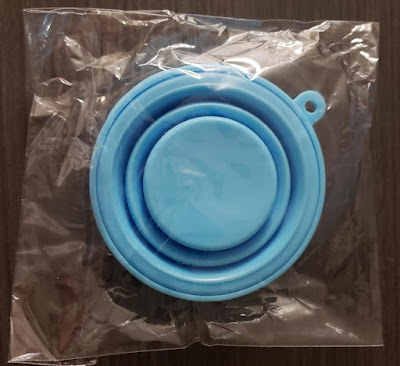
My race packet also included this blue disk.  I didn’t know what it was at first.  As it turns out, it’s a collapsible drinking cup.  More on that later.


While I was at Haig Point Embarkation, I also bought a round trip ticket for a ferry to Daufuskie Island on race day.

I spent the rest of the afternoon exploring Hilton Head Island and relaxing.  I also organized my race gear and labeled my drop bag.  I wanted to have everything ready before dinner, so I could get to bed early.  I set my alarm for 4:15 AM.

I had dinner at an Italian restaurant that was about a mile from my hotel.  After dinner, I had a beer tasting at Hilton Head Brewery.

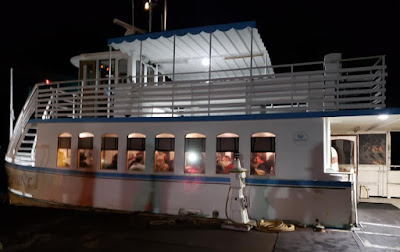
The marathon started at 8:30 AM, but I needed to be on a ferry that left at 6:30.  Parking near the ferry terminal was limited, so we were told to get there an hour early to look for parking.  I was planning to get there by 5:30, but I actually got there at 5:20.  The closest parking lots are reserved for members of the Haig Point Club.  I was able find a parking spot in the closest lot available to visitors.

I waited in the car for about 10 minutes.  Then I walked to the Welcome Center, so I could use the bathroom.  People were beginning to board the 6:00 ferry.  Since I was already there, I took that ferry instead of waiting until 6:30.


The ferry ride took about 40 minutes.  I was talking to another runner who had his collapsible drinking cup with him.  I learned from his that this was a cupless race.  We were all supposed to carry our own cup, bottle, or hydration system.  I somehow missed that when I was reading the race information.

The ferry dropped us off at Haig Point on Daufuskie Island.  From there, it was a short walk to the Runners’ Village, where we waited until the race started.  In the Runner’s Village, there was a large canopy with tables, chairs, and several space heaters.  The temperature was in the low 40s, so I was expecting to be cold.  Under the canopy, I was fairly comfortable.


I asked the volunteers if they had any spare drinking cups.  They didn’t.  I was supposed to bring the one in my race packet.  That was back at the hotel.  Then they told me they would have some paper cups at the aid stations.  They want people to bring their own cups, but they made provision for people who didn’t.

Under the canopy, there were tables with coffee, bananas, and cinnamon rolls.  Nearby, they had port-o-potties and a place to check gears bags.  I brought a bag, so I could check my warm-up clothes and have them to wear again after the race.  I waited until about 30 minutes before the race before taking off my warm-ups and checking them.

The course was a 13.1 mile loop.  The half marathon was one loop and the marathon was two loops.  They also had a 39.3 mile race called the triple half.  That was three loops.  If I was in better shape, I might have been tempted to do that race, but I’m barely in marathon shape now.  Ever since injuring my low back in late November, I’ve cut way back on my training.  I ran a marathon four weeks ago, but since then my longest run was six miles.  I was confident I could finish a marathon, but I expected to be slower than usual.

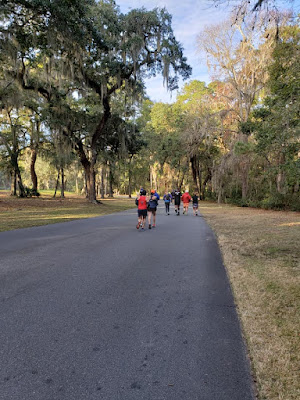
Most of the course was paved.  The start/finish area was paved with brick, but as soon as we got going, we were on asphalt roads.


There aren’t many cars on the island, but I saw several pick-up trucks.  Most people get around the island using golf carts.

I started at a pace that felt easy.  For the first few miles, I was on pace for a four hour marathon.  I didn’t expect to continue at that pace.  It felt easy at first, but I knew it wouldn’t be sustainable for 26.2 miles.

In the third mile, we reached an aid station.  I saw small cups of water and Gatorade on the table.  I drank a cup of Gatorade, but I didn’t discard the cup.  I carried it with me for the rest of the race.  At the other aid stations, I refilled it.  That made me feel less guilty about not bringing a reusable cup.  I wasted a paper cup, but only one.

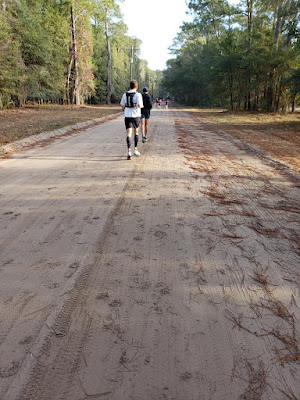
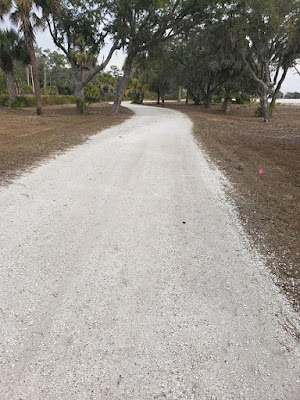
About halfway through the third mile, we turned onto a dirt road.  At first, the ground was damp enough for the surface to be firm.  As I kept running, I noticed patches where the ground was dry, and the footing wasn’t as firm.  I slowed down on this section.  Earlier, I was averaging about 9:05 per mile.  On this section, I averaged closer to 9:30.


As we approached five miles, we turned onto another paved road.  Now that I had better traction, I picked up the pace a little, but I didn’t get back to the pace I was running in the first few miles.  As I passed the six mile mark, I realized this was already as far as I’ve run in the last four weeks.  I wasn’t inclined to push the pace too much.

Just past seven miles, we turned onto another dirt road.  This was similar to the first dirt road.  It was firm in some places, but soft in others.  On this section, I slowed down even more.  My pace here was about 9:45 per mile.

This section of dirt road wasn’t as long.  At most, it might have been a mile and a half.  When I got back onto pavement, my pace didn’t improve much.

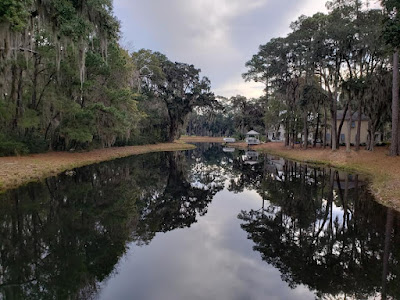
Later in the loop.  We crossed bridges over a couple of streams.  I had to stop to take pictures.


At the end of mile 11, I was dismayed to see I had slowed down to 10:28.  Then I remembered I stopped several times to take pictures.

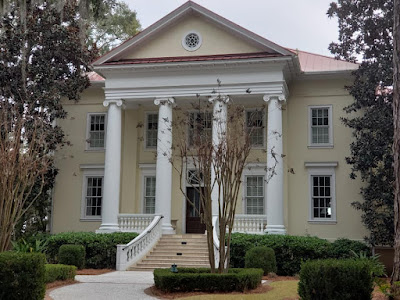
Next, we ran through a neighborhood with some old homes.  Some of them probably date back to the 1800s.


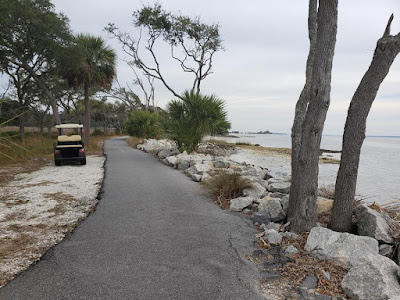
With less than two miles left in the first loop, we crossed a bridge that took us onto a golf cart path.  This was the only part of the course that wasn’t wide enough for cars.  For more than a mile, we ran along the northern short of the island.


At first the path was paved, but later the surface was crushed rock.  Unlike the dirt roads, this path had a nice firm surface with good traction.


For most of the first loop, I was following the runners ahead of me.  Now, for the first time, I had to pay attention to the course markings.  The course was marked with small pink flags, similar to what you might see in a trail race.  The flags were spaced close enough that you could always see the next one in front of you.  The only way to miss a turn on this course is if you aren’t paying attention.

My 12th mile was also slow, but I could once again attribute that to stopping to take pictures.  In the last mile of the loop, we got back onto paved streets.  As I made the last few turns, I could hear cheering and cowbells from the finish area.

I finished the first loop in roughly 2:05.  I was on pace to finish in 4:10, but I had doubts about sustaining the same pace in the second half. 

As I began my second loop, I knew what to expect.  I couldn’t remember every turn on the course, but I remembered the rough layout.  There was a 2.5 mile section of paved roads.  Then there was a 2.5 mile section of dirt road.  Then there was another two mile section of paved roads.  Then a shorter section of dirt road.  Then a couple more miles of paved road.  Then the golf cart path, leading into about half a mile of paved roads at the finish.

Segmenting the course like this made it seem easier.  I didn’t think about running another 13.1 miles.  Instead, I broke it down into seven sections that each seemed manageable.  I took them one at a time.

As I began the second loop, I picked up my effort a little.  I didn’t know if it was wise, but I was willing to put some effort into picking up my pace.  I started to gain ground on two runners who had passed me earlier, when I was stopping to take pictures.  I wanted to see if I could reel them in.

On the first section of paved roads, I ran a pace that was almost as fast as I ran it in the first loop.  I gained on the two runners ahead of me, but I didn’t catch them yet.

Next, I reached the first section of dirt road.  Inevitably, I slowed on this section, but I didn’t slow down as much as I did the first time.  By the time I finished this section, I caught both of the runners I was chasing.  For the rest of the race, I continually caught and passed the runners who were just ahead of me.

On the second section of paved roads, I ran faster than I did on my first loop.  My pace here was close to my pace in the early miles.  By the time I was halfway through my second loop, I knew I was going at least as fast as I did on the first loop.  I felt, however, like I could hit the wall at any time.  I took it one mile at a time.

I slowed down on the last section of dirt road, but I didn’t slow down nearly as much as I did the first time.  This time, my pace was about 20 second faster than in the first loop.  As I got back onto paved roads, my next two miles were also a little faster than they were o         n the first loop.

I had just over three miles to go.  In my first loop, my 11th and 12th miles were my slowest.  In both of those miles, I made multiple stops to take pictures.  This time, I wasn’t stopping.  I wasn’t going to see anything new, so I just focused on running.

I felt like I was fading, but I kept up my effort.  I knew my next mile would be an easy comparison.  The first time I ran it in 10:28, but only because I stopped a few times.  This time, I ran that mile in nine minutes even.  It was my second fastest mile of the race.

I had just over two miles to go.  I was almost to the golf cart path along the shore.  I slowed a little in that mile, but it was still more than 30 seconds faster than the corresponding mile of my first loop.

Now I knew I would run negative splits.  As I reached the last aid station, I refilled my cup for the last time, drank my Gatorade, and tossed the cup into the trash.  I had roughly one mile to go.  I was struggling, but I did my best to limit the damage.

When I got back onto pavement for the last time, I saw a runner who was beginning to pull away from me.  I tried to catch him, but I couldn’t.  He was finishing strong, and I was just hanging on.  That mile wasn’t as fast in this loop, but I was still going to run negative splits by a wide margin.

I finished in 4:06:57.  I ran negative splits by roughly three minutes.  Most of that was attributable to not taking pictures in the second loop, but I think I also ran a bit faster.

There was a ferry leaving for Hilton Head Island at 12:40.  The next one wouldn’t be until 1:40.  I might be able to catch the 12:40 ferry, but I only had a few minutes to get there.

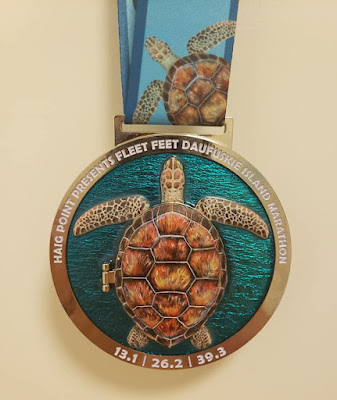
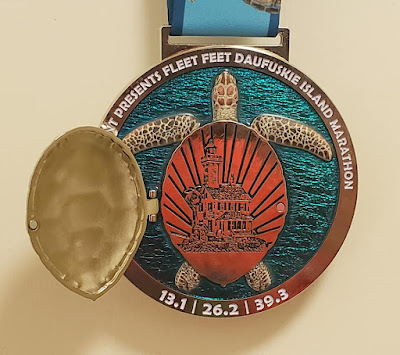
I rushed through the finish area so quickly, the volunteer with finisher medals had trouble catching me.  It’s a nice medal.  It features a sea turtle.  The shell opens to reveal an image of the Haig Point Lighthouse.


After getting my medal, I walked quickly to where the gear bags were.  The volunteers had arranged them on the ground, so I was able to find my bag quickly.  After picking up my bag, I ran (as best I could) to the landing, and boarded the ferry just seconds before it left.

I would’ve been nice to have time to cool down and have a beer in the finish area, but I didn’t want to wait an hour for the next ferry.  Catching this one was my reward for running hard in the second half of the race.

Had the Charleston Marathon not been cancelled, I probably would never have done this race.  I’m glad I did.  Getting to and from this race takes extra time, but I think the experience was worth it.

After driving back to the hotel and getting cleaned up, I took the time to jot down my recollections of the race, so I wouldn’t forget.  Then I went out for an early dinner.  The restaurant had steps.  Going up the steps, I noticed some discomfort in my right knee.  I also noticed my knee when I walked down the steps as I left.  Most days, I don’t notice my knee, but clearly it’s not fully healed yet.

A storm system moved through during the night.  This is the same storm that caused the cancellation of the Jekyll Island Marathon, which was scheduled to take place on Sunday.  My flight out of Charleston wasn’t until 12:22 PM, but I got up early and started driving right after breakfast.  It’s normally a two hour drive, but I wanted to allow extra time in case the rain caused delays.

The shortest route to Charleston includes roads through low-lying area that are prone to flooding during periods of heavy rain.  I took a longer route that’s farther inland.

As I left Hilton Head Island, I encountered sections of road with standing water.  It was still dark, so I couldn’t see the water until I drove over it.  Each time, it was a bit jarring as the car suddenly slowed down, and I felt the ABS engage for a second or two.

Once I got to I-95, I didn’t have to worry about water on the road.  Freeways are generally designed to have good drainage.  Instead, I had a new concern.  Shortly after I got onto the freeway, I saw one of the dashboard indicator lights come on.  It was a symbol I had never seen before, and I didn’t know what it meant.

Ideally, I would’ve pulled over to get out the owner’s manual and see what that indicator meant.  The road was slick, and visibility was poor, so I didn’t feel like it was safe to pull over.

The indicator turned off after about a minute, but a few minutes later if came on again.  I was two miles from a parking area, but it was for trucks only.  When I got to the exit, it said no cars allowed.  I had to press on until I reached a town.

Over the next 15 minutes, the mysterious dashboard indicator turned on about four more times.  Each time, it turned off again.  By the time I left the freeway, it was no longer coming on again.

The second half of my drive was along local roads.  As soon as I got off the freeway, I started encountering puddles.  By now, there was enough light that I could see them coming.  Where there were two lanes, I drove in the left land, to avoid puddles on the side of the road.

The mysterious dashboard indicator came on one more time.  By then, I was less than 30 miles from the Charleston Airport, so I pressed on.

Before returning my rental car, I needed to fill my tank.  While I was at the gas station, I took a few minutes to get the owner’s manual out of the glove compartment.  The indicator light was a pedestrian warning.  Presumable, there’s a camera on the front of the car, and it’s supposed to warn you if you’re in danger of hitting a pedestrian in the roadway.  I can only assume that the rain was obstructing the camera, so it was giving me false alarms.

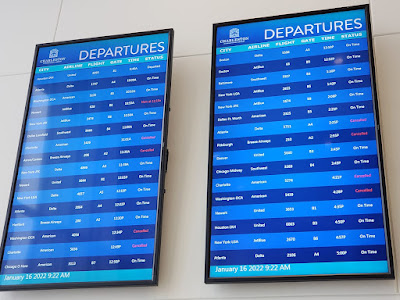
I got to the airport three hours before my scheduled flight.  The guy at rental car return was a runner.  He saw my Boston Marathon jacket, and we talked about races for several minutes.  During our conversation, I learned that the 7:30 flight to Atlanta was cancelled.  When I got into the airport, I saw on the departure board that several flights were cancelled.  Mine was still listed as “on time,” but I was making connections in Atlanta, so I had to worry about the weather in both cities.


After sitting in a car for two hours, my lower back was bothering me.  I wanted to check my bag, so I wouldn’t have to hoist it into the overhead bin on my flights.  I chose to carry it onto the plane instead, so I wouldn’t be stuck without my luggage if I had to spend the night in either Charleston or Atlanta.

While I was waiting in the Charleston airport, I saw that my flight was still scheduled to depart, but all the later flights into Atlanta were cancelled.  The problem wasn’t the weather in Charleston.  It was freezing conditions in Atlanta, where it was snowing.  Early and late arrivals into Atlanta were cancelled, but my flight was arriving at the warmest time of the day.  Of course, getting to Atlanta was only half the problem.  I still had to worry about my flight from there to Minneapolis.

When I arrived in Atlanta, I made the mistake of carrying my bag off the plane.  I should've rolled it.  Walking off the plane while carrying that bag seriously aggravated my lower back.  It bothered me for the rest of the day.

I had a two hour layover in Atlanta.  For most of that time it was snowing, but it was warm enough that the snow wasn't accumulating on the runways.  I got in and out of Atlanta during the afternoon, when it was warmest.  Had it been just a few degrees colder, I might have been stuck there overnight.


Race Statistics
Distance:  26.2 miles
Time:  4:06:57
Average Pace:  9:25
Lifetime Marathons/Ultras:  448
South Carolina Marathons:  5

Saturday, January 1, 2022

My Goals for 2022

Last year was a rebuilding year.  This year will also be a rebuilding year.  My goals for this year are so similar to last year that I could’ve reposted last year’s goals and nobody would know the difference.  I took the time to write a new set of goals for 2022, but they’re going to look awfully familiar.

Heal from Injuries

I’m currently healing from two injuries.  The first is a knee injury that’s plagued me for more than a year.  The other is a lower back injury that first started bothering me in late November.

Let’s start with the knee injury.  A year ago, I couldn’t walk up or down stairs without feeling soreness in my right knee.  Running, even for short distances made it worse.

I’ve been rehabbing that knee for more than a knee.  One of the exercises that’s been helping is single-leg leg extensions.  When I starting doing those last summer, I was only using 10 pounds.  Now, I’m using 35 pounds, and I’m continuing to increase the weight in small increments.

Most days, I can walk up and down stairs without any discomfort.  If I run a marathon, I’ll have discomfort in my right knee the next time I walk up steps, but it’ll be back to feeling normal within 24 hours.

Obviously, I’d like to get back to never feeling discomfort in that knee.  I’ve made a lot of progress, but I’m not quite there yet.

The other injury is my lower back.  I haven’t had an MRI, but it’s most likely a disk protrusion in the lumbar region.  It feels similar to an injury I had in the same area last May.  Sometimes, I feel soreness near the site of the injury.  Other times, I’ll feel minor discomfort closer to my hip.  I think the hip discomfort is actually a nerve impingement.

Last summer, I had to take it easy for about a month, but the injury healed with rest and PT.  This time, I’ve tried to take it easy, but I was already signed up for a couple races.  Running two marathons before healing probably set me back.  Going forward, I’ll continue to run the races I’ve already entered, but I won’t sign up for any more races until my back has healed.  Ideally, I like to run about two marathons per month.  For the next four months, I’m signed up for one marathon per month.  For now, I’ll stick to that.

My first goal for 2022 is to heal completely from both of these injuries.  Until I do, I’ll have to hold back on my training.  In the short term, I’ll get out of shape, but if I can get healthy, I can eventually get back in shape.

Get Back in Shape

One of my goals last year was to rebuild my mileage base.  I’d still like to do that, but I know I won’t get back to pre-injury mileage levels in just one year.  Even if I could, building my mileage is just a means to an end.  The end goal is to get back in shape.

Goals should be well-defined.  Ideally, they should have objective criteria, and they should be measurable.  For running, I’m going to define “getting back in shape” as being able to run a marathon fast enough to qualify for Boston, without resorting to running a race with a downhill course.  For race-walking, I, going to define it as finishing a marathon in less than five hours.

Get Back to a Lean Weight

Whenever I’m forced to cut back on training, I gain weight.  These past several weeks have been no exception.  I haven’t gained a lot of weight, but it’s enough to make a difference in my marathon times.  To get back into shape, I’ll need to lose that weight.

Last year, I managed to lose weight, even while I was taking a break from running.  I know that’s possible.  I also know it won’t be easy.  In the short term, my priority will be to stop gaining weight.  Losing the weight I’ve already gained will be more important when I’m back to doing serious marathon training.

Strike a Balance Between Running and Race-walking

Three times I’ve switched to race-walking when an injury forced me to take a break from running.  Each time, I returned to running when I was healthy enough.  This year, I’d like to train for both running and race-walking.  That’s going to mean splitting my training time between the two.  That doesn’t necessarily mean I’ll devote equal time to each.

I’ve found that race-walking is excellent cross-training for running.  I’ve had good results running marathons when most of my training was race-walking.  It doesn’t work the other way.  Running doesn’t prepare you for race-walking.

Getting in shape for running is largely a matter of improving your aerobic fitness.  Technique, for the most part, comes naturally.  Getting in shape for race-walking also requires aerobic fitness, but there’s no substitute for working on technique.  It doesn’t just take fitness.  It takes practice.

I could probably prepare for both running and walking by alternating between running workouts and race-walking workouts.  While that would work, it’s not necessarily optimal.  I’ve learned from experience that race-walking isn’t as hard in your body.  I’ve never built my running mileage beyond 70 miles a week for very long before getting injured.  I’ve built my walking mileage as high as 140 miles per week without getting injured.  For that reason, I suspect the optimal mix involves more walking than running.

I don’t expect to find the optimal mix, but my goal is to develop a training schedule that prepares me for both.

Run Some International Races

In 2020, I was signed up for nine international races, but I only ran one.  I had to cancel all my other trips, because of COVID-19.  I haven’t traveled outside the U.S. since then, but I’m cautiously optimistic I’ll be able to do that this year.  I’ve already book one international trip, and I’m hoping to add more.  That’ll depend not only on my health, but also on the pandemic.  If things get worse, we could see new restrictions on international travel.

Compete at a National Level in Race-Walking

As a runner, I focus almost exclusively on marathons and ultras.  As a race-walker, I sometimes compete at shorter distances.  Last year, I did the 5,000 meter race-walk event at the Minnesota Senior games, and I qualified for nationals.

I’ve already signed up to compete in both the 1,500 and 5,000 meter events at the National Senior Games.  I’ve never done a race as short as 1,500 meters, so I don’t have high expectations for that distance.  In the 5,000 meter race, I want to be competitive.

What does it mean to be competitive?  I don’t think I have any chance of winning the race, but I might have a realistic chance of placing in the top three.  It all depends on how quickly I recover from my lower back injury and how hard I can train without re-injuring my back.  Without knowing, I’m going to set a range of goals.

One of the first running books I ever read was The New Competitive Runner’s Handbook.  The authors of that book advocated setting three goals for each race.  The first goal, which they called the attainable goal, is one that you know is within your abilities, but which would nevertheless take some effort.  The next goal is called the challenging goal.  This is a goal that you may or may not be capable of doing.  The third goal is called the ultimate goal.  This is a “shoot for the moon” goal.  It might not be realistic, but it’s something you can reach for if you’re having a surprisingly good race.

After reviewing results from recent years, it looks like my time from the Minnesota Senior Games would probably be good enough for third or fourth place in the National Senior Games.  If I was healthy and could keep building on last year, I think I would have a realistic chance of placing in the top three.  I’m not currently healthy, so it’s unclear if I can get back to where I was last summer.  Without knowing, I’m making a top three finish my “challenging” goal.

For my “attainable” goal, I’m setting my sights on placing in the top eight.  Why eight?  That how deep the awards go.

For my “ultimate” goal, I’m setting my sights on breaking 30 minutes.  To do that, I’ll have to be faster than last year.  That might not be realistic when you consider that I’m not currently healthy enough to begin training, and I may have to hold back to keep from injuring myself.  It’s worth noting that I’ve broken 30 minutes at this distance once before.  It’s also worth noting that I did that when I was 30 years old.  I’m 60 now.  Can I compete with my 30-year old self?  Maybe, but I doubt it.

Of all of my goals for 2022, this one is the most tenuous.

Make Progress on My 4th (and 5th) Circuit of 50 States

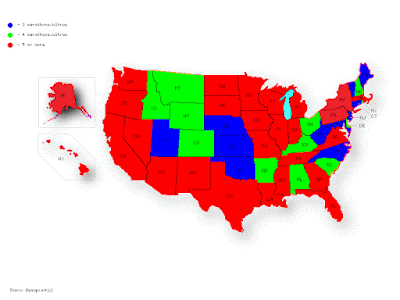
I’ve run (or walked) at least three marathons or ultras in every state.  I’ve completed at least four marathons or ultras in 49 states.  To complete a fourth circuit of 50 states, I need to finish another marathon in 11 states.

My long-term goal is to eventually finish five circuits of 50 states.  I’ve already finished five or more marathons or ultras in 27 of them.  That leaves 23 states when I need at least one more marathon to complete this goal.

There was a time when I raced through goals like this one as quickly as I could.  Now I’m a little more patient.  Running marathons is a lifestyle, and I expect to keep doing it as long as I can.  I’m not in a rush to complete this goal, but I want to keep making progress.  In 2022, I’d like at least one third of my marathons to be in states I need to complete a fourth or fifth circuit.  If, for example, I run 24 marathons in 2022, eight of them should be in states that I still need.

Here’s a map of my progress so far.