Sunday, December 5, 2021

Race Report: 2021 Rehoboth Seashore Marathon

On December 4, I ran the Rehoboth Seashore Marathon in Rehoboth Beach, DE.  When I ran this race in 2013, it was my 200th marathon or ultra.  This time, it was my 446th.  It’s hard to believe I’ve run or walked 246 marathons or ultras in eight years.  That’s an average of 30 per year.

There aren’t any major airports in Delaware, so I flew to Philadelphia and drove from there.  I had a morning flight on Friday, but I got up much earlier than necessary.  I woke up a little after 1:00 and couldn’t get back to sleep.  At 4:00, I finally got up and ate breakfast.

Two weeks ago, I injured my lower back.  Because of that, I made a last-minute decision to repack my bags.  I usually carry a small soft-sided suitcase that fits easily into the overhead bin on the plane.  I don’t usually mind carrying it, but having that extra weight on one side wasn’t going to be good for my back.  I used a roller bag instead.

I arrived in Philadelphia around 11:00, and I was in my rental car 20 minutes later.  I decided to skip lunch and start driving to Rehoboth Beach.  The drive took about two hours.

I’m most apt to notice soreness in my back first thing in the morning or after sitting for too long.  I felt fine after my flight, but I noticed a little discomfort after two hours sitting in the car.

I stayed at Hampton Inn, which is about four miles from the waterfront.  After checking in and unpacking a few things, I drove into town to pick up my race packet at Rehoboth Beach Running Company.  While I was in town, I bumped into my friends, Cade and Karen, and we stopped by Dogfish Head Brewery & Eats for beers.  I was tempted to order a pizza, but it was already 2:00, and I was expecting to eat a big dinner later.  Instead, I opted to have a bowl of chowder to tide me over.

After walking around town a little, my back was feeling better.  Then I went back to the hotel to organize my clothes for the race.  Later, I drove back into town to have dinner with five other runners at an Italian restaurant near where the race starts.  That gave me an opportunity to see where I should park in the morning.  The portions at the restaurant were huge.  I didn’t finish it all, but I still felt like I overate.

I needed to get up early, so I tried to get to sleep early.  At first, I couldn’t get comfortable, because I had too much food in my stomach.  I eventually nodded off, but woke up again, because I was hot.  Sometimes, after a big dinner, my metabolism will rev up a few hours later.  I folded back the blanket, but it took a long time to cool down again.  I fell asleep a few more times, but never for more than 10 minutes at a time.  I got a lot of rest, but very little actual sleep.

The race started at 7:00, but I needed to drive into town and park.  I left the hotel at 5:45 with a goal of finding a parking spot by 6:00.  The start and finish were about a mile apart.  I was able to find street parking about halfway between them.  I waited in the car to stay warm for as long as possible.  Then I took off my warm-up pants, walked to the start, and made a bathroom stop.

For the last two weeks, I’ve been unsure whether I would run or walk this race.  I was originally planning to race-walk it, but that was before I injured my back.  Prior to the Philadelphia Marathon, I was doing most of my walking at a pace of 11 minutes per mile, and I was working on increasing my turnover rate.  I sometimes got my cadence as high as 180 strides per minute.

Walking with such a fast turnover puts a lot of rotation into my lower back.  I suspect this injury started with walking too vigorously and was made worse by the impact of running during the Philadelphia Marathon, which included a few hills.

The day after the Philadelphia Marathon, my back hurt whenever I tried to move.  By the next day, I was already feeling much better, but I was cautious about returning to training.  In the next few days, I only ran or walked on the treadmill, and I limited my workouts to only three or four miles.  When I walked on the treadmill, I kept my pace between 13 and 14 minutes per mile.  That’s as fast as I could go before noticing significant rotation in my lower back.  When I ran, I set the incline to two percent, so I could reduce the impact of running by only running uphill.  That all went OK.

Next, I started doing outdoor workouts.  Some were continuous walking.  Others were a run/walk mix, where I only ran the uphill portions, and I walked everywhere else.  I had mixed results with the run/walk workouts, but the walking workouts went badly.  Even though I was trying to holding back on my pace, I still kept walking too fast.  I always felt OK at the time, but I would wake up with back pain the next morning.

In the last few days, I’ve been taking it easy.  I haven’t done any running, and the only walking I’ve done has been at a casual pace.

For the race, I didn’t know if running or walking would be harder on my back.  The concern with running was the impact.  This race has very little elevation change, so I didn’t have to worry about running downhill.  I wasn’t sure how bad running on level ground would be.  With walking, the concern was putting too much rotation into my lower back.  I would probably be OK if I could keep my pace slower than 13 minutes per mile, but I find it difficult to do that consistently when I’m not using a treadmill to regulate my pace.

The temperature was in the 40s.  That’s not bad for running, but it’s a bit chilly for walking, unless I’m walking fast enough to work up a sweat.  For that reason, I decided to start out running, at least until I was warmed up.

I bumped into several people I know in the start area.  David Shannon was lined up right near me, so I started the race with him.

photo credit: David Shannon

It always takes a minute or two for everyone to get up to their pace.  During that time, I ran with a stride that was more of a slow shuffle.  I felt like I was doing a good job of minimizing impact by barely clearing the ground.  As the people in front of us sped up, David got up to his pace.  I wanted to keep running with him, so I accelerated slightly and adopted a more conventional stride.  So far, I wasn’t noticing any discomfort in either my lower back or my right knee.

I never looked at my watch, but when we finished the first mile, David told me our pace was 9:37.  That’s very close to the pace I ran during the New York City Marathon.  It’s much slower than the pace I ran more recently in the Philadelphia Marathon, yet it felt more tiring.  I definitely wasn’t feeling as strong today as I was two weeks ago.  That may have been the result of two straight nights without much sleep.  Sometimes you can shake that off.  Sometimes you can’t.

The first two miles of the race were a loop through the heart of the city.  Then we turned onto the Rehoboth Beach boardwalk.  Last January, I ran a marathon that included long sections of boardwalk, and running on that surface really bothered my right knee.  I think it’s because the wood was slightly springy.  My knee is doing much better now, but it’s not 100 percent.   I didn’t want to risk aggravating it by running on this surface.  I also didn’t know if running on the boardwalk would be harder on my back.  For those reasons, I switched to walking as soon as I got to the boardwalk.  I told David to go ahead without me.

When I’m cold, I have a subconscious tendency to walk faster.  Now that I was warmed up, that was less of a danger.  I was able to switch to walking without going too fast.  At this point, it felt like a rest break from running, which made it easier to keep from going fast.

I had my phone with me, and I stopped to take pictures of the boardwalk and the coast.  The occasional stop helped keep me from starting to pick up the pace.  I was walking at a slightly brisk pace, but I wasn’t going fast.  I wanted to keep  it that way.


While I was walking, I saw a few friends go by.  I also saw two pace groups go by.  First, I was passed by the 4:20 group.  Later, I was passed by the 4:35 group.  When I reached the end of the boardwalk, I resumed running.  I was running by myself now, so I adopted a slower pace than before.

When we left the boardwalk and got back onto city streets, there was a chip mat and a large digital clock.  A guy there said this was the split for our first 5K.  Looking down the road, I saw a sign for three miles.  If we weren’t to the three mile mark yet, we couldn’t have finished 5K.  Farther down the road, I saw a 5K sign.  Clearly, the chip mat wasn’t measuring our 5K split.  It was probably there just because it was a major turn on the course.  I’m not sure why they had a clock there.

We quickly turned onto another street, and began a long out-and-back section.  I immediately saw runners coming back.  These were the fastest runners in the half marathon.  They had a much shorter out-and-back than the marathon.

Now that I was running again, I started getting sweaty.  I considered taking off my jacket, but it was easier to take off my gloves.  I kept the jacket on for a few mile miles.

I eventually caught up to the 4:35 group and passed them.  I also caught up to David.  I had expected to pass the 4:35 group now that I was running again.  I wasn’t expected to catch up to David this soon.  Then he told me he had made a bathroom stop.

I wasn’t noticing any discomfort in either my knee or my lower back, so I decided to keep running until I had a reason to walk.  Earlier, I considered running until I started getting hot and then taking a walking break until I cooled off.  Now that I was running with David again, I was inclined to stay with him.

After about five miles, we turned onto a trail, which quickly gave us views of this pond.


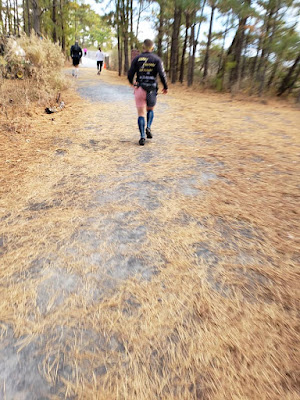
At first, I couldn’t tell if it was firmly packed gravel or if it was pavement that was covered with a thin layer of grit.  Eventually, it became clear that it was the former.  Then I started to notice pine needles as we ran through some trees.

After another mile, we reached something that looked like a bridge.  The surface was different from the boardwalk we ran earlier, but it had wooden supports, so I assumed it might be a bit bouncy.  Now I had a reason to walk.  I told David I was going to walk it, and he went ahead.  What I thought was a bridge was a walkway over a marshy area.


I was still wearing my jacket, and it was clear that I would eventually need to take it off.  Since I had slowed to a walk, I took the opportunity to take off my jacket and tie it around my waist.

The walkway turned out to be much longer than I expected.  As I continued across, I saw views like this.


The 4:35 group passed me again.  I assumed I would play leap frog with them.  They’d pass me whenever I was walking, and I’d catch up to them when I resumed running.

By the time I reached the end of the walkway, my hands and arms were getting cold.  I assumed they would warm up again when I resumed running.  My arms did warm up, but even after I resumed running, my hands remained cold.  I had to put my gloves on again.

Around the eight mile mark, I ran through Fort Miles.  This is a coastal fortification that was built during World War II.  Now it’s a historic site.


As I left Fort Miles, I was back on firm pavement, but there was a section that was noticeably downhill.  Most of this course is flat, but it’s not entirely flat.  On this downhill section, I briefly switched to walking.

I was still three miles from the end of this out-and-back section, but I was starting to see runners coming back.  At first, I saw the lead runners.  Over the next few miles, I would also see several of my friends, who were running at a faster pace.

Somewhere around nine miles, I passed the 4:35 pace group again.  I was running faster than they were, but it took two miles to make up the time I lost when I was walking.  After another mile, I caught up to David again.  After that, I ran with David for the rest of the race.

Just after the 11 mile mark, we reached the turnaround.  We were within sight of this tower.  I'm not sure, but I think this used to be used for spotting artillery fire.  I saw a similar tower in Fort Miles.

Before, I was seeing everyone who was faster than me.  Now, I started to see the runners who were slower.  I eventually saw almost everyone I know who was at this race.

David came here with a large group of runners from Minnesota.  Whenever he saw someone he knew, he stopped to take a picture.  Usually, I took a short walking break until he caught up to me.  One time, I was about to start walking when I noticed our friend Karen just ahead.  I ran just a little bit faster, so I could catch up with Karen.  We ran together until David caught up to us.  Then the three of us ran together.

photo credit: David Shannon

When we ran through Fort Miles again, I asked David if we had gone through the halfway mark yet.  We did, but I never noticed it.  I didn’t have a time goal, but I always like to make note of my halfway split, so I know if I sped up or slowed down in the second half.  We were almost to 14 miles already, and neither of us made note of our halfway split.

So far, I hadn’t noticed anything on the trail that I could trip on.  Then suddenly, I caught my left foot on something.  I never saw it, but it felt just like hitting a root.  More likely, it was a small rock embedded firmly in the dirt.  It caused me to pop up a little and come down hard on my right foot.  I didn’t fall, however.   A hard landing like that is the sort of thing that could be hard on my back or my right knee, but neither one felt any different.  That was a good sign.

When we got back to the walkway over the marshy area, I switched to walking again.  David walked with me, but Karen went ahead on her own.  We didn’t walk all that briskly.  We walked at a normal pace.

When we got done with the walkway, we resumed running.  Before long, I caught my left foot on something again.  I never saw anything sticking out of the trail, but it felt the same as last time.  Whatever I hit was embedded firmly.  Once again, I was thrown off balance and landed hard on my right foot.  Once again, it didn’t seem to bother my back or my knee.

We eventually turned off the trail and back onto pavement.  We still had two more miles before finishing this out-and-back section.  These miles were uneventful, but I was getting hot, so I took off my gloves again.

At 19 miles, we passed the point where we originally started the out-and-back.  We turned onto Henlopen Avenue which skirts the northern edge of the city center.  I commented to David that I was surprised the 4:35 pace group didn’t pass us earlier, when we were walking.  He said, “They did.”  Apparently, a whole group ran past us and I somehow didn’t notice.  Now I wondered if we would catch them again.

David needed to mix some Nuun powder in his water bottle, so we took a short walking break.  When we resumed running.  Eventually, we reached a corner and saw Karen.  She needed to make a bathroom stop, and that allowed us to catch up to her.  The three of us ran together again, although we would eventually get separated going through an aid station.

We crossed a bridge over the canal and entered a residential neighborhood.  In the city center, many of the businesses had Christmas displays.  Here, some of the houses were decorated.  This one caught my eye.


We continued on city streets for about another mile.  Then we started another out-and-back section on a trail.  At first, the trail seemed similar to the one we were on before.  We ran through some trees, and I noticed lots of dry leaves on the trail.  Leaves make me nervous, because they can hide rocks or roots.  Then I remembered that I had yet to see any trip hazards on this trail.

We emerged from the woods.  With no leaves on the trail, it looked nice and clean.  A minute later, I tripped on something.  This time I didn’t keep my balance.  I tumbled onto the trail, rolling over my right side and onto my back.  David stopped to help me up.  My hands were dirty, and they felt like I scraped them.  I looked at my hands but didn’t see any blood.  I told David I needed to walk for a minute before we resumed running.

After we started running again, I glanced at my right elbow and saw some blood.  I also noticed some slight discomfort on the left side of my right kneecap.  Apparently, I banged my knee as I hit the trail.  The knee discomfort I felt now was different from what I’ve felt in the last year.  That seemed like good news.  What I didn’t want is for the old and familiar pain to suddenly get worse.

Having fallen, I paid much more attention to the trail.  Some parts were clean, but other parts had embedded rocks.  I needed to start watching for them.  I became even more wary of leaves that could hide them.

We had to run another two miles before reaching the turnaround point.  Just before we got there, I saw the 4:35 pace group coming back.  They weren’t that far ahead of us.  I wondered if we could catch them.  I asked David how much energy he had.  He said the pace we were running was all he had.  I gave up on catching the 4:35 group.  That’s just as well.  Pouring it on in the late miles might be harder on my back.

On our way back, we were constantly talking.  I enjoyed our conversation, but I think it was taking my attention off the trail.  Before long, I tripped and fell again.  I was really regretting not wearing gloves.  I once again felt painful scrapes on my hand, but there wasn’t any blood.  I noticed more blood on my right elbow.  I felt some minor pain on a different spot on my right knee.

David stopped and heled me up again.  For the second time, I needed to walk for a minute to regain my composure.  Then we resumed running.  After that, David occasionally reminded me to watch my footing and pick up my feet.

We were almost to the end of the trail section.  I thought I was home free.  Then I tripped and fell again.  Each time this happened, I felt more embarrassed than the time before.  David helped me up again and asked me if I wanted to walk.  I just wanted to start running again.

It's worth noting at this point that this isn’t a rugged trail.  It was mostly flat and a good solid surface to run on.  There’s weren’t any roots.  There were spots where there were small rocks embedded in the trail surface, but they never protruded more than about a quarter of an inch.  Trail runners would consider this to be a road race.

I don’t know anybody else who fell during this race.  It was just me.  Over the years, I’ve developed a stride that’s efficient for road running.  My feet barely clear the ground.  When I’m on roads, it serves me well.  I don’t have much wasted energy.  All my motion is forward, with no wasted vertical motion.  Unfortunately, it’s not a good stride for trail running.  My feet hit everything.

Early in a race, I can adapt and pick up my feet.  Late in a race, when I’m fatigued, I fall back into old habits.  All three of my falls came late in the last four miles of the race.  In retrospect, I probably should’ve walked this section of the course.  My falls all occurred over a span of about two miles.

When we got back onto pavement again, I breathed a sigh of relief.  We had about two miles to go.  We were both tired, and I had some sore spots, but we just needed to put one foot in front of the other for about 20 more minutes.

With less than a mile to go, we crossed the canal again.  The first time we crossed it, we were on the sidewalk.  Coming back, we were in one of the driving lanes.  The middle part of the bridge has a steel grate surface.  I had to watch my step carefully to make sure I didn’t trip.  This type of surface is treacherous, and it would really hurt to fall here.  We slowed down a lot, but we made it across the bridge without incident.

We had to negotiate a few more turns, but then we saw the finish line.  We crossed the line at about the same time.  I haven’t seen the official results yet, but according to my watch, I finished in 4:38:02.  David finished with the same time.

After crossing the line, we each got a heat shield.  It was sunny now, and the temperature was several degrees warmer than when we started.  It was still nice to have the heat shield.  It meant I wouldn’t need to get any clothes from my car before going to the party tent.

The finisher medal had a similar design to other years, but it was larger, and it included the shape of Delaware.


They had an impressive spread of post-race food.  In the middle of the street, they had a tent with two buffet lines.  Hot foods included, waffles, bacon, sausages, biscuits & gravy, hot dogs with warm buns, meatballs, macaroni & cheese, and at least three other items I can’t remember.  Outside the tent, there was a table with cold items, including potato chips, bananas, Coke, and water.

After getting our food, we headed for the party tent.  At packet pickup, we each received a wristband.  You needed the wristband to get into the tent.  Each wristband had three coupons for free beers.  At the far end of the tent, they had a table with an assortment of beers and hard seltzers.

We found a place to sit down and made our way to the beer table.  To get there, we had to navigate through a huge crowd of people who were rocking out to the music.


Eventually, we were joined by most of the friends we had seen that weekend.  Several of were 50sub4 club members, so we took a group photo.

photo credit: Sadie Smith

As I ate my food and drank by beer, I became more aware of my injuries from the three falls.  I noticed a patch of dried blood on the right side of my knee.  I was wearing tights.  The tights didn’t appear to be torn.  The blood soaked right through it.  I noticed a dirty smudge on my T-shirt in same spot where I had a sore spot on my shoulder.  I’d have to wait until later to see if the skin underneath was scraped.  I also noticed some discoloration on the palm of my left hand, going all around my thumb.  Neither hand had scrapes that were bleeding, but I appeared to have some deep bruising on my left hand.  Did I mention I should’ve kept my gloves on?

I heard the DJ announce that one of the runners did her 50th half marathon.  I wondered if he had  any idea that several of us had run hundreds of marathons.  In particular, Cade ran his 300th marathon at this race.  Julia made sure they knew, and one by one, we all had our names and accomplishments announced.

I was at the post-race part for about two hours, but eventually I needed to go back to the hotel and clean up.  Here are pics of the scrapes on my right elbow, knee, and shoulder.  These are all superficial wounds that’ll be fine in a day or two.


This is what my left hand looked like.  It was somewhat sensitive to pressure.  I’m not sure how long that will take to heal, but it doesn’t seem like a big concern.


After taking a bath, I did some stretches that I do every day.  When I stretched my right quadricep, I felt some discomfort in my right knee.  That was something new.

Later in the day, I had dinner at Cooter Brown’s with most of the other runners I had been hanging out with this weekend.  When I walked up the stairs, I noticed some discomfort in my knee.  I’m hoping that proves to be a short-term symptom of today’s falls and not a setback in healing from the old knee injury.  Only time will tell.

Before dinner, I wasn’t noticing any discomfort in my back.  After sitting down in the restaurant, I noticed my lower back when I got up again.  I’ll need to keep an eye on that.

Saturday night, I slept like a rock.  The exhaustion finally caught up with me.  That’s usually how it goes the night after a race.  When I got up, I started taking inventory of my various sore spots.  My various scrapes had scabs, but those will heal.  There’s a small bruise on the tip of my elbow, but that’ll also heal.  My left palm was still sensitive to pressure, but no worse than it was right after the race.

I noticed some minor discomfort on one side of my lower back as I moved around, but it wasn’t any worse than what I’ve been feeling for the last two weeks.  On the drive back to Philadelphia, I noticed my back a little, but only for the first 30 minutes of the drive.

When I got to the airport, it brought back memories of how my back felt the day after the Philadelphia Marathon.  I felt worlds better this time.  I’m cautiously optimistic that my back is no worse now than it was before the race.  I’ll train cautiously so it can continue to heal.

I’m more concerned about the knee.  It’s too soon to say whether this will be a setback to my recovery.  I’ll have a better idea in the next few days.


Race Statistics
Distance:  26.2 miles
Time:  4:38:02
Average Pace:  10:36
Lifetime Marathons/Ultras:  446
Delaware Marathons:  4

Monday, November 22, 2021

Injury Report: I Tweaked My Lower Back Again.

I guess it’s a sign of my age.  It seems like I post injury reports almost as often as I post race reports.  I tweaked my lower back again.

I first noticed it yesterday morning, as I was waiting for the start of the Philadelphia Marathon.  I felt some minor discomfort around my right hip.  At the time, I thought I just had some tight muscles.  It was in the same area where I experience soreness in my hip after a vigorous race-walking workout.  I was glad I was running instead of race-walking, because running wouldn’t put the same strain on those muscles.

It never bothered me during the race.  I also didn’t notice it later in the day.  I was only aware of some stiffness in my right knee after the race.

The next time I noticed it was during the night.  Getting in and out of bed, I felt some soreness in my lower back.  It was worse this morning.  There’s soreness on the right side of my lower back, and sometimes on my right hip.

I’ve had these symptoms before.  It’s similar to the symptoms I had last May, although that was worse.  In May, I also had tingling on the right of my right leg.  Most likely, I have a disk protrusion in the lumbar region, and it’s impinging on a nerve root.  I felt it just walking back and forth in my hotel room.

I was originally planning to take a train to the airport this morning.  I already wasn’t looking forward to walking up and down steps in the train station, because I knew that would be hard on my right knee.  Now, I was more concerned about walking to the train station carrying a suitcase in one hand.  Carrying extra weight on one side would have me off-balance, putting more strain on my lower back.

In all likelihood, that’s how I injured it.  On Saturday, I was carrying my bag on one side while walking through airports, train stations, and on the walk to my hotel from the train station.  The impact of running hard for 26.2 miles probably made it worse.

Instead of taking the train, I took a taxi to the airport.  That not only spared me from walking to the train station with my luggage, but also spared me from having to walk up and down and stairs.  When I got to the airport, I was all too happy to check my bag, so I wouldn't have to carry it around through the airports.  It's bad enough that I was still supporting the weight of my backpack.

I already know what exercises to do while I’m recovering from this injury.  I’ll start doing them as soon as I get home.  It shouldn’t take too long to recover, but it’s going to have some impact on training and racing.

The short-term impact is that I’ll have to back off on the intensity of my race-walking.  The faster I walk, the more rotation I put into my lower back.  I’ll still do some walking, but I won’t go as fast.  It’ll be more about getting exercise than training to go fast.

I’m less sure about how it will affect my running.  Already, I was limiting myself to only running uphill in training.  I’ve been doing that to lessen the impact on my knee.  It also limits the impact on my spinal column.  Maybe that’s enough.  If not, I’ll take a break from running.

My next race is in two weeks.  It’s a race with a nice flat course.  I was planning to race-walk it.  I’ll probably still walk, but I might back off on the pace.

Two weeks after that, I’m doing a downhill race.  That will involve much more impact on both my knee and my back.  I don’t think I can walk that course.  Walking on that downhill grade would be awkward.

I scheduled the downhill race to give myself an opportunity to qualify for the 2023 Boston Marathon.  I was a bit concerned about it being hard on my knee.  Now I’m also concerned about it being hard on my lower back.  If there’s good news, it’s that I no longer need a Boston qualifier.  I qualified yesterday in the Philadelphia Marathon.  I’m not sure how that race will go, but it’s still four weeks away.  The last time I tweaked my lower back, I was much better after four weeks.  Only time will tell.

Sunday, November 21, 2021

Race Report: 2021 Philadelphia Marathon

On November 21, I ran the Philadelphia Marathon.  I’ve done this race twice before, but the last time was way back in 2014.

I flew to Philadelphia on Saturday and took a train into town from the airport.  Before walking to my hotel, I stopped for a slice of pizza at Rex Pizza, which was on the way.  My hotel was in the city center, so I was able to walk everywhere I needed to go.

When I got to my hotel, they didn’t have any rooms ready, so I checked my bags and went for a walk.  I started by walking to the Philadelphia Museum of Art, which is close to where the race starts and finishes.  There’s a scene in Rocky II where Rocky goes for a run.  He’s shown running through various neighborhoods in Philadelphia.  The scene ends with Rocky sprinting down Benjamin Franklin Parkway and running up these steps.


In Rocky III, there’s a scene where the city unveils a statue of Rocky.  That statue now sits near the base of the steps.  On marathon weekend, the race organizers sometimes make an extra large version of the race T-shirt and put in on the statue.  They didn’t do that this year.


On my way to the museum, I passed the Rodin museum and this fountain.


On my way back, I walked through Love Park, where they had a Christmas village.


Finally, I went by city hall.


When I got back to the hotel, they had a room ready.  After checking in, I went to the expo to pick up my race packet.

This race was limited to runners who have been vaccinated for COVID-19.  To verify vaccination status, they used CrowdPass.  About a month ago, I received an email with an event ID.  I unloaded a copy of my vaccination card and received an email form CrowdPass with a QR code.  I needed to show that QR code at the expo to pick up my race packet.  Alternatively, I could’ve shown them my vaccination card, but the QR code was easier.

Later, I had dinner with my friends, Julia and Shane.  As early as Thursday I tried to make a dinner reservation, but all of the downtown restaurants were booked until at least 9:00.  We were hoping to eat at 6:30.  We had dinner at Iron Hill Brewery & Grill.  They don’t take reservations, but you can go online to put your name on the waiting list.  I put us on the list at 5:30, with hopes that we could be seated at 6:30.  For a while, it looked like we might have to wait until 7:15 or later, but we ended up getting seated just after 6:30.  They have a varied menu that includes pizza.  Also, it’s a brewery, so they have a variety of beer.

I went to bed early.  I didn’t sleep perfectly, but I got enough sleep to feel OK.  That’s all I can hope for the night before a race, when I’m sleeping in a hotel.

When I registered for this race, I assumed I would be race-walking.  It was only in the last few days that I decided to run it instead.  The weather played a big part in that decision.  It was a cold morning, with an overnight low in the upper 30s.  I thought I would be warmer if I ran.  If nothing else, I would finish sooner, so I wouldn’t have to spend as much time on the course.

Because I originally thought I would be walking, I estimated a slow finish time when I registered.  At the time, my fastest walking marathon this year was 5:15.  There was a colored band on the side of each race bib that indicated our corral assignments.  Mine was blue.  I had to look at a map of the start area to find out where that was.  There were eight corrals, and blue was the slowest.


The race started at 7:00.  I got up at 5:00, so I could be ready to leave the hotel by 6:00.  I didn’t have much time for breakfast.  I just had a few sips of Coke and a mini-muffin, which I ate while walking to the start.

I had to walk more than a mile to get to the start area.  When I got there, I saw an information desk, so I asked if I could get my corral assignment changed.  I was told that corral assignments weren’t enforced.  I could line up anywhere I wanted, except for the gold corral, which is where the elite athletes were.  I didn’t know which corrals corresponded to which times, but I knew Julia was in the green corral, and she usually runs marathons in 4:30.  I decided to start in the green corral, which was the fourth one.

Before making my way to the green corral, I had to get through three lines.  The first one was the security line, where they had to inspect everyone’s bags and screen everyone with a metal detector wand.

Next, I had to get through the gear check line.  There were about a dozen trucks for checking bags.  At most races, the trucks are either organized alphabetically by runner’s name or numerically by bib number.  At this race, all the trucks were interchangeable.  I noticed one of the trucks had a line that was much shorter, so that’s the line I got in.  I didn’t know it at the time, but that would later prove to be a mistake.

After checking my gear bag, I still had to get through the line for a port-o-potty.  Then I had to make my way to the green corral.  Without knowing the cutoff between that corral and the one in front of it, I decided to line up in the front of the green corral.

I wore tights, a T-shirt, arm warmers, gloves, and a warm hat.  Basically, I wore the same cheetah outfit I wore for the New York City Marathon, but I added arm warmers.  To stay warm on the walk from the hotel, I also wore my  poncho from the New York City Marathon.  After taking that off and checking it in my gear bag, I expected to be cold.  Surprisingly, I felt fairly comfortable standing in line for the port-o-potty and standing in the start corral.  After the national anthem, I heard some pre-race announcements, and then the gold corral started. 

The other corrals were staggered by two minutes each.  Before the red and black corrals started, I heard announcements calling out a few runners in those corrals who were in costume.  One was dressed as Santa.  Another was an elf.  As my corral moved into place, I heard mention of a cheetah.  At first, I didn’t know where the announcements were coming from.  Then I looked to my right as saw that I was right in front of the announcer, who was joined by well-known runners, including Meb Keflezighi, Bill Rodgers, and Bart Yasso.  I didn’t expect to get mentioned in pre-race announcements, but I’m pretty sure the announcer was referring to me.

I didn’t have an ambitious time goal.  I ran the New York City Marathon in 4:12:42, so I thought it would be nice if I could go a couple minutes faster than that.  That seemed like an easy goal.  This was an easier course, and I wasn’t planning to stop to take pictures.

As I started running, I immediately felt cold.  Usually, on a cold morning like this, I’m cold before the race starts, but I warm up after I start running.  This was the opposite.  I didn’t notice the cold breeze until I started running.  I warmed up eventually, but I was freezing for the first two or three miles.

The race starts on Benjamin Franklin Parkway.  Looking ahead, you have a clear view of City Hall.  The only time it wasn’t directly in front of us was when we went around the fountain at Logan Square.

I quickly got the sense that I was starting fast.  I think there were two reasons for that.  The first was the way I’ve been training lately.  About half of my training has been race-walking.  The other half is running.  When I race-walk, I try to keep my cadence as rapid as possible.  When I run, it’s either continuous running on a treadmill or a run/walk mix outside.  On the treadmill, I’m always running slightly uphill.  Outside, I only run the sections of my route that are uphill.  Where it’s flat or downhill, I race-walk.  I’ve been doing this to minimize the impact that my knees need to absorb.

Running uphill, I generally take short strides with a rapid cadence.  Running on level ground, I found myself taking longer strides, but I still had a rapid cadence.  That caused me to go faster than I do in training.

Another reason I started fast is because I was surrounded by faster runners.  Green may have been the right corral, but I probably lined up too far forward in that corral.  I wasn’t trying to keep up with the runners around me, but when everyone around you is running fast, it tends to skew your perception of how fast you’re running.

When we reached Love Park, we made a slight left onto Arch Street.  As we passed City Hall, the next neighborhood we ran through was Chinatown.  From there, we continued east, toward the Delaware River.

I never saw the one mile sign, so I didn’t check my pace until I finished the second mile.  I ran the first two miles in 16:35, which is an average of 8:17 per mile.  That’s more than a minute per mile faster than my average pace in the New York City Marathon two weeks ago.  As I started the third mile, I told myself to relax and let myself drift back through the pack, rather than keeping up with the runners around me.  That proved to be easier said than done.

As we started the third mile, we were running downhill toward the river.  It’s hard to slow down much when you’re running downhill.

When we turned onto Columbus Boulevard, the course leveled out.  Then I reached an aid station.  I was still cold, so I didn’t feel any need to drink anything yet.  I stopped to drink some Gatorade anyway.  Stopping briefly and then restarting gave me a chance to hit the reset button on my pace.  As I resumed running, more of the runners around me were passing me.

My pace in mile three wasn’t really any slower than the first two miles.  I attributed that to that mile being partially downhill.  Still, the next time I reached an aid station, I walked briefly while drinking Gatorade, and I tried to hit the reset button again.

Whenever I wear the cheetah gear, I get lots of shout-outs from the crowd.  I also get comments from other runners.  At least twice per mile, another runner would say they loved my outfit.

Running through the historic district, I only had a vague sense of where I was.  I could tell I was running through older neighborhoods, but I wasn’t looking for landmarks.  I was more aware of the crowds.  They were starting to get thick here, and they were making noise for us.

I never noticed the sign for four miles.  When I got to five miles, I noticed that my average pace had slowed, but not by that much.  It occurred to me for the first time that I was running fast enough to qualify for the Boston Marathon.  For my age group, the qualifying standard is 3:50, which is an average pace of about 8:46.  My average pace so far was just a little slower than 8:30.

It's getting increasingly common for spectators at races to hold homemade signs.  Some are made to encourage specific runners.  Others are humorous or meant to be encouraging to anyone.  As we ran back through the city center, I noticed a sign with pictures of cats on it.  As I turned to read it, I saw it read, “Big Cat Energy.”  I was dressed like a big cat, so I waved.

Just before seven miles, we crossed the Schuylkill River.  We would remain on the west side of the river for almost six miles.  This course isn’t as hilly as the New York City Marathon, but the middle miles have some rolling hills.  The first hill comes between seven and eight miles.  After making a couple more turns, I saw the hill.  It wasn’t steep, but it was uphill for several blocks.

My average pace was gradually slowing, but it was still under 8:40.  I was still on pace for a Boston-qualifying time.  I wasn’t convinced that this pace was sustainable, but I also wasn’t convinced that it wasn’t.  I felt like I was putting some effort into my pace, but I never felt like the effort was going to break me.

Going up this first hill, I picked up my effort.  I was careful not to overdo my effort, but I also didn’t want to give back a lot of time by getting lazy on the hills.

After cresting the hill, I enjoyed a nice downhill section.  In New York, I had discomfort in my right knee after the downhill side of each bridge.  This was the first real test of how my knee would feel on hills today.  It passed.

I saw another spectator with a sign that caught my attention.  It read, “Run Like a Gazelle.”  Since I was dressed like a cheetah, I was tempted to say something like, “I eat gazelles for breakfast.”  I didn’t.  Ten years ago, when I was much faster, I might’ve been cocky enough to say that.”  I’m not as fast as I used to be.  I don’t feel like I’m fast enough to be wearing the cheetah gear, much less talking it up.  At best, I’m fast for my age.  I’m an aging cheetah, and I probably couldn’t catch a gazelle.

At nine miles, we began an out-and-back section that had a loop in the middle.  This part of the course didn’t look familiar.  I’ve run this race twice before, but the last time was seven years ago.  I knew the general layout of the course, but I didn’t remember all the details.  As it turns out, this section was new.

Going out, it started out downhill, but then turned uphill.  I realized I would have to do the same down and up later, but in the opposite direction.  I moved to the center of the street, so I could more easily look for people I know among the faster runners coming back.  I didn’t recognize anyone.  Then I started the loop through Fairmount Park

For the first time, I started thinking seriously about trying to sustain a Boston-qualifying pace for the whole race.  I wasn’t sure if it was a good idea to try.  If it was any other round number, such as four hours, I probably would’ve retreated into my comfort zone.  Qualifying for Boston is different.  I don’t have a qualifying time yet for the 2023 Boston Marathon.  If I could knock that off, it would take a lot of pressure off me in the coming months.  I didn’t know if it was possible, but if it was, I had to try.

For the next several miles, I felt like I had two voices whispering in my ears.  One was telling me I had to pick up my effort enough to stay on pace.  The other was telling me I had to ease up a bit and make sure I didn’t wear myself out.  I didn’t know which one to listen to.  I vacillated between the two.

Mile 11 was the first one that wasn’t on pace for a Boston qualifier.  I ran that one in 9:02, despite putting more effort into that mile.  Then in mile 12, I sped up to 8:05, despite relaxing a bit.  That was my fastest mile so far, although it’s worth noting it was a downhill mile.

After running the out-and-back part in the other direction, I crossed the Schuylkill River again.  The rest of the race would be on the east side of the river.  I was expecting it to be one long out-and-back that followed the river.  It wasn’t.  First, we had another section that included a short out-and-back, and had a loop in the middle.  This time, I was sure.  This was not part of the course I ran in 2012 or 2014.  I was expecting the rest of the race to be mostly flat, but this section had more gently rolling hills.

I reached the halfway mark in 1:53:36.  I was on pace for a Boston qualifier with almost a minute and a half to spare.  It’s worth noting however, that the first half of the race included some fast miles at the beginning.  I wasn’t expecting to have fast miles like that in the second half of the race.  At this point in the race, a Boston qualifier still seemed possible, but negative splits seemed unlikely.

One of two things was going to happen.  In one scenario, I would get more confident as I put more miles behind me.  The fewer miles I had left, the more likely I could sustain my pace.  In the other scenario, each mile would add a little to my fatigue, until I eventually reached my breaking point.  I’ve had both of these experiences in multiple races.  I didn’t know yet which way it would go today.  Maybe that’s why I love to race.  You can get halfway through a race and not know what you’re made of, but you always find out in the second half.

The end of this section was noticeably downhill.  In New York, I always adjusted my stride on the downhill sides of the bridges.  My only concern was minimizing the stress on my right knee.  This time, I had other priorities.  I ran down this hill for all it was worth.  I wanted to take advantage of the opportunity to pick up my pace.

Shortly before 16 miles, I turned onto Kelly Drive, which follows the Schuylkill River.  I only had 10+ miles to go, but I was finally on the long out-and-back I had anticipated.  I was mostly done with hills now.

When I reached the 16 mile mark, I saw I ran that mile in 8:10.  I couldn’t believe it.  That obviously improved my chances of staying on pace for a Boston qualifier, but I still had a lot of miles ahead of me.  I wasn’t confident yet.

I saw runners coming back on the other side of the road.  They had to be only about two miles from the finish.  They were about eight miles ahead of me.  I paid attention to the colored bands on the sides of their race bibs.  They were all either gold or red.  Those were the two fastest corrals.

Most of the runners coming back were men, but several were women.  I noticed three things about the women.  First, they were all wearing their most serious game faces.  They were racing hard.  Second, they all had gold bands on the side of their race bibs.  Third, unlike my race bib, which said, “blue,” theirs said, “elite.”  The elite men were past this point, but I was getting to watch the elite women race toward the final two miles.

Watching the faster runners briefly distracted me from my own pace and effort.  It was a welcome distraction.  I was still keeping up with the runners around me, but I wasn’t as conscious of how hard I was working.

When I got to 17 miles, I saw I ran that mile in 8:20.  That made two fast miles in a row.  I was comfortably ahead of the pace I needed, I was running just as fast as I did in the early miles, and I was almost two thirds done.  Now I believed!  For the rest of the race, I ran with confidence.  Now there was only one voice in my head.  I was racing for a BQ, and I would push hard to stay on pace.

As I continued along the river, I kept watching the runners coming back.  I spotted my friend Cade.  I knew he was here, but I didn’t know if I would see him this weekend.  As it turns out, he’s the only runner I recognized along the course.

I saw a group of spectators who were all dressed as different animals.  I thought, “These are my people.”  Then one of  them pointed at me and said, “He’s OK.”

I never noticed the sign for 18 miles.  When I got to 19 miles, I observed that miles 18 and 19 weren’t as fast as miles 16 and 17, but they were fast enough.  I also realized that I only needed to run nine minutes per mile the rest of the way.  That seemed like it should be easy.  Then I remembered that my fastest stretch during the New York City Marathon was between 5K and 10K, and that was an average pace of 9:01.

Before reaching the turnaround, we ran through Manayunk, where there’s always a beer stop.  I spotted several spectators on the side of the road offering beers.  Normally, I would indulge, but I was now racing for a BQ, and I wouldn’t do anything to endanger that.  Still, they didn’t make it easy to resist.  We had our names printed on our race bibs.  One guy looked at me and said, “David, you want a beer!”  Did I mention he was wearing horns?  I had my own personal demon, but I resisted temptation.

The crowds in Manayunk were great.  I needed that.  Looking ahead, I could see it was slightly uphill just before the turnaround.  I had to dig a little deeper, but then I was able to use the downhill coming back.

Before leaving Manayunk, I had to pass through the beer stop gauntlet again.  They were on both sides of the street.  This time, one looked right into my eyes and said, “You want a beer.”  I resisted temptation again.  I was on a mission.

With each passing mile, I recomputed the pace I needed the rest of the way to finish in 3:50.  With 3.2 miles to go, I just needed to average 10 minutes per mile.  I could afford to slack off, but I didn’t.  With 2.2 miles to go, I just needed to average 11 minutes per mile.  I could afford to relax, but instead I dug deep.  I was no longer racing to break 3:50.  Now, I wanted to break 3:47, and I was confident I could do it.  Why 3:47?  At the halfway point, I was on pace for 3:47:12.  I wanted to run negative splits to put an exclamation point on today’s effort.

The last mile was the only one that was truly difficult.  I was feeling the fatigue, but I didn’t want to let up.  I knew we had to run past the Philadelphia Museum of Art before reaching the finish line.  I kept looking for it, but I never saw it.  Amazingly, I got all the way to 26 miles, and I never saw the museum ahead of me.  Then I realized I was already running by it.  It was on my right.  All that was left was running the last 385 yards to the finish line.  It seemed longer, but I never let up.  I finished in 3:46:28.  I ran negative splits by almost a minute.

I got a space blanket, which I knew I would need.  I didn’t realize how much I would need it.  More on that later.

I got my finisher medal and walked through the food tent.  I had some orange juice, an energy bar, and a cup of chicken broth.  At another tent, I got a chicken hot dog.  Then I made my way to the gear check trucks.

Standard procedure is for the volunteers to sort the bags while we’re running the race.  After the race, you go to the appropriate truck and tell them your number.  Since the bags are sorted numerically, they can go right to your bag and hand it to you.

That’s how it’s supposed to work.  That’s how it worked at every truck but one.  The bags in truck #4 didn’t get sorted before runners started showing up to retrieve their bags.  The only way they could retrieve a bag on request was to go through every bag on the truck to look for one with a matching number.  That obviously doesn’t work.  There were hundreds of bags on the truck.

Remember when I got into the shortest line for a gear check truck?  Guess which truck it was.  That’s right, I picked truck #4.

When I got there, dozens of runners were already waiting for their bags.  The volunteers on the truck did the only thing they could do at this point.  They would pick up a bag and read off the number.  Does anyone have #358?  At first, they would call out several numbers before finding a bag whose owner was waiting.  As more and more runners made their way over there, the probability of a bag belonging to someone already waiting increased.  Still, it was a painfully slow process.  Several of us were waiting for well over an hour.

As some volunteers were handing out bags, other were trying to sort the remaining bags.  In time, it became possible for them to look for a specific number.  When they asked me the number of my bag, I said ,“131,” which was the number on the wristband they gave me.  More than once, I was told, “We don’t have a 131."  Are you sure you have the right truck?”  More than once, I doublechecked that my wristband said truck #4.

Eventually, one of the volunteers invited me to come into the truck.  He led me to the other end and confided that there were a few bags with no numbers on them.  Maybe the volunteer who collected my bag forgot to tag it with the number that matched the wristband she gave me.  Maybe the number fell off.  There were only a few bags without numbers, and I quickly recognized mine.

I was standing there in the cold for nearly an hour and a half before I got my gear bag.  The only thing that kept me from freezing was that space blanket I was wrapped in.  I started walking back to the hotel.  It was about a mile and a half, and I wasn’t walking as briskly as I was in the morning, but now I could wrap myself in my poncho, in addition to the space blanket.

While I was walking back, I was talking on the phone with Deb.  She could hear something jingling, and she asked me what it was.  It was my finisher medal.  The design included the Liberty Bell, and the bell had a working clapper.  The bell rang as I walked.


I finished the race before 11:00, but I didn’t get back to the hotel until 1:00.  I took a hot bath and did some stretches.  That helped, but my knee got stiff during the long wait for my gear bag.  It doesn’t hurt walking on level ground but it probably would hurt to go up or down steps.  Thankfully, I wouldn’t have to do any steps today.  I expect some soreness walking down the steps in the train station tomorrow.

The guys in Manayunk were right.  I did want a beer.  I just wasn’t willing to give up any time during the race.  Now that the race is over, I plan to visit a brewery after dinner.


Race Statistics
Distance:  26.2 miles
Time:  3:46:28
Average Pace:  8:38
Lifetime Marathons/Ultras:  445
Pennsylvania Marathons:  5
Boston Qualifiers:  149