Sunday, January 28, 2024

Race Report: 2024 Big Beach Marathon

On January 28, I ran the Big Beach Marathon in Gulf Shores, AL.  I’m making a push to finish a fifth circuit of marathons or ultras in every state, and this was my fifth marathon in Alabama.  As you might guess, Gulf Shores is on the Gulf coast, and it has a big beach.

I could’ve flown into either Pensacola, FL or Mobile, AL.  In 2021, I flew into Pensacola.  This time, I was able to get better flight times by flying into Mobile.  Either way, I needed to change planes in Atlanta.

I arrived in Mobile Saturday afternoon.  From there, it was a 90-minute drive to my hotel.  I stayed at The Lodge at Gulf State Park, which was the host hotel for the race.  Packet pickup for the race was at The Lodge.  I picked up my race packet first, and then checked into my room.

Most of the rooms at The Lodge have balconies.  I had a room facing toward the highway and Gulf State Park, but there were sitting areas on the other side of the hotel where I could get a beach view.  This is a view of the beach at sunset.

After picking up my race packet and checking into my room, I went to the fitness center to do a strength training workout.  I was originally planning to go into town for dinner, but it was drizzly, so I had dinner in one of the restaurants at The Lodge.

I was able to get to sleep early, but I woke up during the night and had trouble getting back to sleep.  I felt pretty rough when I got up, but I felt better by the time the race started.

The race started at 7:30 AM.  There’s parking near the start, but it’s limited.  I couldn’t remember how early I arrived when I ran this race before, so I got there an hour before the start.

The race starts and finishes next to an entertainment venue called The Hangout.  The last time I did this race, I was able to park in a lot right next to The Hangout.  This year, that parking lot was blocked off.  The nearby street parking was filling up quickly, but I was able to find a parking space about two blocks away.

All of my recent training runs have been in winter conditions.  Snow and ice on the streets has sometimes forced me to run at a cautious pace, and cold wind chills have sometimes forced me to bundle up like an Eskimo.  I’ve been getting in lots of mileage, but I haven’t done any training at race pace since December.  I have another race next weekend, so I decided to use this race as a tune-up.

I had been looking forward to running in temperatures warm enough for shorts.  The temperature on race morning was 50 degrees.  Normally, that would be warm enough for shorts, but there was a cold wind near the coast.  Instead of shorts, I opted for tights.  I was surprised how cold it was when I was walking to my car.  I wore short sleeves, but I made a last-minute decision to start the race wearing a Tyvek jacket, but I kept it open in front, so it didn’t cover my race bib.

I ran this same race in 2021, but the course is different now.  It used to be two loops.  Now it’s a single loop with some out-and-back sections.  Most of the course is paved, but there are sections of wooden walkways in Gulf State Park.  The starting line is also in a different place, this year, it was in between The Hangout and the beach.

I was expecting to have to wait in the cold to use a port-o-potty.  When I got to the start area, I discovered we could use the bathrooms inside The Hangout.  We could also wait indoors until it was time to line up.  It was crowded, but we were sheltered form the cold wind.

I wasn’t sure how fast I would run, but I saw a 4:00 pace group and lined up right behind them.  I didn’t know if I would run with them, but it seemed like a reasonable pace to start.

Going around the first turn, I was almost half a block behind the leader of 4:00 group.  I put in a little extra effort to catch up to him.  Within the first half mile, I caught up.  Then I spotted my friend Heather just ahead of the group, and I moved forward to talk to her.  I ended up running with Heather for more than seven miles.

For the first mile, we were on city streets.  We were running away from the coast, but I could still feel the cold wind.  In the second mile, we turned onto a paved trail that took us through the north side of Gulf State Park.  We had trees on both sides of us, so I didn’t notice the wind as much.  After about two miles, I took off my jacket and tied it around my waist.

Heather and I were talking and running just ahead of the 4:00 pace group.  In the early miles, we were averaging 9:00 per mile.  I was surprised how comfortable I felt at that pace.

We crossed a wooden bridge, and a short time later, we crossed another short section of wooden walkway.  The wood was wet from rain the day before, so it was a little bit slippery.  Other than that, these sections didn’t concern me too much.  There wasn’t much space between the boards, and these sections were short.  The sections that worried me came later in the race.

The aid stations all had water and Gatorade.  Usually, the volunteers handing out water were on the right and the ones handing out Gatorade were on the left.  I usually slowed to a walk briefly while drinking.

For about five miles, Heather and I were ahead of the 4:00 group.  Then, at one of the aid stations, we fell behind the group.  We continued to follow, close behind.

There was a half marathon that started at the same time as the marathon.  Just after the seven-mile mark, we came to a place where the two courses diverged.  Runners doing the half marathon turned right onto a trail that would bring them back to Gulf Shores.  Those of us doing the Marathon went straight and continued east toward the city of Orange Beach.

Heather needed to make a bathroom stop, so I continued on my own at the same pace.  I could see the 4:00 group a short distance in front of me, but I didn’t make any effort to catch up to them.  When I reached the eight mile sign, I saw that I was still on pace for four hours, even though I wasn’t with the group.  I continued running on my own, but I made a point of keeping them in sight.

Somewhere around nine miles, we reached the end of the trail we were on and turned onto the shoulder of a highway going through Orange Beach.

After about a mile along the highway, we turned onto another paved trail.  I knew there was going to be an out-and-back section soon.  As soon as I turned, I saw runners coming back from the other direction, so I knew this was it.

There were port-o-potties right at the beginning of this section.  I saw the 4:00 pace leader waiting to use one.  He had handed his “4:00” sign to someone else in the group.  I could still see the group ahead of me.

Before I reached the turnaround, I saw the 4:00 pace leader go racing by.  He was catching up with his group as quickly as he could.  I was still content to follow them from a short distance.

When I reached the turnaround, I was right behind the group.  Coming back, I started to fall behind them again.  I wondered if I was relaxing too much.  When I got to the 11-mile mark, I realized I was still going the same pace.  The group must have sped up.

A few minutes after the turnaround, I saw Heather going the other direction.  She was far enough behind me that I knew she wouldn’t catch up.  I started to gradually pick up my pace, so I could catch up to the pace group.

After I saw Heather, I saw a woman going the other way who was asking all the runners coming back which race they were in.  “Y’all doing the full?  You?  Full?”  I got the impression that she was doing the half marathon and had just realized that everyone around her was doing the full marathon.  I remembered where the two courses diverged.  She had already been on the wrong course for almost four miles.  Even if she turned around and backtracked to the turn she missed, she would still end up running almost 21 miles to complete the half marathon.  I’m not sure what she did.  It’s worth noting that the turn she missed was well-marked, and there were volunteers there telling us which way to go.  I don’t know how she missed it.

After the out-and-back section, we briefly ran alongside the same highway.  Then we turned onto another paved trail to come back through Gulf State Park.

At 12 miles, I was still trailing the 4:00 pace group, but I could see that I was more than a minute ahead of schedule.  They were going a bit fast.  By the end of the 13th mile, I had caught up to the group.  Now, we were even farther ahead of schedule.  At the halfway mark, we were almost two minutes ahead.

For almost half of the race, I was wearing gloves.  I don’t recall exactly when I took my gloves off, but coming back through the park, I started to feel the wind again.  My hands quickly got cold, but I didn’t put the gloves on.  I decided to wait and see if I warmed up later.

For now, I was running at the back of the pace group and making a point of not getting ahead of them.  I was conflicted about what my goal should be.  The obvious goal at this point would’ve been to stay with the group and rest of the way and break four hours.  Another goal I often set at the halfway point is to run negative splits (i.e., run the second half of the race faster than the first half).

The group wasn’t likely to run at this same pace for the rest of the race.  If they did, they would finish about three and a half minutes too fast.  It was more likely that they would slow down, so they came in closer to their target time.

I continued to run with the group, but I crept up to the front.  Just past the 14-mile mark, I heard the pace leader say, “we’ll be slowing down soon.”  That’s when I made up my mind.  I wasn’t going to slow down.  I would go ahead of the group with the intent of running negative splits.

I ran the next mile in 8:55.  That wasn’t much faster than before.  Our average pace in the first half was roughly 9:00.  My goal now was to run each remaining mile in 9:00 or faster.

I don’t like running by myself.  I prefer to have someone to follow.  I sped up enough to catch up to the next runner ahead of me.  Before I knew it, I had passed him.  Then I focused on catching up to the next runner.  This continued until I finished mile 16 and realized I had sped up to 8:23.  Oops.  I didn’t mean to run that fast.

I made a sharp turn, crossed a short wooden bridge, made another sharp turn, and reached an aid station.  I walked through the aid station while drinking some Gatorade.  That short walking break would’ve been an opportunity to reset my pace, but as I left the aid station, I couldn’t see the next runner in front of me.  I didn’t need to run as fast as my previous mile, but I wanted to run fast enough to get within sight of other runners.  I needed to have someone to follow, so I could tell if I was keeping up a consistent pace.  The irony is that I first had to run a pace that I knew was kind of fast.  I ended up running mile 17 in 8:30.

I was running in a different direction now, so I didn’t feel the cold wind any more.  This section of trail was out in the open, so I also started to notice the warmth of the sun.  My hands were no longer cold.

There were a couple of short sections of wooden walkway toward the end of mile 18.  Then there was a much longer one at the beginning of mile 19.  These were different from the earlier sections.  There were noticeable gaps between the boards.  I slowed to a more cautious pace and paid close attention to my footing.  In mile 18, I slowed to 8:47.  Mile 19 was 8:55.  I was happy with that.  I was still keeping my pace under nine minutes, even as I ran more cautiously.

Whenever I got back onto firm pavement, I picked up the pace and started chasing the runners in front of me.  For the next three miles, I averaged 8:40.

With just over five miles to go, I came back to the same junction where the marathon and half marathon routes had diverged earlier.  This time, instead of going straight, we turned right.  Now, I was headed back toward Gulf Shores, where we would finish.

The next long section of wooden walkway started right at 22 miles.  This one was more than a mile long.  There wasn’t a sign for 23, but when my watch gave me a split for that mile, it was 9:11.  I didn’t like slowing down that much, but navigating this section safely was more important than keeping up my pace.  I’ve been known to trip on surfaces like this.

To my right, I caught a glimpse of a pedestrian bridge going over Beach Boulevard, which is the coastal highway.  I mistook this bridge for one that’s right next to the entrance to The Lodge.  That led me to believe that this was the last section of wooden walkway.  When I reached the end of this section, I assumed the rest of the race would be paved.

As I got back onto firm pavement, I picked up my pace and resumed chasing the runners ahead of me.  The next mile took me through a campground.  I resumed my previous fast pace.

I was expecting to come out to Beach Boulevard, but we turned onto another section of wooden walkway.  It was long.  It didn’t seem familiar until I got to the last section, which went over water.

I saw another pedestrian bridge over Beach Boulevard.  This was the one by The Lodge.  I was shocked when I saw the runners ahead of me running up the wooden ramp to get to the bridge.  This was a significant climb.  This bridge definitely wasn’t part of the course that I ran in 2021.  The course I ran before stayed on the north side of Beach Boulevard.  This year, we crossed the bridge to get onto the south side of the road.

When I got off the bridge and down the ramp on the other side, I still had a mile and a half to go.  It would all look familiar.  It’s the same mile and a half that I drove in the morning, when I was on my way to the start.

In mile 25, I slowed to 9:03.  That was disappointing, but not surprising.  I was determined to run the last 1.2 miles as fast as I could.  The good news is that it was all flat and all paved.  The bad news is that it was all into the wind.

The wind was much stronger now.  Running into it wasn’t just cold.  It was tiring.  I fought hard all through the next mile.  I was pleasantly surprised when I saw my split for mile 26.  Despite the wind, it was my second fastest mile.  I ran it in 8:28.  I went on to finish the race in 3:52:45.  I was almost four minutes faster in the second half.

My pre-race goal was to use this race as a tune-up before attempting an all-out effort.  I think it went well.  In the first half, I learned that I can run comfortably at a 9:00 pace.  In the second half, I was running at a Boston qualifying pace.

Near the finish line, there was a sand sculpture on the beach.  People were posing behind it with their medals.  I just wanted a picture of the sand art.

Post-race food and beer was available just outside The Hangout.  The free food included wraps, cookies, potato chips, and gumbo with rice.  For friends and family, there was also food for purchase inside The Hangout.

After I finished eating, I spotted Heather in the finish area.  I went over to ask her how the rest of her race went.  Then I spent the next hour and a half talking with her and other friends inside The Hangout before eventually walking back to my car.


Race statistics:
Distance:  26.2 miles
Time:  3:52:45
Average Pace:  8:53
First Half:  1:58:17
Second Half:  1:54:28
Lifetime Marathons/Ultras:  504
Alabama Marathons:  5

Monday, January 8, 2024

Race Report: 2024 Las Cruces Marathon

On January 6, I ran the State 47 Las Cruces Marathon.  I ran this same race a year ago.  Deb’s oldest brother lives nearby, so it was a chance to visit.

Wednesday, January 3

The closest airport is El Paso, TX, but there aren’t any direct flights there from Minneapolis.  Instead, we flew to Tucson, AZ.  It’s a longer drive, but we were able to get a direct flight to Tucson.  Deb is still in a wheelchair, so fewer flights meant fewer times that Deb had to endure boarding and deplaning via an aisle chair.

Rather than fly and drive the same day, we spent the night in a hotel near the Tucson airport and waited until the next day to drive to Las Cruces.

Our flight arrived almost an hour early, but we lost that time and more when we got to our hotel.  We had booked a handicap accessible room at Home2 Suites, but there was a mix-up with our reservation.  When we arrived, they didn’t have any accessible rooms available. The hotel manager was very apologetic and found us an accessible room at Hilton Garden Inn, which was only a block away.  Our room was free, and we also got a free breakfast.

Although it took longer than expected to get into a hotel room, I still had time to go for a run before dinner.  The weather in Tucson was warmer than the weather in Las Cruces, and it was much warmer than the weather at home.  It was nice to be able to run in shorts and a T-shirt.

The restaurants near the airport were all fast food and chain restaurants.  For dinner, we drove into the city, where we found a nice diner.

Thursday, January 4

Thursday morning, we drove to Hatch, NM, where we had lunch with Deb’s brother Jim and his wife Kathy.

From Hatch, it was a 30 mile drive to Las Cruces.  Deb’s knee was bothering her, so after we checked into our hotel in Las cruces, Deb relaxed at the hotel for the rest of the day.  I waited for it to get warmer, and then I went for an afternoon run.

Rather than run on the streets near our hotel, I drove to La Llorona Park, which is in the Rio Grande valley.  I knew I could park there and run on a paved trail that follows the river.  This section of trail is part of the marathon route, and it has also been used for the Day of the Dead Series.  I’ve run back and forth on this section of trail dozens of times, so I felt at home running there.

The weather in Las Cruces on Thursday wasn’t nearly as nice as the weather in Tucson on Wednesday.  The temperature was in the upper 40s, but the wind was so strong that it was blowing sand out of the mostly dry river bed.  I also had to endure a brief rain shower.

Neither of us needed a big dinner, so rather than go out, we picked up some fast food and stayed in for the evening.

Friday, January 5

We didn’t have to be up early for anything, so we slept in and had a leisurely breakfast at the hotel.

For races, I run with a fanny pack, so I have a place to put things like car keys, room cards, and gloves.  I discovered on Thursday that the fanny pack I brought from home wasn’t in my suitcase.  I realized I must have accidentally left it behind when we left our hotel in Tucson.  Housekeeping found it and set it aside, but the soonest I could go back and get it was Monday.

There was a Wal-Mart near our hotel, so after breakfast, we went to Wal-Mart to buy a new fanny pack.  Then we went to packet pick-up, which was at a nearby Holiday Inn.  Besides my race bib and T-shirt, my race packet included a pair of sunglasses.

We spent the rest of the morning exploring shops in Old Mesilla, where we bought way too many sweet treats.  We also had lunch there.

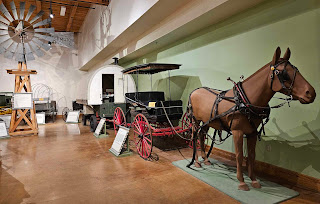
After lunch, we went to the New Mexico Farm and Ranch Heritage Museum.


On our way back to the hotel, I saw someone running on a trail that runs parallel to the freeway.  I had never noticed this trail before, even though it goes near our hotel.  For my afternoon run, I went running on my newly discovered trail.  It was the day before the marathon, so I didn’t run as far as I did the other days.

For dinner, we went to an Asian buffet that was right next door to our hotel.  I’ve stayed at this hotel four times, and I’ve driven by there many times, but this was the first time I tried it.

Saturday, January 6

Saturday was race day.  The race didn’t start until 8:00 AM, so I didn’t have to get up outrageously early.  As is often the case, I was awake before my alarm went off.

The start and finish were both on the track at the Field of Dreams stadium.  There was plenty of parking, and the stadium has heated bathrooms.  That was especially nice, since the outdoor temperature was in the 30s.  It was cold enough for tights, so I wore my cheetah garb.  I recall wearing the same outfit for this race last year.

I started coming down with a cold just before Christmas.  It was worst the week between Christmas and New Years, but I still had some congestion and an occasional cough.  I could tell from my training runs during the week that my cold was slowing me down.  Since I wasn’t fully recovered, I wasn’t inclined to pace myself too aggressively during the race.  There would be other races where I could try for a fast time.  This one was all about finishing.

The course was mostly out-and-back.  The majority of the course was paved, but there was a mixture of surfaces.  After running around the track, we came out of the stadium onto city streets.  We followed city streets for about a mile before running on a dirt trail for one block.  Then we turned onto an asphalt trail that took us to the river.

Just before getting to the river, we crossed a dirt trail with some rocks.  Then we got onto a wide concrete sidewalk along the river.

I started the race at a pace that felt comfortable.  I was surprised to see that I ran the first mile in 9:15.  It didn’t feel tiring, but I knew that pace was too fast, so I eased back until I was averaging about 9:30 per mile.

About three miles into the race, I heard two women behind me talking.  Their names were Merry and Kimberle, and before long they had caught up to me.  I remembered meeting Merry a few months ago at the Clarence DeMar marathon, so I said hello.

Next, we ran under a bridge and through the parking lot of La Llorona Park, where I had started my run on Thursday.  There was an aid station set up in that parking lot.  We each got something to drink, but as Kimberle and I left the parking lot, Merry was no longer with us.  I ended up running with Kimberle for the rest of the race.

For the next few miles, we were on the same paved trail where I was running on Thursday.  When we reached the end of that trail, we crossed a road and turned onto a different trail that took us away from the river valley.

Along this section, we were briefly talking to another runner who was wearing a Boston Marathon jacket.  The jacket caught my eye, because it was from 2013.  For the next mile or so, the three of us were trading stories about our experiences at Boston.

Roughly eight miles into the race, we turned onto a two lane road.  We were on this road all the way to the turnaround.  On one side of the road, we ran past groves of pecan trees.

Early in the race, my hands were cold, even though I was wearing gloves.  As the sun got higher in the sky, I started to warm up.  Along this road, I finally felt like I was warm enough to take off the gloves.

I was also wearing arm warmers.  About two miles after taking off my gloves, I started to wonder if I would also need to take off the arm warmers.  I didn’t, because I started to feel a cool breeze.

The turnaround was between 12 and 13 miles.  Before the turn, I didn’t know which direction the breeze was coming from.  After the turn, it was obvious.  The wind was at our backs before.  After turning around, we were running directly into it.

Shortly after turning around, we reached the halfway point.  At the time, I was on pace to finish in about 4:12, but I realized the second half was going to be slower.  Running into the wind was tiring.  I knew I wouldn’t be able to keep up the same pace going into the wind.  I also knew we would be running into this wind for most of the remaining miles.

The wind wasn’t just tiring.  It was cold.  I was glad I never took off my arm warmers.  After less than a mile going into the wind, I had to put my gloves on again.

I had a pair of shell mittens in my fanny pack that I had been wearing over my gloves before the race.  After another mile running into the wind, my hands were cold enough that I had to put on my mittens as well.

I wasn’t paying close attention to my pace.  I found the pace tiring, but I was trying to keep up with Kimberle.  We had about three more miles before the next turn, and I found it difficult to keep up.

Finally, after about 17 miles, we left that road to turn back onto the trail that would take us back to the river.  Now, the wind was at our side.  I no longer felt cold, so I immediately took off the mittens.  I was tempted to take off the gloves too, but I knew we would be going in this direction for less than a mile.  Then we would get back onto the trail by the river, and we would have a headwind again.

Before we got back to the river, Kimberle mentioned that her heart rate was getting too high, so she needed to take a brief walking break.  I was all too happy to slow the pace down.  For about five miles, I had been finding the pace to be too tiring.

Once we were alongside the river, the terrain was familiar to me.  That helped, but we had a tiring headwind again, and we still had eight miles to go.

For the rest of the race, our pace was much slower.  Kimberle needed to manage her pace to keep her heart rate from climbing.  We ran at a slower pace, and we took frequent walking breaks.  At this point, I could have gone faster, but I was enjoying the company, and after several tiring miles, it felt good to slow down.

The next few miles were familiar to me.  Then, as we retraced the last two miles through the river valley, the wind got stronger.  Those miles were tiring.

It got a little easier when we finally turned away from the river.  We still had more than three miles to go though.

Instead of taking the most direct route back to Field of Dreams, we had to do two extra out-and-back sections that we didn’t do earlier in the race.  Those miles were slow, but at least we were no longer fighting a headwind.  When we had the wind at our backs, it suddenly felt hot.

When we finally got back to the stadium, we had to run twice around the track before finishing.  Having run this race before, I knew that was coming.  I told Kimberle about it, so she would also know what to expect.

In the last 100 meters, Kimberle started her sprint to the finish.  I sped up too, but didn’t quite keep up with her.  I finished a step or two behind her.

My time was 4:32:10.  That was disappointing, but not surprising.  I was almost 20 minutes slower in the second half.  That was mostly due to the tiring headwind, but I was also holding back at times so I wouldn’t leave Kimberle behind.

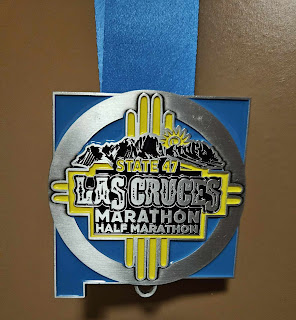
The finisher medal was in the shape of New Mexico.  Runners who placed in the top 47 got a small roadrunner pendant that attached to the bottom.  I didn’t place in the top 47.  I was 80th.

By now, it was 50 degrees.  It was a sunny day.  It was only the wind that made it feel colder.

Post-race food included birthday cake.  January 6 is the anniversary of New Mexico becoming a state in 1912, so we were celebrating New Mexico’s 112th birthday.

By the time I finished the race, Deb was getting hungry for lunch.  I hurried back and got cleaned up as quickly as I could, so we could go out for lunch.  We wanted something quick, so we went to a nearby place with burgers and frozen custard.

On our way back from lunch, we saw some vendors selling rocks, geodes, fossils, and jewelry in a parking lot.  We stopped to shop for almost an hour before returning to the hotel.

We stayed in for the rest of the afternoon, and I had a good soak in the whirlpool.

For dinner, we went to Bosque Brewing.  They were one of the race sponsors, and runners could get a discount on food or beer by showing their race bibs.  Besides their beer, also have a full food menu.  We got their street tacos.

Sunday, January 7

We were originally planning to spend the day with Jim and Kathy, but Jim wasn’t feeling well.  There were other things we could’ve done in Las Cruces or El Paso, but we decided to drive to Tucson a day early.

There was a strong wind advisory in the forecast for later in the day and all day Monday, and we wanted to get ahead of that.  The section of I-10 between Las Cruces and Tucson is prone to dust storms, and the last thing we wanted was to get caught in a dust storm during the four-hour drive back to Tucson.

We left Las Cruces right after breakfast.  During the last hour of the drive, the wind was picking up, and we could see dust clouds to the south.  Thankfully, we didn’t have to drive through any dust clouds.

We ate lunch on our way into Tucson and then stopped by Hilton Garden Inn to pick up the fanny back that I had left behind on Thursday.  I didn’t get a roadrunner for my finisher medal, but I saw one outside the hotel.

Rather than stay at Hilton Garden Inn again, we opted to stay at Home2 Suites.  We appreciated the way they took care of us after the reservation mix-up earlier, so we gave them a second chance.  They had an accessible room for us, and we were pleased with the accommodations.

Deb and I have been to Tucson before, so we’ve already done most of the sightseeing there.  That’s just as well, since it rained all afternoon.

I wanted to do a short recovery run, but I wasn’t excited about running in the rain.  Instead, I settled for doing some walking on one of the treadmills in the fitness room.

After a big lunch, neither of us had room for another big meal.  Instead, we opted for smoothies from a place near our hotel.

Monday, January 8

Our flight wasn’t until the afternoon, so I had time to go for a run before heading to the airport.  The temperature dropped into the low 30s, so I had to bundle up.  It won’t be any warmer at home, so it’s time to get used to it again.  At least Tucson didn’t have any snow.


Race statistics:
Distance:  26.2 miles
Time:  4:32:10
Average Pace:  10:23 
First Half:  2:06:15
Second Half:  2:25:55
Lifetime Marathons/Ultras:  503

Monday, January 1, 2024

My Goals for 2024

For the first time in years, I’m starting the year healthy, and with a good training base.  My first two goals for the year reflect that.

Run 3,000 Miles in 2024

One of my goals for 2023 was to get back in shape.  I did that.  For 2024, I have the easier task of simply staying in shape, which is mostly a matter of keeping up my training.  The hard part is to be consistent all year, which depends on staying healthy all year.

I’ve never run 3,000 miles in a calendar year, although I’ve been in the 2,800s three times.  To run 3,000 miles, I need to average 250 miles per month.  I ran that much each month in the last four months of 2023, so I just have to keep training at the same level, which mostly comes down to staying healthy.

Run at Least 100 Miles in the FANS 24-Hour Run

I mostly run marathons, but once or twice a year, I’ll do an ultra.  The last time I did a long ultra (100+ miles) was two years ago at the FANS 24-Hour Run.  When I decided to do this race in 2022, it was a last-minute decision.  I chose to enter the race when I discovered that I could compete for a state championship for men over 60.  I was pretty sure I could win that, even though I had not been training for an ultra.

Relying mainly on experience, I was able to run 101.4 miles, even with minimal training.  This year, I’m starting the year with the best mileage base I’ve had in years.  The race isn’t until June, so I have five more months to train.

My minimum goal for this race is to run 100 miles.  If I can do that, I’m confident I’ll also win another state championship for my age group.  Obviously, I’ll run farther if I can, but I have to be careful not to overreach.

Run My 100th Minnesota Marathon

I’ve run 95 marathons or ultras in my home state of Minnesota.  Running at least five more in 2024 is a priority.  I was already interested in doing the five-day Summer Camp Series in July.  Those five races alone would be enough to get me to 100.  I’m also planning to do FANS, and I may do one or two others as well.

Run Marathons in 50 Countries

I’ve run marathons in 46 different countries.  That puts me within striking distance of 50.  I’ve already booked travel to three new countries this year.  Ideally, I’d like to add a fourth, although there isn’t much room in my schedule.  This one is sort of a stretch goal.  It might come down to whether I can schedule an international trip in December.

Run Outdoors Whenever Possible

Last year, I didn’t do any running on a treadmill.  Running outdoors is challenging during the winter months, but running outdoors has forced me to pick up my feet more, so I’m less prone to tripping.

Inevitably, there will be days when running outdoors just isn’t possible.  I’m not going to run during a blizzard, nor am I going to run during a thunderstorm.  If my only choices are run indoors or take a day off, I’ll consider running indoors.  Still, I’d like to keep my indoor running to a minimum.  I won’t run on the treadmill just because it’s easier or more convenient.

Qualify for the National Senior Games

The National Senior Games are held in odd-number years.  Qualifying takes place at various state games in even-numbered years.

The Minnesota Senior Games are held in August.  At a minimum, I’d like to qualify for nationals in the race-walk events.  Ideally, I’d like to also qualify for the 5K and 10K road race events, and perhaps a track event, like the 1500 meter run.

Qualifying at the state level is usually pretty easy, as the race-walk events tend to be thinly attended, and you can qualify in road race events just by competing.  The difficulty with competing in multiple events is scheduling.  Doing more events means spending more days away from home, and sometimes there are schedule conflicts between events in different disciplines.

Stay on Schedule to Finish a 5th Circuit of 50 States in 2025

I’m within striking distance of completing my 5th circuit of marathons or ultras in every state.  To finish, I need to run marathons in Alabama, Arkansas, New Jersey, North Carolina, Ohio, Oklahoma, Vermont, West Virginia, and Wyoming.

It would be possible to schedule all nine of these states in 2024, but some of the races I would need to schedule conflict with my other priorities.  Rather than try to finish this year, I’m aiming for 2025.  I finished my first circuit of states at the Vermont City Marathon in Burlington.  Since Vermont is one of the states I need, I’d like to go back to the same race to finish my 5th circuit.

I can easily schedule races in most of these states.  Ideally, I’ll go into 2025 needing just a couple states, with one of them being Vermont.

Sunday, December 31, 2023

2023 Year-End Review

Every year, I post a list of goals for the year.  I usually achieve most of my goals, but I sometimes miss a few.  This year my goals were fairly modest, so it’s not too surprising that I nailed them all.

Finish My 4th Circuit of 50 States

At the beginning of 2023, I had already run four or more marathons (or ultras) in 45 states.  To complete my 4th circuit of marathons in every state, I needed to run marathons in Maryland, Oklahoma, Utah, Vermont, and West Virginia.

I got off to a rough start.  I was planning to run the Sun Marathon in Utah in January, but I had to skip that one because of a respiratory infection.  The day before I was scheduled to fly to Utah, I tried running for the first time in a week.  I managed to run just over a mile.  Two miles would’ve been too much.  A marathon was out of the question.

I recovered in time to run the George Washington’s Birthday Marathon in February, giving me my Maryland race.  In May, I ran the Maple Leaf Marathon in Vermont.  Then in the summer, I found another Utah race.  I actually ran two of them.  I ran the Deseret News Marathon in July and the Mt. Nebo Marathon in August.

I finished my fourth circuit in November by running the Marshall University Marathon in West Virginia and the Route 66 Marathon in Oklahoma.

I already had my eye on eventually doing a fifth circuit of states, so I also went out of my way to schedule races in a few states where I already had four marathons.  Besides running my fourth marathon in the states listed above, I ran my fifth marathon or ultra in Kentucky, Maine, Idaho, Montana, Colorado, Utah, Kansas, New Hampshire, and Maryland.  By the time I finished my fourth circuit, I just needed nine more states to finish my fifth circuit.

Run Marathons in Two New Countries

This was a fairly soft goal.  At the start of the year, I didn’t have any international trips scheduled, but I had tentative plans to run marathons in Slovakia and Brazil.  I ended up running both of those races, and I also ran the Antarctica Marathon.  More on that later.

Get Back into Shape

At the start of the year, I was out of shape, and I was carrying a little extra weight.  My training was held back by a high hamstring injury in my left leg and sciatica in my right leg.

To get back in shape, I first had to get healthy enough to train.  To lose the weight, I needed to get more exercise, which also depended on getting healthy enough to train.  I’ve never been able to lose weight through diet alone.

Things got worse before they got better.  In January, I came down with a respiratory infection that was mostly likely RSV.  I was completely sidelined for about a week, and it was two more weeks before I was recovered sufficiently to do any real training.

My hamstring injury was healing nicely, but my sciatica got worse.  It flared up so badly that I couldn’t run without pain.

I had a cortisone injection in February.  The first time I had one of those, I noticed improvement immediately.  This time, I felt no better after two weeks.  Then something surprising happened.  I flew to Argentina to join my tour group for the trip to Antarctica.  After the 10 hour flight from Atlanta to Buenos Aires, I fully expected to be stiff and painful.  My sciatica was usually worst after a long period of sitting.  Instead, I got off the plane with no discomfort.  It hasn’t bothered me since.

It's possible, although unlikely, that it just took that long for the cortisone injection to be effective.  It’s much more likely that something else changed.  One possibility is that I had a synovial cyst putting pressure on the nerve, and then the cyst drained, relieving the pressure.  Those things can come and go unexpectedly.

That trip included a 10-day cruise, so my opportunities to run were limited.  When I got back, however, I started gradually building my mileage.  I was careful not to increase my mileage too quickly, but by mid-July, I was running 50+ miles a week.  I’ve kept that up since.

A goal should be measurable.  I wouldn’t consider myself to be “in shape” until I could run fast enough to qualify for the Boston Marathon.  In recent years, most of my BQs have been on downhill courses.  My goal for this year was to BQ on a course that didn’t have any net elevation loss.

By the end of April, I was able to run a marathon in four hours.  To qualify for Boston, I needed to shave off 10 more minutes.  In July, I qualified at the Deseret News Marathon, but that course has almost 3,000 feet of net descent.  In August, I qualified on another sharply downhill course.  It wouldn’t be until September that I would have a chance to test myself on a mostly flat course.  By then I was not only getting into getter shape, but I had also lost the excess weight.

I felt like I made a major breakthrough at the Clarence DeMar Marathon, where I qualified for Boston with more than four minutes to spare.  That course is also downhill, but not by nearly as much.  The first half descends about 600 feet.  The second half is relatively flat, although there’s a tough hill in the last few miles.

Two weeks later, I finally reached my goal of qualifying for Boston on a course that started and finished at the same elevation.  I did that at the Cape Cod Marathon, which is mostly flat.

I followed that up with a BQ at the Baltimore Marathon a week later.  That course is moderately hilly.  Before the year was up, I also had BQs at the Mankato Marathon (moderately hilly), the Marshall University Marathon (flat), and the Route 66 Marathon (moderately hilly).

My final BQ of the year came at the Hawaii Bird Conservation Marathon.  This course descends 3,700 feet, but it’s worth noting that I was 11 minutes faster this year than I was on the same course a year ago.

Of all my goals for 2023, this one was the most important.  It seems like every year I start the year thinking it’s going to be a rebuilding year, but then I end the year about where I started.  This year, I actually rebuilt.  I’m going into 2024 running better than I have in years.  I have a good mileage base, my weight is down, and I’m healthy.

Do My Winter Running Outdoors

Since buying my first treadmill (to train for the Pike’s Peak Marathon), I’ve fallen into the habit of doing all of my winter running on the treadmill.  There’s nothing wrong with training on a treadmill.  It has enabled me to train at a faster pace than I could if I had to run on icy streets.

The problem is that after years of doing half of my training on a treadmill, I developed the bad habit of barely getting my feet off the ground.  On a flat road course, I have an efficient stride.  On a trail course, I don’t pick up my feet enough, and I’m prone to tripping.

In recent years, I’ve started to trip and fall, even in road marathons.  If there’s an uneven spot in the pavement, I’ll catch it with one of my feet.  In the latter half of 2022, I was tripping about once per race.  Sometimes I fell, but even when I didn’t, I would have a few awkward jarring steps.  More than once, I aggravated an existing injury.

To cure myself of that habit, I committed to doing all of my winter running outdoors.  My hope was that running on snow and ice would force me to pick up my feet.

The first big test came in the Antarctica Marathon.  That was a hilly course on a dirt road with lots of rocks.  There were times when I was racing down a hill, knowing that I would have a bad fall if my foot caught one of those rocks.  It scared me, but I got through that race without tripping on anything.

I thought I would make it through the entire year without tripping.  Unfortunately, I tripped on a pothole in the Cape Cod Marathon, and hit the pavement pretty hard.

I’ve continued to use a treadmill for race-walk training, but I haven’t run on a treadmill at all this year.  While I didn’t make it through the whole year without a fall, I improved significantly.  One fall per year is a lot better than one fall per race.

Doing my winter running outdoors had another benefit.  It forced me to reacquaint myself with how to dress for different temperatures.  I didn’t know I would be running in Antarctica, but dressing properly for that race was a lot easier after running in similar temperatures at home.

Place in My Age Group in the National Senior Games

Most of my goals were running goals, but I also had two race-walking goals.  I was competing in two race-walking events at the National Senior Games.  The first was 1,500 meters on a track.  The second was 5,000 meters on a road loop.

Last year, I took fourth place in the 1,500.  There are medals for the top three and ribbons for places five through eight.  I got a late start on my training this year, so my goal was simply to place in the top eight.  My time was one second slower than last year, but I placed higher.  This year, I came in third, which was good for a bronze medal.

In the 5,000, my goal was to place in the top three.  I managed a second place finish, earning me a silver medal.

Move Up Among Minnesota Runners

Since 2015, I’ve been on the Megamarathon List, which lists every runner in the world who has finished at least 300 marathons.  I rank in the top 400 runners in the world and roughly 50th in North America, but as recently as 2021, there were still six runners ahead of me in my home state of Minnesota.

By the end of 2022, I had moved into 5th place among Minnesota runners.  My goal for 2023 was to move into the top four.

To move into 4th place, I needed to run 15 more marathons.  I ran 30 this year, easily moving me into the top four.  The three runners still ahead of me have all run more than 600 marathons.  Only one of them is still active, but it’ll be a long time before I run enough marathons to move into the top three.

The Goal That Wasn’t Even on My List

For the second straight year, my biggest accomplishment of the year was something that wasn’t even on my list of goals.  Last year, it was winning the state championship for men over 60 in a 24-hour race.  This year, it was finishing marathons (or ultras) on every continent.

I had previous run marathons or ultras on five continents.  I was only missing South America and Antarctica.  I had plans to run Maratona do Rio in June, but I wasn’t expecting to run a marathon in Antarctica this year.

I had made a deposit to run the Antarctica Marathon in 2024, but I was also on the waiting list for 2023.  Marathon Tours & Travel was leading two voyages to Antarctica this year, one in early March, and one in late March.  On the outside chance that I might get in off the waiting list, I avoided planning any other races in March.

By the middle of January, I was getting anxious to finish planning my race schedule for March and April.  In particular, I wanted to book a trip to Vienna and Bratislava at the beginning of April.  If I went on the second Antarctica voyage, I wouldn’t get home in time to leave for Vienna.

I called Marathon Tours to find out if there was any chance of getting into one of this year’s voyages.  I didn’t think there was any chance.  I just wanted to know for sure, so I could start booking other trips.

I was shocked to find out that both of this year’s Antarctica trips had room.  I chose the first one, so I could also go on the Vienna/Bratislava trip.  At the time, I was sick with RSV, so I took a leap of faith that I could recover in time to be ready for the Antarctica trip.

Antarctica was my sixth continent.  Three months later, I added South America as my seventh continent by running Maratona do Rio.