Showing posts with label 1500 Meter. Show all posts

Monday, July 28, 2025

National Senior Games: 1500 Meter Race-Walk

On July 28, I competed in my first of two race-walk events at the National Senior Games in Iowa.  Today’s event was 1500 meters.  That’s three and 3/4 laps around a track.

The National Senior Games have events in two dozen different sports, including running and race-walking.  I qualified for these events by competing in the Minnesota Senior Games last summer.

I was originally signed up for four events.  I was going to do the 5K road race on July 24, the 10K road race on July 26, the 1500 meter race-walk today, and the 5000 meter race-walk tomorrow.  I decided to skip the 5K run, so I could stay in St. Cloud long enough to do the entire Summer Camp Series.  Then I skipped the 10K run, so I could to the Xenia Avenue Marathon.

I can’t run a 5K or 10K fast enough to place in my age group.  These events are too large and competitive.  By skipping those two events, I was able to run three extra marathons instead.

The host city for this year's National Senior Games is Des Moines, but the race-walk events are being held 50 miles away in Ames.  If I was also doing the running events, I would’ve stayed in Des Moines.  Since I’m only doing the race-walking events, I decided to stay in Ames.  Unfortunately, I still had to do athlete check-in and packet pickup in West Des Moines.

I drove to Ames yesterday, arriving in the early afternoon.  After checking in at my hotel and doing some unpacking, I drove over to the Cyclone Sports Complex, to check out the race venue for today’s race.

Next, I went to the MidAmerican RecPlex in West Des Moines to do athlete check-in and packet pickup.  All athletes received a gift bag that included a program and a few product samples, all oriented toward seniors.

I'm wearing the same race bibs for both of my race-walking events.  There’s one to wear in front and another to wear on my back.  Both race bibs have my number, but the front bib has my name, and the back bib has my age.

I was pleased to see that everyone would have their age on their back.  There’s more than one age group in each heat, so it’s helpful to know who I’m completing with and who I can ignore.

Ames is a college town.  I found a good pizza place near the Iowa State University campus.  After dinner, I went to bed as early as I could.

After the last day of the Summer Camp Series, my left Achille tendon was tight.  I rested the next two days, but I could feel it during the Xenia Avenue Marathon on Saturday.  After that race, it was worse.  I’ve done everything I know to recover, but I went into this morning’s race knowing it might be an issue.  For most of my daily activities, I’ve been putting some padding under my heel, to ease the tension on my Achilles tendon.  I wasn’t comfortable doing that for a race-walking event.  I wasn’t sure how that would alter my stride.  I just had to hope for the best.

My heat was the fifth of the morning.  It didn’t start until 9:20 AM, which gave me time to eat breakfast at the hotel.

As I was eating breakfast, I noticed that it had rained overnight.  I expected the track to be wet.  I went to the track a little early, so I could watch some of the other heats and observe the condition of the track.


As I expected, there were a few puddles on the track, including one in the inside lane right at the start of a turn.

There were four age groups in my heat.  It included all men between the ages of 50 and 69.  In all, there were 19 of us.  We were assigned hip numbers based on our qualifying times, and we lined up across the track in order of our numbers.  I was seeded 15th out of 19.

Two years ago, at the National Senior Games in Pittsburgh, I walked the 1500 in 9:01, and I placed third in my age group.  This year, I had lower expectations.  I’ve done very little race-walk training in the last month.  Based on the training I had done before that, I expected to be about 20 seconds slower this year.  It didn’t seem likely that I would be fast enough to win a medal.

For the first 100 meters, I tried to outrace people to the turn.  Eight other walkers got to the turn ahead of me.  I started at a pace that already had me out of breath, so I knew I wouldn’t catch up to any of these eight guys.  They quickly pulled away.

After completing one full lap, I started to hear other walkers behind me.  I could see their shadows on the track.  Three guys were right on my tail.  I tried to stay ahead of them, but one of them surged ahead of me before we reached the turn.  As he went by, I saw that he was 57 years old.  He wasn’t in my age group.

I held my position going around the next turn.  Halfway down the straightaway, I saw one of the other guys pulling ahead of me.  He also wasn’t in my age group.

The third guy went around me in the next turn.  He wasn’t in my age group either.  That was a relief.  Had I not known the ages of these three walkers, I would’ve wrecked myself trying to keep up with them.  Instead, I was able to maintain a sustainable pace and focus on keeping my knees straight.

Judging at the National Senior Games is usually pretty strict.  Two guys got disqualified in this race.  Nobody was right behind me, so I was able to focus on keeping my form legal, rather than fighting to be a few seconds faster.

With 300 meters to go, I noticed that the guy ahead of me was starting to slow down.  I made a point of passing him before the next turn, so I wouldn't be bottled up behind him.

I kept up the same pace for the last 200 meters .  I finished in 9:22.  That put me in fourth place in my age group.  The top three get medals.  Places four through eight get ribbons.  As it turns out, there were only six men in my age group.


Both my time and my place were about what I expected, so I can’t be too disappointed.  I can try again for a medal in tomorrow’s 5000-meter race.  In the past, I’ve been stronger in that event.

The best news of the day is that my Achilles tendon didn’t bother me at all during the race, and it also didn’t tighten up afterwards.


Race statistics:
Distance:  1500 meters
Time:  9:22
Average pace:  6:15 per kilometer (10:03 per mile)
Place in age group:  fourth

Saturday, August 17, 2024

2024 Minnesota Senior Games: Race-Walking Events

This is my second post from the 2024 Minnesota Senior Games.  Yesterday’s post included my two running events.  This one covers the two race-walking events.

The race-walk, power-walk, and track and field events were all held at the Sauk Rapids Middle School, and they were all scheduled for Saturday.  Last month, I saw one of the race-walking judges at another event, and I asked him if he was aware of the schedule conflict.  He was, but he didn’t seem too concerned about it.  I got the impression that all of the events would be held on the same track

Yesterday, I drove over to the school, and I noticed a one kilometer loop around the school buildings marked off with traffic cones.  The distance around the building must be just under one kilometer, because the route included a detour into one of the parking lots for a short out-and-back.


My first race today was the 5,000 meter race-walk.  It started at 7 AM, so I had to set my alarm earlier today.  When I arrived at the school, I confirmed that this race wasn’t going to be on the track.  It was five laps of the one kilometer loop marked off with cones.

The last time I was healthy and well-trained for the Minnesota Senior Games was three years ago.  On that occasion, I was the overall winner of the 5,000 meter race-walk.  I’m healthy this year, and I’m in comparable condition, so I expected to win again.  My goal was to break 31 minutes, but that’s ambitious.  I would need to average 10 minutes per mile.

I assumed the lead from the beginning of the race.  I started out at a fast enough pace, but after making the first turn, I encountered a headwind.  Walking as fast as I could into the wind caused me to get out of breath, so I was forced to back off a little in my pace.

After following the cones through a parking lot on the back side of the school building, we walked along a driveway that took us out to the street on the other side.  We were going counter-clockwise around the school, so most of our turns were left turns.  This driveway was an exception.  It bent to the left, then the right, and then back to the left.  Here, I needed to be mindful to walk the tangents.

On the out-and-back section, I was already done with it before the next two walkers started that section.  At that point, I knew nobody would catch up to me.  I was only racing the clock now.

There were two race-walking judges.  One was in the start-finish area.  The other was next to the out-and-back section, where he could watch us in both directions.  The judge in the start/finish area was also the time keeper.  When I finished my first lap, he told me my time was 6:20.

To be on pace for 31 minutes, I needed to average 6:12 per lap.  I was already eight seconds too slow.

At this point, it might have been possible to speed up enough to bring my pace down, but this was my third race of 5K or 10K in three days.  These are intense races where you’re at or near your aerobic limit for the entire race.  To pick up my pace, I would need to go into oxygen debt.  I just couldn’t force myself to do that again.  Instead, I continued at about a 95% effort.

The course was mostly flat, but it was slightly uphill where we turned into a parking lot to begin the short out-and-back segment.  Here, I had to stay focused on keeping my knee straight as my lead foot made contact with the ground.  That’s one of the rules of race-walking.

When I finished the out-and-back on my second lap, I couldn’t see any other walkers approaching, they were still somewhere behind the school building.

My time for the first mile was 10:26.  Now I knew for sure that I wasn’t going to break 31 minutes no mater how hard I pushed.  I had no incentive to go all-out, knowing I would easily win the race.

My time for the second lap was 6:32.  That was 12 seconds slower than my first lap.  That was disappointing, but not surprising.

As I was finishing my third lap, I passed a walker who was still on her second lap.  That was the last time I saw another walker during the race.  Nobody else was every close to me.

My third lap was only one second slower than my second lap, but when I got my split for the second mile, it was 10:40.  I knew I wasn’t pushing as hard as I could, but that was still disappointing.  There was a time, several years ago, when my marathon pace was almost that fast.

As I finished my fourth lap, the race-walking judge told me that my right knee looked a little soft.  It was just a warning, but after that, I paid more attention to keeping my knees straight.

I managed to pick up my pace in my last lap.  I finished with a time of 32:45.  I won the race by about three minutes.

There was enough time between finishers that the race-walking judge in the finish area was able to take video of our form as we each finished our last lap.  On my last lap, I did a better job of keeping my knees straight.

After everyone was finished, we had a brief awards ceremony.  I was first overall, so I already knew I won the gold medal for my age group.

Race statistics:
Distance:  5,000 meters
Time:  32:45
Average Pace:  6:33 per kilometer (10:32 per mile)
Place in Age Group:  1st

After my first race, I went back to the hotel to get cleaned up and change into dry clothes and shoes.  I had a couple hours to relax, but then I needed to head back to the school for my second event, which was scheduled to start at 11:30.

My second race was the 1,500 meter race-walk.  This race was on the track, so it had to be scheduled around the various track and field events.  When I got back to the track, I found our that the track events were running behind schedule.  At 11:45, the only remaining track event was the men’s 200 meter, but there were seven heats.

While I waited, I was standing in the parking lot, talking to other walkers.  Spending so much time out in the sun wasn’t helpful.

At times, I noticed a strong breeze.  Before the race, it helped keep me cool, but I didn’t want to feel that same strong breeze during the race.

My primary goal was to win this race, but I also wanted a fast time.  My time in this event will be my qualifying time for the same event at next year’s National Senior Games.  Lane assignments will be based on our qualifying times, and I wanted to get a good lane assignment.

It was a 400-meter track, so we needed to do three full laps, plus an additional 300 meters.  We started at the beginning of the far straightaway.  My goal for the first 100 meters was to be the first person to reach the turn, so I could go around the turn in lane one, with nobody in front of me.

They lined us up with the women in the inside lanes.  Other than that, we were lined up in order of our bib numbers, which were essentially random.  I had about five people on my left.

When the gun went off, I started fast and raced for the turn, which was 100 meters away.  There was one woman who went out faster.  I had never seen her at a race before, but I couldn’t match her speed in the first 100 meters.  She was a stride or two ahead of me as we entered the first turn.

I followed her around the turn.  As soon as we were out of the turn, I poured it on to see if I could pass her.  Within the next 50 meters, I pulled alongside of her.  In the next 50 meters, I got far enough in front that I was able to move into the inside lane for the second turn.  After that, I led for the rest of the race.

The start of that turn was our eventual finish line.  I had walked 300 meters, and I now had three full laps to go.  I looked at my watch as I crossed the line.  My time so far was 1:46.

My goal was nine minutes, but I knew I could only do that if I went all out the whole way, without ever letting up.  Before the race, I figured out what time I needed at the 300 meter mark to be on pace for a nine minute finish.  The time I needed was 1:48, so I was two seconds ahead of schedule.

My first 300 meters were only that fast because I had worked so hard to get into the lead.  It wasn’t a pace that I could sustain.

As I came out of the second turn, I felt a headwind.  The strong breeze came back.  For the next 100 meters, I had to fight it.  That made my pace more tiring.

About half of the time, I was focused on going as fast as I could.  The other half of the time, I was focused on making sure my knees were straight.  That’s the difficult thing about race-walking.  You need to constantly pay attention to making sure your form is legal.  At this race, the judging was fairly lenient.  At the National Senior Games, the judging is strict.  I need to be thinking about that now, so I don’t develop bad habits.

As I got back to the eventual finish line, I had two full laps to go.  I did my best to keep up my effort.  I didn’t check my watch again until I had 500 meters to go.

To be on pace for a nine minute finish, I needed to complete the first 1,000 meters in six minutes.  I got there in 6:13.  I was winning the race, but my time was going to be disappointing.

I was about to pass the two slowest walkers in the race.  They were walking side by side in the first two lanes.  I was able to pass them before reaching the turn to begin my last full lap.

In my last lap, I had to fight the wind again.  That caused me so slow down in that lap.  As I came around to the final 100 meters, I knew I wouldn’t like my time, but I made sure I was keeping my knees straight.  I finished in 9:26.

The woman who led for the first 250 meters was second overall with a time of 10:15.  She’s fairly new to race-walking.  I encouraged her to keep training for the next year and go to the National Senior Games next July.  If she does, she’ll be competitive in her age group.

Because it was such a short race, we didn’t have to wait long for everyone to be finished.  I won my second gold medal of the day.  I also won a gold and a silver in my running events, so I came away from the Minnesota Senior Games with three gold medals and one silver medal.


Race statistics:
Distance:  1,500 meters
Time:  9:26
Average Pace:  6:17 per kilometer (10:07 per mile)
Place in Age Group:  1st


Friday, July 7, 2023

2023 National Senior Games: 1500 Meter Race Walk

On July 7, I competed in the first of three events at the National Senior Games in Pittsburgh.  My first event was the 1,500 meter race-walk event.  In the coming days, I’ll also compete in the 5,000 meter race-walk event and the 5K road race.

Anyone over 50 can compete in the senior games at the state level.  If you place high enough in your age group at the state level, you qualify to compete in the same event at the national level.  I qualified to compete in the 2023 National Senior Games by competing in the 2022 Minnesota Senior Games.

Last year, I had a hamstring injury that made it impossible for me to go all-out in any of my events at the Minnesota Senior Games.  When I checked in, I looked at the list of registrants and saw that there were only four men in my age group in the 1,500 meter race-walk event.  The top four in each age group qualify for nationals, so I walked at a moderate pace.  I came in last in my age group, but I still qualified.

In the race-walking events, if you qualify in either event at the state level, you can compete at both distances at nationals.  Similarly, if you complete in either road race event at the state level, you qualify for both road race events at nationals.  In the road race events, you don’t need to place in your age group.  Anyone who competes in their state’s senior games can compete at nationals.

I was qualified to complete in both the 5K and 10K road race events, but the 10K conflicted with the 1,500 meter race-walk event.  Both events were scheduled for Friday morning, and they were on opposite sides of town.  It wasn’t feasible to do both of these events.  I had a much more realistic chance of placing in the 1,500 meter race-walk, so I skipped the 10K road race.

I flew to Pittsburgh on Thursday.  I stayed at a hotel in the western suburbs, because it was centrally located for my events.  Before competing in any events, I needed to check in at the race headquarters to receive my credentials.  Athlete check-in didn’t begin until 5:00 PM on Thursday.  That gave me time in the afternoon to do some strength training in my hotel’s fitness room.  I try to do leg and core exercises at least three times a week.


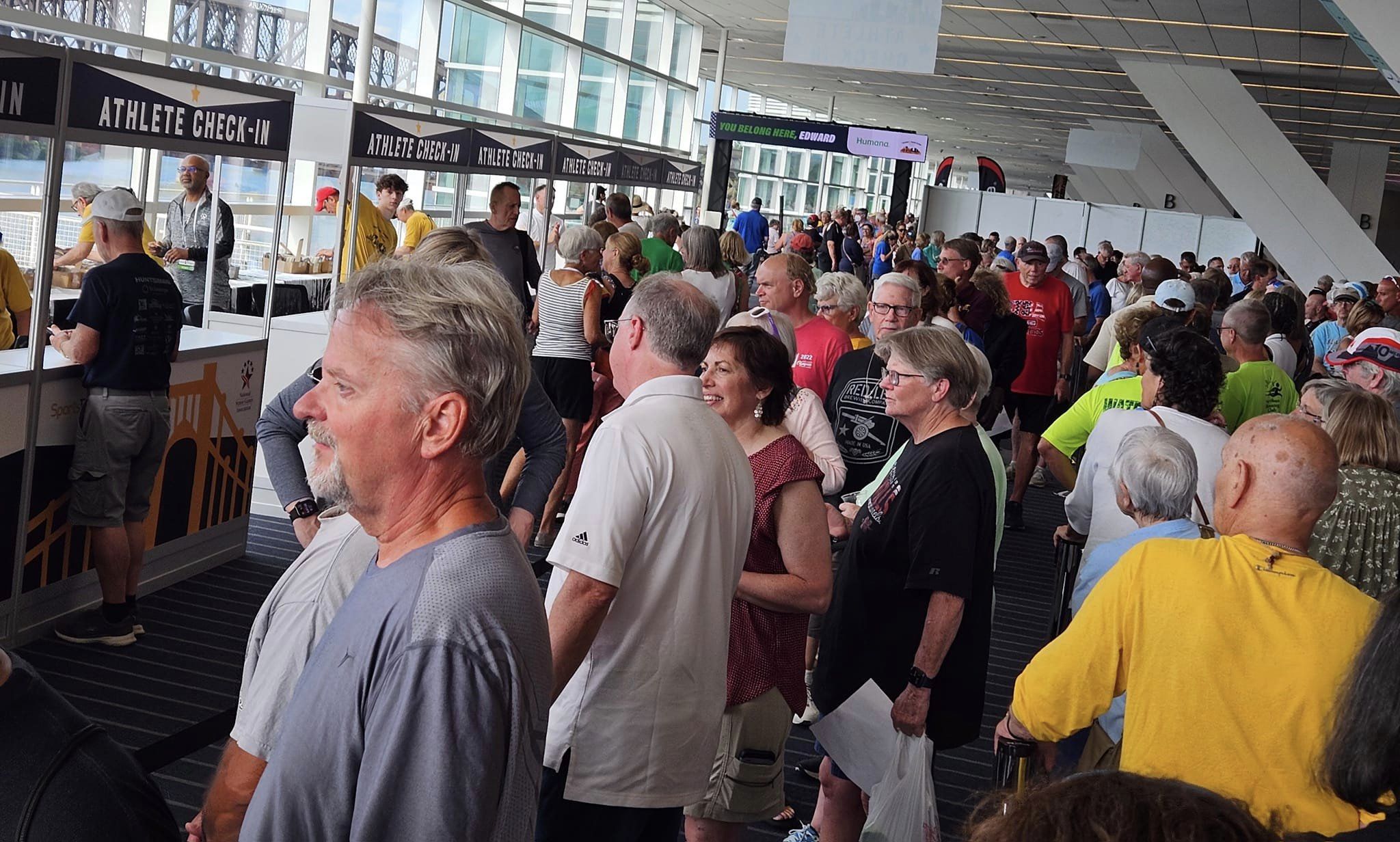
Athlete check-in was at the David L. Lawrence Convention Center in downtown Pittsburgh.  I wanted to check in before dinner, so I wanted to get there as soon as they opening.  I knew a lot of other people would have the same idea.  If there’s one thing seniors have in common, it’s a tendency to arrive early.

I got to the convention hall 20 minutes early, and there was already a long line for athlete check-in.  It was 20 minutes before the line started moving.  It was another 30 minutes before I reached the beginning of the line.


After picking up my credentials, I needed to get in another line to pick up my race bibs for my two walking events.  Then I went to the other end of the convention hall to get my goody bag.  By the time I left the convention center, it was after 6:00.

For dinner, I found a bar & grill about a mile from my hotel with a menu that included personal sized pizzas.

Getting enough sleep was a challenge.  The AC was under-powered, so I couldn’t get the room as cool as I wanted.  On top of that, the AC was controlled by a motion sensor.  During the time I was at athlete check-in and dinner, the room was warming up.  I wanted to get to bed early, but it took a long time for the room to cool down again.  Making matters worse, the AC wouldn’t stay on while I was sleeping, because I wasn’t moving.  I only managed to sleep for about half of the night.

The 1,500 meter race-walk was held on the track at South Fayette High School.  We were divided into six heats based on age and gender.  My heat included men in the 50-54, 55-59, 60-64, and 65-69 age groups.

The earliest heat started at 8:00 AM, but my heat didn’t start until 9:30.  That gave me time to have a light breakfast before driving to the high school.

I got to the high school in time to watch all of the earlier heats.  I also bumped into several people I knew.  Some I had met at other walking events.  Others were runners who, like me, also do some race-walking.


Last year, I placed fourth in my age group in this event.  My goal this year was to improve enough to place in the top three.  My training was going well until three weeks ago.  Then, after a particularly aggressive race-walking workout, I started to experience discomfort behind both of my knees.  In my left leg, I just had some soreness at the top of my calf.  In my right leg, I had discomfort both above and below the knee.  The discomfort I was feeling below my knee was probably a sore calf, but I’m not sure what was causing the discomfort above my knee.  My best guess was that walking at such an aggressive pace while keeping my leg straight caused me to stretch or strain the tendons in back of my knee.

Since then, I’ve done very little race-walking.  I’ve kept up my fitness by running, and I’ve done some moderate-paced walking, but I’ve avoided walking at an all-out pace.  My priority was to get to the starting line as healthy as possible.  Finally, on Wednesday, I walked a few miles at a pace that was fast enough to be good practice, but not all-out.

Going into today’s race, my left leg felt OK, but I was still concerned about my right leg.  It’s better than it was three weeks ago, but I still notice it when my leg is fully extended or bent at a sharp angle.

I wasn’t sure if my recent lack of training would hurt me in this event.  I haven’t lost any fitness, but race-walking is as much about technique as it is about fitness.  I felt a little more confident after the workout I did on Wednesday, but it had been three weeks since I last walked at my intended race pace.

We each had two race bibs – one to wear in front and another to wear on our backs.  The race bibs on our backs had our age.  That was important, since there were multiple age groups on the track at the same time.  I was only concerned about competing with the other men in my age group.


After arriving at the race venue, we were each assigned a one or two-digit number.  We had stickers with these numbers.  We had to wear them in front and in back.  These numbers made it easier for the race-walking judges to identify us if they saw an infraction of the race-walking rules.

There were two rules we had to follow.  We had to always have at least one foot in contact with the ground, and we had to keep our supporting leg straight at the knee.

The weather was favorable.  It rained during the night, but there wasn’t any rain during today’s race-walk event.  The temperature was in the low 70s.  While I was waiting for my heat, the sun felt hot, but it got cloudy before my heat started.

We were lined up across the track according to our qualifying times.  When I registered, I listed my time from last year’s National Senior Games.  I was assigned number 5, out of 21.  That put me on one of the inside lanes.

The walkers lined up to my left were much faster than I was.  They started so fast that I could move over to lane one almost immediately.

My form felt nice and fluid, allowing me to start fast.  I started so fast that I was already getting out of breath after about 10 meters.  Then I had to moderate my pace.  The pace I started wasn’t sustainable for 100 meters, much less 1,500.

I paid close attention to the race bibs on the backs of the walkers who were ahead of me.  In addition to the four walkers who lined up on my left, two of the walkers to my right also started faster.  Of the six walkers who started faster, only two were in my age group.

Once I found a pace that I could sustain, I held my position in the field.  I was fighting hard to pick up my pace, but I didn’t know if I could sustain that effort.  After about 600 meters, I chose to focus instead on how I would place.  My goal was to finish in the top three, and I was currently in third place.  As long as nobody in my age group passed me, I didn’t necessarily need to fight for every second.

I was just starting to feel more relaxed when one of the judges held out a yellow paddle with the symbol for bent knee.  He also said, “bent knee,” as I walked by him.  The fact that he held out the paddle told me he was giving me a “red card,” and not just a warning.

It’s the first time I’ve ever had a red card.  Getting one isn’t the end of the world.  If you get three, you’re disqualified.

I realized I was probably getting a little bit too relaxed.  For the rest of the race, I paid close attention to keeping my leg straight as I planted my lead foot.  I didn’t get any other red cards.

With about 700 meters to go, I started to wonder if I could gain ground on the walker who was currently second in my age group.  He wasn’t any farther in front of me than he was a lap earlier, and I felt like I could pick up my effort.

I didn’t know if I was gaining ground on him, but I was definitely gaining ground on another walker who between us.  I realized I could pass him, but I didn’t want to have to go around him in a turn.  I got right up behind him, but waited until we were out of the turn.  Then I make a big push to go around him.

When I reached the next turn, I couldn’t avoid passing a walker who was a full lap behind me.  That was in the middle of the turn, so I had to into the second lane going around that turn.  That may have cost me a second or two.

In the last 300 meters, I realized I couldn’t catch the walker who was in second place.  I was speeding up, but he was also speeding up.  He was actually pulling away from me.

There was a lot of moisture in the air.  In the last 100 meters, I could see small drops of sweat flying off my forearms.  In a longer race, the humidity would’ve bothered me.  Fortunately, this race was over quickly.

I finished with an official time of 9:01.43.  That’s two second slower than my time in last year’s National Senior Games, but I was more concerned with my place.  After placing fourth in my age group last year, I was able to move into the top three this year.

They had a white board that showed which walkers had red cards.  I didn’t have time to look for it during the race, but I walked over to see it afterward.  One person in my heat got three red cards for bent knee.  He was disqualified.  I had one read card, as did about half of the walkers in my heat.

I had to wait until the remaining heats were done before they did awards.  I got the bronze medal for my age group.


I didn’t have any discomfort around my right knee during the race.  I also haven’t noticed any discomfort since finishing.  I’ll have to wait and see how I feel tonight and tomorrow, but I’m cautiously optimistic that I got through this race without doing any damage.

Tomorrow morning, I’m doing the 5,000 meter race-walk event.

To be continued …


Race statistics:
Distance:  1,500 meters
Time:  9:01.43
Average pace:  6:01 per kilometer (9:40 per mile)
Place in age group:  3rd

Thursday, August 11, 2022

2022 Minnesota Senior Games: Walking Events

Last year, I competed in the Minnesota Senior Games for the first time.  A knee injury prevented me from competing in any running events, but I was still able to compete in the race-walking events.  There are two race-walking events, and they’re both held on the same day.  Last year, I skipped the 1,500 meter race, so I could focus on winning the 5,000 meter race.

For the same entry fee, you can sign up for as many as five different events.  I’ve recovered from the knee injury that plagued me last year, so this year I optimistically signed up for two race-walking events, two road running events, and one track and field event.

At the time, my goal was to win the two walking events and try to place in my age group in the running events.  If I could do that, I would also qualify for all five events in next year’s National Senior Games.  I was pretty confident about my race-walking, but I would need to start doing speed work to do well in the running events.

My biggest concern at the time was my lower back.  As it turns out, my lower back is doing much better.  It didn’t bother me in any of my July races, and it’s not holding back my training in any way.

Unfortunately, I have a new concern.  In May, I started to notice some minor discomfort in the proximal hamstring tendon of my left leg.  That’s the tendon that connects my hamstring to my pelvis.  At the time, I was training for FANS, so I was doing all my training at a slow pace.  When I ran or walked slowly, it didn’t bother me.  After FANS, I started to pick up the pace of my training runs.  Then it became much more inflamed.

I got through six marathons in July by running at a slow pace.  At the time, I wasn’t doing any race-walking, since I was pretty sure that would cause this injury to flare up again.

Two weeks ago, I finally tried race-walking.  I walked five kilometers as fast as I could.  I wanted to know how much speed I had lost since the National Senior Games in May.  I also wanted to know how my left leg would feel.

My pace was about a minute per mile slower than it was a year ago.  Still, that might be fast enough to win the 5,000 meter walking event at the Minnesota Senior Games.  That was the good news.  The bad news is that race-walking even once made my injury worse.  That’s when I knew it would be a bad idea to try to compete for the win today.

The race-walking events were both held today.  I was signed up for both events, but I decided to skip the 5,000 meter walk.  At this point, my only goal was to qualify for nationals.  If I qualified in one event today, I could do both events at nationals.  With that in mind, there was no point in doing both events today unless I was trying to compete.

The Minnesota Senior Games were held in Mankato.  The race-walking events were both held on the track at the Mankato campus of Minnesota State University.


I drove to Mankato this morning and went straight to the university.  First, I stopped at the Johnson Alumni Room to check in.  There are several fast food restaurants nearby, so I grabbed an early lunch before heading over to the track.

The 5,000 meter race-walk event started at 11:00.  Although I was no longer planning to complete in this event, I still wanted to watch.  I informed the officials that I was scratching in this event, but I was still planning to compete in the 1,500 meter race later in the afternoon.

There were dark clouds nearby, and we sometimes heard thunder.  There was a storm system about five away, but it wasn’t moving in our direction.  Most of the walkers finished in dry weather.  Before the last two walkers finished, I started to feel drops, so I walked back to my car.


After watching the race, I went to my hotel to check in.  I’m still planning to do the 10K run tomorrow morning, and I didn’t want to drive to Mankato two days in a row.  There weren’t any rooms ready yet, so I drove to Sibley Park to see where I would need to park for the start of tomorrow’s race.  When I got back to the hotel, they had a room ready.

I returned to the track at 4:00 to do the 1,500 meter race.  To qualify for nationals, I needed to place in the top four in my age group.  That was never in question, as there was only one other guy in my age group.  I didn’t have to walk fast.  I just needed to walk 1,500 meters at any pace.

I had no intention of walking as fast as I could, but I also didn’t want to be the last one to finish.  I wanted to walk at a pace that was somewhat brisk, but not fast enough to cause any discomfort in my leg.  Qualifying for nationals was never in doubt, so the most important thing was to keep from making my injury worse.

If I was making a serious attempt to compete, I would start at the fastest pace I could manage.  Instead, I did the opposite.  I made a point of staying behind almost everyone, to keep myself from starting too fast.  After about 200 meters, I gave myself permission to pick up the pace a little, but I was still going much slower than I would if I was trying to compete.

By the end of my first full lap, I was beginning to feel some soreness in my left leg.  Then I had to slow down until the soreness diminished.  For the rest of that lap, I forced myself to stay behind the walker who was right in front of me.

One of the rules of race-walking is that you have to have a straight knee when your lead foot makes contact.  I was about 700 meters into the race when I heard the race-walking judge warn the walker in front of me that his right knee was bent.  As he tried to correct his form, he slowed down a bit.

After he slowed down, I was no longer comfortable staying behind him.  We had just started a turn, and I didn’t want to be in lane two all the way around the turn as I slowly passed him.  I picked up my pace enough to pass him quickly, but then I felt soreness in my left leg again.  For the second time, I had to slow down.

For the rest of the race, I did a better job of finding the pace that wasn’t quite fast enough to cause any soreness.  I eventually finished the race in 13:13, which is about what I expected.  For comparison, the last time I race-walked this distance, my time was 8:59.

Everyone who places in their age group gets a medal.  Placing second out of two in my age group didn’t seem like much of an accomplishment, but at least I showed up.  You know what they say.  When you finish last, you’re still lapping everyone who’s sitting on the couch.  I finished last in my age group by more than four minutes, but that was still put me in second place.


After the race, I no longer noticed any soreness in my leg.  I’m cautiously optimistic that I didn’t overdo it today.

There’s nothing impressive about walking 1,500 meters in 13:13, but now I’m qualified to do both race-walking events at next year’s National Senior Games.  Tomorrow I’ll work on qualifying for the running events.


Race statistics:
Distance:  1500 meters
Time:  13:13
Average pace:  8:49 per kilometer (14:11 per mile)

Tuesday, May 10, 2022

2022 National Senior Games: 1500 Meter Race-Walk

On May 10, I competed in the 1,500 meter race-walk event at the National Senior Games in Fort Lauderdale, FL.  I qualified for nationals by winning my age group in the 5,000 meter race-walk event at the Minnesota Senior Games last August.  There are two race-walk distances: 1,500 meters and 5,000 meters.  I didn’t do the 1,500 meter race in Minnesota, but if you qualify in one distance, you can do both distances at nationals.

At the Minnesota Senior Games, the 1,500 and 5,000 were both held on the same day.  I didn’t think I could race both events, since they were only two hours apart.  At the National Senior Games, the 1,500 and 5,000 meter events are on different days, so it seemed more reasonable to do both.

The National Senior Games take place over 14 days.  There are events in 21 different sports.  I was only competing in the race-walk events, which took place on the first two days.

I stayed at a hotel that was near the airport.  Ideally, I would’ve stayed at a hotel that was closer to where I was racing.  The 1,500 and 5,000 meter events were held at different venues.  There weren’t any hotels close to the track and field complex where the 1,500 meter race was held.  There was one hotel close to where the 5,000 meter race will be held, but I couldn’t get a room there.  No matter where I stayed, I would have to get up early to drive to the races, so I picked a hotel that had some nearby restaurants.

I flew to Fort Lauderdale on Monday.  I arrived after noon, so I made a fast food lunch stop before continuing to my hotel.  After checking in at my hotel, I had to wait until 4:00 before I could pick up my credentials.  In the meantime, I went to the hotel’s fitness rooms to do some leg and back exercises.

Athlete check-in was at the Greater Fort Lauderdale/Broward County Convention Center.  We had to check in and pick up our credentials before we could pick up our race bibs for individual events.


In addition to my badge, I received a welcome bag that contained a program, some coupons, and some product samples.  The most useful product sample was probably the pain relief gel.

There were some good restaurants near my hotel, but I wanted to get to bed early, so I had dinner in the hotel restaurant before turning in early.

My alarm was set for 5:00 AM.  I was already awake at 4:30, so I got up and started getting ready.  I was planning to leave before the hotel started their breakfast, so I made a cup of tea in my room and ate some Pop Tarts that I bought the night before.

The race was held on a 400 meter track at the Ansin Sports Complex.  I had to pick up my race bib at the race venue between 6:00 and 7:00 AM.  I was planning to get there around 6:30.  Since I was up early, I was able to leave a little earlier than I planned.  I got to the race venue a little after 6:00.

When I checked in, I received two race bibs.  The first one, which I wore on the front of my shirt, was a standard race bib with a timing chip.  The second race bib, which I wore on my back, showed which age group I was in.


The race was split into four heats.  I was in the third heat, which was for men between the ages of 50 and 69.  My heat wasn’t scheduled to start until 8:20 AM.  In the meantime, I talked to other walkers and watched the first heat, which was for women, ages 70-94.


While the first heat was still going on, they were already lining up the men who were in the second heat.  Since my heat was next, I put my phone in my car and made a bathroom stop.

When I checked in for my heat, I was assigned a number reflecting where I would line up.  This number was also used by the race-walking judges, in case they needed to disqualify someone.

They had stickers with numbers from one to thirty.  I was assigned number 32.  Since they didn’t have any stickers for numbers above thirty, they had to use a “3” and a “2.”  I had to wear stickers like this on the front of my shirt, the back of my shirt, and on my left hip.


The temperature at the start was 74 degrees.  I was expecting high humidity, but I really didn’t notice it.  There was just enough of a breeze to keep me from feeling hot.  We were also starting before the sun got too high in the sky.  I found the conditions to be surprisingly comfortable.

I’ve never raced this distance before.  All my training has been for the 5,000 meter event, which will be held tomorrow.  I’m hoping to be competitive at that distance, but I didn’t expect to be competitive in the 1,500.  With that in mind, I viewed today’s race as a tune-up for tomorrow’s race.

We started on the far side of the track.  We had to go three quarters of the way around the track and then do three complete laps.  I was lined up in the outermost lane.  When the gun went off, I focused only on the first 100 meters.  I walked as fast as I possibly could, with no regard to whether I could sustain this pace for 100 meters.  I needed to cross over in the inside lane before the first turn.  My goal was to pass as many people as possible in the first 100 meters, so I wouldn’t be behind as many people when I started the turn.

I was going as fast as I could, but the majority of the walkers in my heat were already in front of me by the time I got over to the inside lane.  After that, I just followed the other walkers around the turn and tried my best to keep up my initial fast pace.

By the time I entered the second turn, I was gaining on the walker right in front of me.  I stayed behind him going around the turn, but sped up and passed him as soon as we reached the next straightaway.

There were five race-walking judges spread out around the track.  Any one of them could give you a warning if your form was borderline or a “red card” if your form wasn’t legal.  There are two possible infractions.  The first is called, “lifting.”  It means you have both feet off the ground at the same time.  The other infraction is called “bent knee.”  The knee of your supporting leg has to be straight from the moment you make contact with the ground.  It’s easy to know if you’re lifting.  You would feel it.  It’s harder to know if you’re consistently keeping your knee straight.

I was mostly concerned with the effort it took to walk so fast, but whenever I saw one of the judges, I asked myself if I was confident my knee was straight on every stride.  I was reasonably sure it was, but I wouldn’t know for sure unless a judge said something.

As I was nearing one of the judges, I saw her suddenly move toward the track.  Then she said, “Number 3, bent knee.”  That was the guy in front of me.  Going around the next turn, I heard another judge say, “Number 3, right knee bent.”

By the end of my second lap, I passed walker number 3.  He was the last runner I would pass.  By then, we were spread out far enough that I was more concerned with maintaining my pace than my position relative to other walkers.

Although my number was 32, there weren’t that many walkers on the track.  There were several no-shows.  I counted about 24 runners in my heat.  I didn’t know how many of them were in my age group.  The 50-54, 55-59, 60-64 and 65-69 age groups were all on the track at once.

I could’ve looked for the age group listed on each walker’s back, but I pretty much only saw the walker in front of me.  I really didn’t have any idea where I stood against other walkers in my age group.

If three different judges give you a “red card,” you’re disqualified.  There’s one exception to that.  In the last 100 meters of the race, the head judge can disqualify you, even if you haven’t been flagged by any other judge.  The purpose of that rule is to keep someone from taking off and running when it’s late in the race and only one judge is around.

With this rule in mind, I was very conscious of my form as I entered the last 100 meters.  Rather than fight like mad to shave off a second or two, I played it safe and maintained my same stride.

I crossed the finish line in 8:59.96, but I would have to wait for the awards presentation to find out how I placed within my age group.  While I was waiting, I heard one of the judges call for number 3 to come see them.  I knew what that meant.  He was disqualified.  That wasn’t a big surprise, since I already knew at least two judges had flagged him for bent knee.

Number 4 and number 16 were also disqualified.  Number 16 was flabbergasted, since he didn’t remember getting any warnings.  Most likely, he was disqualified in the last 100 meters by the head judge.  That’s why I was extra careful in the last 100 meters.

I eventually learned that I placed fourth in the 60-64 age group.  They had medals for the top three finishers and ribbons for places four through eight.


Before I left the Ansin Sports Complex, I learned that the race bibs I wore today will also be used for tomorrow’s 5,000 meter race.  Since I already have my race bibs for tomorrow, I won’t have to get to the race venue as early.

My pace for today’s race was about what I expected.  I didn’t know if that would be fast enough to be competitive, so I’m happy with fourth place.  Tomorrow’s race is the one I was training for.  My goal is third place, but I didn’t get my training going until March.  I’m not as fast right now as I was last October.

The three walkers who finished ahead of me today will probably all be doing tomorrow’s race as well.  Can I place higher in a longer race?  I know the pace I was walking today won’t be sustainable for 5,000 meters.  It stands to reason, however, that everyone will have to go at a slower pace tomorrow.  I’m hoping I have better endurance than at least one of the guys who finished ahead of me today.  If nothing else, I appear to be within striking distance.  That’ll make tomorrow’s race exciting.

To be continued …


Race statistics:
Distance:  1,500 meters
Time:  8:59.96
Average pace:  6:00 per kilometer; 9:38 per mile
Place in age group:  4th