On June 2-3, I walked the FANS 24 Hour Race in
Minneapolis. I’ve done FANS ten times
before. I did the 24 hour race seven
times, the 12 hour race twice, and the 6 hour race once. On all of those occasions, I ran. This was the first time I registered as a
walker.
The FANS races have always had walking divisions. Over the years, the races have become more
and more competitive. With the addition
of a USATF race-walking judge, it became possible for walkers to earn a
Centurion Racewalker badge by walking 100 miles within the 24 hour time limit. Sometimes competitive walkers travel from
other countries to attempt 100 miles at FANS.
When I ran the FANS 24 Hour Race in 1998, it was my first
ultramarathon. I immediately fell in
love with the race. Last summer, John
Greene – who often crews for me – reminded me that this year would be the 20th
anniversary of that race. At the time, I
was still recovering from back surgery, so I couldn’t do any running. I was intrigued by the idea of walking FANS,
but only if I thought I had a realistic chance of walking 100 miles. John has walked this race several times, and
I’ve also crewed for him. I followed his
progress as he kept setting new course records for walking, until he eventually
reached 100 miles. I knew it wasn’t an
easy thing to do.
Last August, I walked a marathon in 5:21:57. That was just eight weeks after surgery. I told myself, “If I could make that much
progress in just eight weeks, imagine what I could do if I kept at it for 10 more
months.” That’s when I decided that
walking 100 miles at FANS was feasible.
I knew I could walk fast for distances up to a marathon, but
maintaining a brisk pace for 24 hours is another story. To reach 100 miles in 24 hours, I needed to
maintain an average pace of 14:24 per mile.
That may sound easy, but it includes the time I take for eating,
drinking, bathroom stops, required weigh-ins, and clothing changes. Realistically, I probably needed to be able
to walk at a 13:30 pace and have it feel effortless, even after several hours.
I didn’t have any experience training for an event like
this, but it seemed like the most important thing was to do as much walking as
possible. I wanted to get really
comfortable at a pace that was about a minute per mile faster than the pace I
needed to sustain at FANS. I was already
averaging 10 miles per day. From there,
I ramped up my mileage by roughly 10 percent each month.
In 1999, Danny Ripka ran 136.01 miles at FANS. At the time, that was a course record. Danny said his training included “20 a day
for May.” That seemed like an insane
number of miles to be running, but walking is much easier on your body. When I was doing 10 miles a day, I never felt
sore, stiff or tired. Every morning, I
woke up feeling fresh as a daisy. 20
miles a day seemed feasible. At the rate
I was ramping up, I had just enough time to get there by May.
That’s it. My entire
training plan was based on a whim. I
wanted to do “20 a day for May,” just like Danny. It took me nine months to gradually ramp up
to that level, but I did it.
Physically, 20 miles a day was manageable, but I no longer
felt fresh as a daisy. I was starting to
accumulate some minor aches and pains.
Psychologically, it was much tougher.
I usually split up my mileage into three workouts. Including the time to get ready for each
workout and the time to cool down and shower afterwards, it seemed like all I
did was train. From breakfast to dinner,
seven days a week, I didn’t have time for much else.
I did most of my training at paces ranging from 12 to 13
minutes per mile. I tried to never get
any slower than 14. In races, I could
push myself much faster. Over the course
of the last year, I walked 11 marathons, a 10K, a 5K, and a mile. By the end of April, I was able to average
10:40 per mile for a marathon.
My longest walk was the Darkside 8 Hour Race, which was
three weeks before FANS. In that race, I
averaged 12:31 per mile on a 90 degree sunny day. On the plus side, I never got any slower than
13 minutes per mile. On the negative
side, I was completely spent after eight hours.
I knew I had to pace myself more conservatively at FANS.
The FANS course is a 2.14 mile loop around Snelling Lake in
Fort Snelling State Park. The park is in
the Minnesota River valley, just below historic Fort Snelling.
The park is close to the Minneapolis/St. Paul International
Airport. It’s so close that part of the
course goes directly underneath the towers that hold the runway lights.
About half of the loop is paved. The other half is dirt trail.
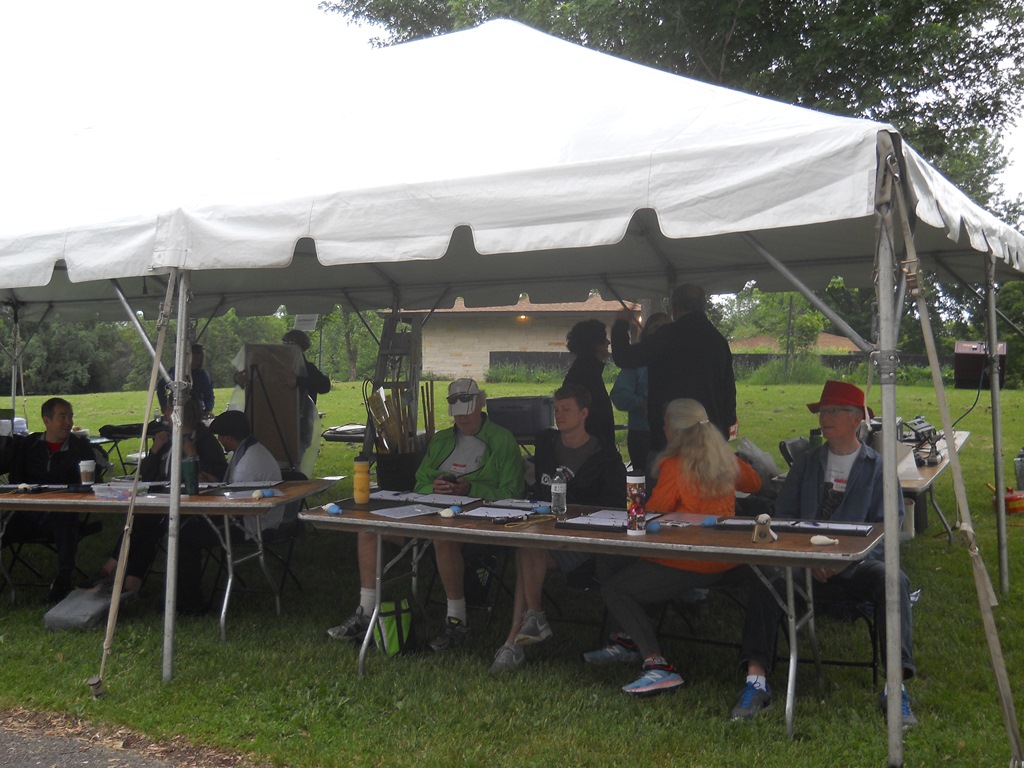
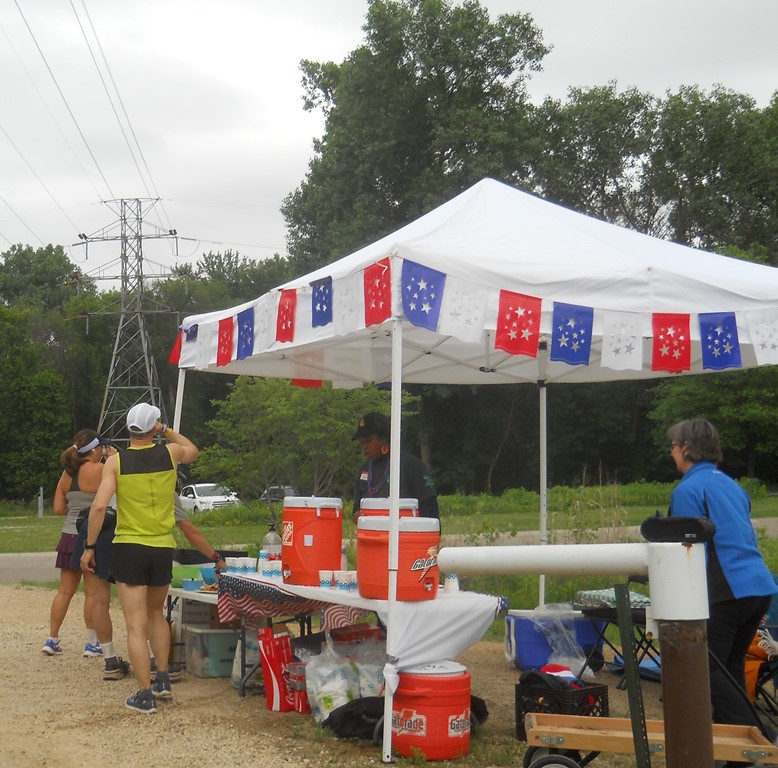
Near the main aid station, there’s an area where the
participants can set up tents and have all their gear handy.
Even though this was a local race, I had a packing list that
took two pages. It’s like packing for a
camping trip. In addition to multiple
pairs of running shoes, spare running clothes and rain gear, I needed a tent,
folding chairs, a card table, bug spray, sunblock, Aquaphor, electrolyte pills,
headlamp, flashlights, and a whole assortment of stuff that I might or might
not need. For a race like this, I’d
rather have it and not need it than need it and not have it. To save time on race day, I had most of my
gear loaded into the car on Friday.
Late Friday afternoon, I went to the Waite House in
Minneapolis for packet pickup and the pre-race dinner. While I was there, I was able to meet some of
the other walkers.
I wasn’t the only one aiming to walk 100 miles in this
race. There were six experienced
Centurions registered. They included Marco
Bloemerts, Arie Kandelaars, and Gertrude Achterberg from the Netherlands,
Andrew Titley from the Isle of Man, Rob Robertson from Oklahoma, and John
Greene from Minnesota. Marco, Arie,
Gertrude, and Andrew each had Centurion badges from other countries and were
here to get a US Centurion badge. Rob got
his first Centurion badge at FANS three years ago. He has since earned badges in other counties,
but came back to earn a second US Centurion badge at FANS. John was registered, but wasn’t trying for another
Centurion badge. He was crewing for me,
but was also planning to walk at least 51 miles. John and I are each working on eventually
getting into the FANS 1,000 mile club.
The race didn’t start until 8:00, but I got up at 4:00, so I
could eat an early breakfast, get to the park early, unload the car, and set up
our tent. We had a new tent this year. A week before the race, we practiced putting
it up in our back yard. It goes up
quickly. Taking it down is a bit more
involved, but that was a problem for after the race.
After setting up the tent, changing shoes, and shedding my
warm-up clothes, I went over to the medical tent to check in and get
weighed. During the race, everyone had
to weigh in every four hours. By
monitoring our weight, the medical staff could tell if we were hydrating
properly.
FANS used to be held on the last weekend of June. It was always hot and humid, and in any given
year, there was about a 50 percent chance of a thunderstorm. Several years ago, they moved the race to the
first weekend of June. On average, the
temperatures have been more comfortable, but it’s still possible to get a hot
day. Thunderstorms, unfortunately, are still
something you have to plan for.
In the weeks leading up to this race, we had unseasonably hot
weather. On Memorial Day, it got up to
100 degrees. I had been worried about hot,
humid conditions, but race day brought a completely different set of concerns. The forecast high was only 65 degrees, with rain
and thunderstorms in the forecast for the entire day. A
little light rain on a hot day might feel good, but it wasn’t hot, and too much
rain can make the trail muddy. Thunderstorms
make everything more complicated.
I was hoping to wear the same clothes for the whole race,
but had spare clothes, including a light jacket and a rain poncho. Ideally, I also wanted to do the whole race
in the same pair of shoes, but I brought two spare pairs. I also brought extra pairs of socks. I was worried about getting gravel in my
shoes, so I wore gaiters.
Before the race started, I made a point of meeting my lap
counter for the first shift. Laps are
all counted manually by volunteers. It’s
good to know who your lap counter is, so you can make sure they see you as you
finish each lap.
Before the first full lap, we did an out-and-back that was
about 1.7 miles. The purpose of the
out-and-back was to align the 100 mile mark with the end of a lap. 100 miles has always been a common goal for
24-hour runners. In recent years, it has
also been a common goal for walkers.
I wanted to start the race at a pace somewhere between 13:00
and 13:30 per mile. That corresponds
roughly with lap times between 28 and 29 minutes.
I did the out-and-back in 22 minutes, which corresponds to a
pace of 13 minutes per mile. My first
few full laps were about 27:45. That’s a
little faster than I planned to start, but not outrageous. I eventually settled into lap times that were
averaging 28 minutes.
There were two aid stations per
lap. Each time I reached an aid station,
I had something to drink. About once an
hour, I also had something to eat. Over
the course of the race, I ate cookies, candy, tea breads, cake and PBJs. I tended to go for sugary snacks that I could
eat quickly.
John walked with me for the first
four laps. Then he took a break while I
walked my next two laps. He repeated
this pattern for the first half of the race.
Later, John switched to walking two laps and then resting during my next
two.
Most of the walkers who were going
for Centurion badges started at about the same pace. In the early laps, I could see Marco, Arie,
and Gertrude just ahead of me. Andrew
was going faster, and quickly got too far ahead for me to see him. Rob lined up behind us, so I didn’t see him,
but I assume he was never far behind me.
To keep from going out too fast, I
made a point of staying behind Arie and Gertrude, who were walking together.
In this picture of Marco, you can
see Bruce Leasure wearing the blue jacket.
Bruce was the USATF race-walk judge.
He walked the course in the opposite direction, so he could see the
walkers as many times as possible.
About two hours into the race, I
noticed a few rain drops. Then it stopped. After a few false starts, it turned into a
steady light rain. I wasn’t sure if it
was just a passing shower, so I kept wearing the same clothes. After about an hour, the rain stopped.
The rain actually seemed to
improve the trail conditions. Before the
race, the dirt was somewhat loose. The
rain, in combination with people running and walking on it, helped pack down
the dirt. After that, the trail was
fairly firm.
There were loose rocks on the trail. I
found them to be incredibly uncomfortable for walking. When I stepped on a rock, it sometimes made
my shoe roll in an unusual way. Within
four hours, I already had painful blisters on the heels of both feet. Heel blisters are a common problem when I
walk, but usually only when it’s hot or I’m going fast. It was worrisome that I was feeling so much
blister pain so early in the race. I
still had 20 hours to go. At this point,
I was pessimistic about being able to cope with blister pain that I assumed
would only get worse.
At noon, we had our first required
weigh-in. My weight was up half a
pound. It could have simply been the
weight of my wet shoes, but I was making frequent bathroom stops, so I
concluded I was drinking too much. I cut
back temporarily to only drinking at the main aid station and skipping the one
on the opposite side of the loop.
Eventually, I realized that
cutting my fluid intake meant I was also cutting my sugar intake. I was counting on getting most of my calories
from Gatorade. Instead of eating snacks
once per hour, I started eating them every lap.
In the early afternoon, we had
another rain shower. This one also
lasted about an hour. Puddles started
forming on the road. The trail was dry
enough before the race that it was able to absorb most of the water, but a few
muddy spots formed.
I was still stopping to pee every
two or three laps. I told John I would
alternate between 28 and 29 minutes laps, depending on whether they included
bathroom stops. I didn’t stick to that. At some point, Arie and Gertrude stopped at
the main aid station, and I inadvertently got ahead of them. With nobody holding me back, I started to get
overzealous in my pacing. On my
non-bathroom laps, I sometimes went faster to make up the lost time.
At 4 PM, we had our second
weigh-in. My weight was back to where it
started, even though my shoes were still wet.
I was able to go up to five laps between bathroom stops, so I went back
to drinking at every aid station.
Eventually, I found myself making more frequent bathroom stops again, but
I waited for the next weigh-in before making any more adjustments.
John heard that a thunderstorm was
coming. I felt a few drops, but then it
stopped. Then the sun came out. The thunderstorm passed north of us. That was a relief. I don’t think the trail could have absorbed
any more water.
Between 4 and 8 PM, my lap times
started to drift. I slowed to 29
minutes. Some laps took almost 30
minutes. I found myself suddenly needing
to work much harder to walk the same pace.
I also realized that I was no longer noticing the blister pain. I had two possible theories for that. The first is that I was subconsciously
altering my stride to avoid making contact with my heels, particularly on the
trail section of the course. A shorter
stride would make me work harder to go the same pace. My second theory was that I was pushing
harder to maintain my pace, so I was generating more endorphins. Endorphins are natural pain killers.
I was getting the sense that I was
putting in too much effort to maintain my pace.
I didn’t think this effort would be sustainable for the rest of the
race. I wanted to relax and allow myself
to slow down a little, but I was afraid.
What if endorphins were suppressing the blister pain? If I relaxed, I risked turning off the
endorphin spigot. That in turn, could
turn on the pain spigot. I wasn’t
willing to risk that. Instead, I risked
blowing up badly in the second half by going too fast. I was more worried about intense blister pain
making it difficult for me to continue through the night. I continued to push the pace on every lap.
I was 40 miles into the race when it occurred to me that I had already set a new PR for longest distance walked. I couldn't be satisfied with that. I couldn't settle for anything less than 100.
At least twice during the race,
pizza was delivered. After my 21st lap,
I had a small slice of pizza.
I wanted to do 53 miles in the
first 12 hours. I ended up doing
53.75. That gave me a nice cushion, but
I was concerned about how much effort I was putting into each lap.
At the 8 PM weigh-in, my weight
was up a pound and a half. I went back
to only drinking at the main aid station.
I was reluctant to cut back any more than that. My body was sending me mixed signals. On one hand, I was back to making bathroom
stops every other lap. On the other
hand, I felt thirsty.
Objectively, it seemed obvious
that I was overhydrating, but it was hard to see how that was happening. Whenever I drank, I looked for the cup that
was least full. I seldom drank more than
four ounces at a time. That added up to
only eight ounces per hour. When I peed,
it seemed like I was passing much more fluid than I was drinking. Where was it coming from?
In the second half of the race, I
had to start setting intermediate milestones.
When I passed 57 miles, I could tell myself I walked my age in
miles. I’ve run my age several times,
but this was the first time I walked my age.
The next intermediate milestone was 100K.
By now, I was starting to feel
slightly out of breath whenever I ate solid food. Chewing took too much energy. The fatigue was taking a toll on me.
At 9 PM, I put on my
headlamp. The race volunteers had
already set up lamps along most of the course, but they didn’t illuminate the
entire course. On the trail, you really
need a headlamp, but the lamps were still useful. They gave me perspective. I could see when the trail started bending to
the left or right. That gave me a good
feel for where I was.
One of the traditions at FANS is
that the lap counters ring a cowbell whenever someone reaches a milestone like
50 miles or 100K. After my 23rd lap, I
got my 50 mile cowbell. I was looking
forward to hearing the cowbell again when I reached 100K, but they forgot to
ring it. I was momentarily disappointed,
but I didn’t let it bother me.
The trail section had a number of
uneven spots, where the soil was bumpy.
At night, I didn’t always see them, so I often scuffed my foot over
one. That was uncomfortable, and it also
caused me to waste energy.
With the trail section getting
more tiring, I worked harder and harder to compensate. I took things one lap at a time. In each lap, I worked as hard as I could to
maintain the pace on the trail section. The
road section was much easier. There I
worked hard to pick up my pace to compensate for slowing down on the trail
section. I knew my effort was
unsustainable, but I was trying to keep my lap times under 30 minutes for as
long as I could.
At some point, I could no longer keep my lap times below 30
minutes. That’s OK. John calculated that I only needed to average
33:20 per lap the rest of the way. If I
could do a lap in 30:20, I was putting three more minutes in the bank.
For the rest of the race, my pace gradually deteriorated,
but the pace I needed to average was also getting slower. By the time I slowed to 31 minutes, I only
needed to average 34:10. By the time I
slowed to 32 minutes, I only needed to average 35. That trend continued and eventually
accelerated as there were fewer and fewer laps.
At midnight, my weight was unchanged, so I continued to
drink at only the main aid station. I
cut back to only eating snacks every other lap.
I was taking too long to finish eating snacks, and it caused me to start
each lap at a slow pace.
During the night, I really hated walking on the trail. It helped that John was with me on half of my
laps. John wondered if he was slowing me
down. I was slowing down, but it wasn’t
John’s fault. I was running out of gas.
I loved walking on the paved part of the course. If I could do the whole race on smooth
pavement, I could easily keep up the pace.
It was the uneven trail surface that was wearing me down.
When I only had 12 laps to go, I could tell myself that it
was less than a marathon to go, and I still had seven hours to do it. That should have made it seem manageable, but
it didn’t. Instead, I just counted down
the laps. Twelve laps didn’t seem like
that many, but I was now putting a heroic effort into each one. I had been doing that for several hours
already. I didn’t seem like I should be
able to keep doing that, but I walked every lap as if it were my last. I’m not sure how I kept up that effort. I’ve never pushed myself so hard in a race.
At the final weigh-in, my weight was up another pound. I was clearly overhydrating, but I didn’t
want to stop drinking entirely. I was
getting the majority of my calories from the Gatorade, and I needed that fuel.
I was relieved when the sun came up. Finally, I could see all parts of the trail
clearly. I was able to do a better job
of avoiding the various bumps and slick spots.
Unfortunately, I couldn’t avoid all the rocks. They were all over the trail.
After sunrise, the wind really picked up. The temperature had dropped into the low 50s,
and the wind made it feel like 40s. I
had to put on a light jacket for my last three laps.
With three laps to go, I had to make a bathroom stop – the
long kind. I lost a few minutes, but
more importantly my legs were stiff when I resumed walking. Despite the stop, that was a 36 minute
lap. At this point, I only needed to
average 39.
I never saw Rob, but he was just behind me when I made that
last bathroom stop. While I was in the
bathroom, he passed me.
Andrew was the first walker to reach 100 miles, getting
there in 22:27:32. On his final lap, he
wore the flag of the Isle of Man. He
went on to complete 106.8 miles. That’s
a new course record for a walker.
I pressed on through one more lap on my own, and then John
joined me for the last two. On those two
laps, I only needed to average 44 minutes per lap.
I managed 34. As I finished my 46th
lap, I reached the 100 mile mark and got to hear the cowbell again. I got there in 23:39:33.
In the last hour of the race, we can switch to a quarter
mile out-and-back course. Three of the other
walkers had already reached 100 miles and were adding on as much additional
mileage as they could. Arie was still
working on getting to 100 miles. He made
it with less than 10 minutes to spare.
I was still trying to walk fast, but I couldn’t do it
anymore. Despite my best efforts, a 15
minute mile was the best I could manage.
I ended up doing four quarter mile laps, bringing my total to 101 miles. I probably had time to do one more lap, but I
wasn’t paying close enough attention to my pace, and I didn’t want to start
another lap if I might not have time to finish it.
After the race, my blister pain came back with a
vengeance.
When I was working hard, I
generated enough endorphins to suppress the pain.
Now, I could barely walk.
Soreness in my calf muscles also made it
difficult to walk.
I needed to make
another bathroom stop, but it was difficult to walk to the bathroom.
The wind was cold, so I needed to get something on my
legs. With John’s help, I managed to
pull on a pair of wind pants over my shoes.
I knew if I took the shoes off I would never get them on again.
After everyone packed up their tents, we had a post-race
breakfast on a patio near the start/finish area. That was followed by an awards ceremony. In addition to awards for the top finishers
and various directors’ awards, they give sweatshirts to anyone who completes
100 miles in 24 hours. This year, 12
people reached 100 miles. Five of them
were walkers.
Throughout the breakfast and awards, I felt borderline
sick. I wasn’t nauseous, but I felt like
I was somehow off. I’m sure my body
chemistry was messed up. I also found it
increasingly difficult to move. Now,
every muscle in my legs was sore. In
addition, I had sore muscles in my arms, shoulders and upper back. My vigorous arm swing stressed my upper body
as much as the brisk walking stressed my legs.
This was the 12th time I’ve covered at least 100 miles in a
race, and it was the eighth time I’ve done it in 24 hours. It was only the first time I did it walking
the whole way.
I was one of four walkers to earn their first US Centurion
badge. Based on our order of finish, I
became the 91st US Centurion.
When the other walkers learned that I’ve also run this race,
they asked me which was more difficult.
There’s no question that walking 100 miles in 24 hours is much more
difficult than running 100 miles. This
is by far the most difficult thing I’ve ever done in my life. There were times during the race when I
didn’t think I could continue all night.
There were times when I wanted to quit.
There were times when I wanted to slow down and just walk at a casual
pace for the rest of the race. I knew if
I did that I wouldn’t get to 100 miles.
I started training for this race last August. In recent months, I spent so much time
training that I didn’t have time for anything else. There were other races I wanted to do, but I
skipped them if I thought they would disrupt my training. I was all in on getting my Centurion
badge. It’s common to fail on the first
try, but I didn’t want to spend another year training for a second try. I also didn’t want to endure this much pain
and fatigue again.
Knowing that I like to travel to other countries to race, John
and Rob each asked me if I would start doing Centurion races in other
countries. I admire the other walkers
who have done that, but I think I’m one and done.
Race Statistics
Distance: 101 miles
Time: 24 hours
Average Pace: 14:15
Lifetime Marathons/Ultras:
354
Lifetime 100s: 12
Lifetime FANS Miles: 933.5