Sunday, September 13, 2020

Race Report: Running Ragged 20in20, Day 2


Today was day two of the Running Ragged 20in20 Series.  Our course today was one I’ve never run before.  It was a paved trail at the Sartell Community Center.  I was excited to be running on pavement.  Not only was it surface with sure footing, but it’s a good surface for walking.
Our course was an out-and-back loop.  We ran from the aid station to a pond.  Then we ran counter-clockwise around the pond, turned around, and ran clockwise back around the same pond.  Finally, we turned and ran back to the aid station.  We needed to do this 18 times

I arrived a little earlier today, because we were taking a group photo as a tribute to Ila Brandli.  Ila has been a regular with Mainly Marathons, but she’s not here for this series, because she’s recovering from surgery.  Ila often dressed as Wonder Woman, so several of the other runners ordered Wonder Woman shirts.  Those of us who didn’t have a Wonder Woman shirt wore something red, white, and blue.
The temperature at the start was in the low 50s, which was similar to yesterday.  Unlike yesterday, there wasn’t any threat of rain.  The sun was out, so I expected it to warm up during the race.
I had another concern besides my right knee.  I was also worried about my left Achilles tendon.  Earlier in the year, I had a case of tendonitis at the insertion point that took months to heal.  I thought it was fully healed, but that same Achilles tendon has been feeling tight during my last three races.  One bright spot is that I was running on pavement today, so I didn’t have to worry about uneven footing.
Yesterday, I did far more walking than running.  Today, my plan was to do more walking and work on walking at a faster pace.  I knew walking would be easier on my knee than running.
For the second straight day, I opted to start running without any type of support for my knee.  If it didn’t hurt, I would continue running that way.  If it did, I could stop and put on a knee strap.
As I started running, I noticed some slight discomfort in my right knee.  It wasn’t a big deal, but I noticed it more than yesterday.  That only lasted for a minute or two.  Once I got warmed up, my knee felt about the same as yesterday.
While my knee got better, my left Achilles tendon got worse.  It felt tight within minutes of starting.  Then I felt a few brief twinges of pain.  I was suddenly much more worried about the Achilles tendon than I was about the knee.
I considered walking, but I didn’t want to walk for the whole race.  I held out until I reached the turnaround point of the first lap.
I walked slowly around the cone.  Then I accelerated into a race-walk gait.  I haven’t done much race-walking lately, but I have done a few workouts.  It was just enough that I’m starting to get my form back.  I could walk fast, although I knew I would eventually get tired.  I was really working my hips, and they were bound to get fatigued.
I didn’t know how my Achilles tendon would feel when I was race-walking.  To my relief, it felt just fine.  My knee also felt fine.  Race-walking was an option, but only if I didn’t get too tired.
I was curious to know what my pace would be when I was doing half running and half walking.  If I could do my laps in 20 minutes each, I’d be on pace for a six hour finish.  When I finished my first lap, I eagerly looked at the clock.  That lap took 16 minutes.  At that pace, I’d finish in 4:48.  That’s faster than yesterday, despite doing much more walking.  Perhaps it was faster because I was doing much more walking.  The more I walk, the faster I walk.
As I left the aid station to begin my second lap, I switched back to running.  My knee felt no worse than yesterday.  It didn’t quite feel normal, but it didn’t hurt.  My Achilles tendon again felt tight.  During that lap I felt another twinge or two of pain, but it seemed no worse than the first lap.  Maybe it was better.
I once again race-walked the second half of the lap.  As I started running again at the beginning of my third lap, I no longer noticed my right knee at all.  It actually felt better than yesterday.  Meanwhile, my left Achilles tendon was still a bit tight, but I didn’t have any more twinges of pain.  Running the first half of each lap and walking the second half seemed like it was going to be manageable.
Through my first five laps, I continued to average 16 minutes per lap.  Then I had to stop to refill my bottle, and for the first time, I fell behind that pace.
Someone asked me how fast I was walking.  I didn’t actually know.  I only knew my total time for each lap.  I didn’t know how much was running and how much was walking.
On my next lap, I checked my time at the turnaround.  I was running the first half of each lap in seven minutes and walking the second half in nine minutes.  I had to wait until after the race to calculate my pace.  It works out to a running pace of 9:37 per mile and a walking pace of 12:21 per mile.
The first time I tried to eat some solid food, I realized I was doing things in the wrong order.  Yesterday, I was starting a walking break each time I left the aid station.  That meant I was always unwrapping and eating food while walking.  Today, I was always running as I felt the aid station.  Eating a small candy bar while running isn’t that difficult, as long as the wrapper comes off easily.  A few laps later, I tried to eat a Nutri-grain bar.  It wasn’t as easy to open the wrapper while running, and those bars break apart easily.  To keep from dropping crumbs, I had to open one end and then basically slide the whole bar into my mouth at once.  I had already left the aid station, so I had to chew and swallow it without any water or Gatorade.  I didn’t do that again.
I considered switching to walking the first half and running the second half.  That would make eating easier, but I would need to walk the first half of one lap immediately after walking the second half of the previous lap.  I didn’t know if I could walk that far at once.
Because of my fast walking pace, I was putting much more energy into the walking.  Walking gave me a break from running, but running also gave me a break from walking.  Each gait used different muscles, and of the two, walking was more tiring.
Because we were doing a shorter loop today, we made more visits to the aid station.  I was drinking Gatorade more frequently, so I decided that I didn’t need any more solid food.  I continued running the first half of each lap.  For the rest of the race, I just drank Gatorade.
I reached the halfway mark in 2:25, which put me on pace to finish in 4:50.  I was beginning to slow down, but I was still going much faster than yesterday.
During my 12th lap, I started to notice some pain in my big toe.  I assumed it was a blister.  I’m much more prone to developing blisters when I race-walk, so I assumed it was the walking that was causing it.  Usually, I get them around the back of my heel.  I assumed a blister on my toe would be easier to drain.
I had enough discomfort in my toe that I seriously considered just running the rest of the way.  The running actually felt easier.  Most people who do run/walk pacing consider the walking to be a break from the running.  Increasingly, I was finding the running to be a break from the walking.  My running pace felt casual, while I was putting a lot of effort into my walking.
I still had six laps to go, which is a third of the race.  Running the last six laps seemed like too much.  I stuck to run half, walk half for another lap and then asked myself the same question.  It still seemed like too much.  One lap at a time, I kept doing the same thing.
With five laps to go, I had to refill my bottle again.  With four laps to go, I had to make a bathroom stop.  My walking pace was slowing down, and these delays made my laps even slower.
With three laps to go, I knew I could run the rest of the way, but I liked the symmetry of always running one half of the lap and walking the other half.  I could tolerate the painful toe.  I just wanted to make sure I was still on pace to break five hours.
With each passing lap, it seemed more obvious that I could maintain my current run/walk pattern and still break five hours.  Midway through my last lap, as I transitioned to walking, I looked at my watch.  I had less than three quarters of a mile to go, and I had almost 15 minutes to do it.  That was enough time that I could walk it at a casual pace.  I continued to walk at the best pace I could, although I could tell I was slowing down.
I finished in 4:54:18.  I slowed down some in the second half of the race, but that was to be expected.  I haven’t done enough race-walk training recently to sustain my pace.  Still, I was much faster than yesterday, and I did it with far less running.
It seems like I’ve found a template for coping with my injuries.  By the end of the race, I wasn’t noticing my right knee at all.  My left Achilles tendon is a long-term concern, but the walking breaks kept it from getting worse.  It actually seemed to get better.  It was really only bothering me in the first two laps.
If only all of these races had a nice smooth paved course like this one.  This surface was ideal.

Most of the other races, unfortunately, are some type of trail course.  They’re not technical, but the uneven surfaces make race-walking more difficult.  I can’t get into a nice smooth rhythm.
The fastest two runners form yesterday’s race weren’t here today.  There were other new arrivals, however, and they had fresh legs.  One of them went out at a pace nobody else could match.  He led the race from wire to wire.  Despite walking half of the race, I came in second.
I’ve finished the first two races, but I still have 18 to go.  Before the race, I overheard another runner talking about her experience doing 11 in a row.  She said for the first four days, each day got harder.  After that, they all felt the same.  I could live with that.

I have an insulated bag that can hold at least two gallons of crushed ice.  When I got back to the hotel, I made a trip to the ice machine to fill it.  When I got back, I took off my shoes and socks.  My big toe was now so painful I couldn’t wait to get my shoes off.
The sock on that foot felt really snug on my toes.  When I pulled it off, I saw the source of my pain.  I had a big blood blister under my toenail.  I was wrong about it being easy to drain.  I couldn’t see any easy way to relieve the pressure under my toenail.
The toenail with the blister was on my left foot.  I got the ice so I could ice my left ankle.  I pushed my left foot into the bag filled with ice.  While icing my ankle, I also iced my toe.  I propped my right leg onto a chair and put an ice pack on my right knee.  Might as well ice everything at once.
After I was done icing, I took a hot bath to loosen up my muscles.  Then I did all my usual stretches and massages.  My knee and my ankle are feeling OK.  My toe still hurts.
I’m hoping the blister was caused by a tight sock, rather than by my race-walking.  If that’s the case, I just need to be more careful putting on my socks.  I’m hoping my body will gradually reabsorb the fluid under my toenail.  We’ll see.  Every day seems to bring a new adventure.

Race Statistics
Distance:  26.2 miles
Time:  4:54:18
Average Pace:  11:14
Lifetime Marathons/Ultras:  407
Minnesota Marathons:  60

Saturday, September 12, 2020

Race Report: Running Ragged 20in20, Day 1


Today was the first day of the Running Ragged 20in20 Series.  Our venue for this race was Bend in the River Regional Park, which is just south of Rice, MN.  It’s a 14-mile drive from my hotel in St. Cloud.  This was one of the venues used for last year’s Minnesota Brother Trail Series, so I was already familiar with the course.  In particular, I knew it was fairly flat, and there wasn’t anything I was likely to trip on.
As you might guess, this park is located at a bend in the Mississippi River.  Our course took us near three scenic overlooks.


We also ran past the buildings of an old farm.


All of the races in this series are multiple laps.  Today’s course was an out-and-back route that we ran 14 times.  There was one aid station in the start/finish area.  In past years, the aid stations in these races were similar to the aid stations in large ultramarathons.  Besides water and Gatorade, they had a variety of snack food.  They also had hot entrees, cooked on site by the volunteers.  For this series, the aid station was scaled down, because of COVID-19.  Water and Gatorade were provided, but we were each responsible for refilling our own bottles.  All food was pre-packaged.
There were about two dozen runners in the marathon.  There was also a half-marathon, but that didn’t start until an hour later, so the start area wasn’t too crowded.  We all wore face coverings until we started running.  After that, they were optional, but we also needed to cover our faces if we stopped at the aid station.
The temperature at the start was in the mid-50s.  Normally, I would consider that ideal weather for racing, but I was planning to do a mixture of running and walking.  When I’m going that slow, I like it to be a little bit warmer.  I dressed like I normally would, but added a Tyvek jacket as an extra layer that I could easily take off as it warmed up.
It rained during the night, but the rain stopped before the race started.  There was a chance of more showers during the race, so I kept a rain poncho in the car.  One of the nice things about a multi-loop course is that I would be near my car every time I completed a lap.
Because the course was damp, I didn’t think it was necessary to wear gaiters.  There wasn’t going to be as much loose dirt or dust.  I didn’t want to wear them if it might rain.  Then the gaiters would just be one more thing that could soak up water and get heavy.
Last weekend, I ran a marathon wearing a knee brace.  It supported my knee well, but it was so snug that it felt somewhat binding on the back of my knee.  After wearing it for less than five hours, it caused soreness in one of the tendons on the back of my knee.  After that race, I realized wearing it every day for five or six hours wasn’t going to work.
Since then, I bought two different knee straps.  They don’t support the entire knee, but they’re less likely to cause discomfort in other areas if I wear them for several hours.  I tried out one of them on a few long walks, but I haven’t run since last Saturday, so I haven’t had any opportunity to see how much the knee straps help.  Ideally, I’d want to try them out before the race, but rest was more important.
I had no idea how my knee would feel today, or how much any of these knee supports would help.  My knee actually felt better this morning than it has at any time in the past two weeks.  I started the race without anything on my knee, so I could see how it felt.
When the race started, I tried to start my watch, but it didn’t start.  I pressed the button a few more times, and it still didn’t start.  Then I realized I was pressing the wrong button.  That’s what happens when you switch between two different styles of watch.  Once I got the watch started, I finally started running.
I ran tentatively at first.  I think I was afraid to find out how my knee would feel.  To my surprise, it didn’t hurt at all.  I could feel a difference between my right and left knees.  The right knee didn’t feel perfect, but even without a brace, it didn’t hurt.  I would have to monitor it, but as long as it didn’t hurt, I didn’t see any need to stop and put on a knee brace.
Our course was a trail course, but it was completely non-technical.  It was all gravel with nice level footing and no hills.

During my first lap, I was stopping to take pictures.  The frequent stops put me in the right mindset to start at an easy pace.
By the end of my first lap, I was warm enough that I could take off my jacket.  As I began my second lap, I started talking walking breaks.  I walked for a minute or two at the start of each lap.  At the midpoint of each lap, we made a U-turn around a cone.  I always slowed to a walk as I went around the cone.  Starting with my second lap, I continued walking for another minute or two after making the turn.
When I finished my second lap. I stopped briefly at my car to put my camera away.  I was done taking pictures and didn’t want to carry the extra weight for the whole race.  Since I was stopping anyway, I also made a bathroom stop.
Before leaving the aid station, I grabbed a fun-size Snickers bar to eat during my walking break.  I usually just drink Gatorade during races, but between the relatively late start time and my slow pace, I was going to be running through lunch every day.  If it was just one race, I could get by with just Gatorade.  Since I need to run again tomorrow, I felt it was important to start replacing calories as I ran.  After that, I never left the aid station without eating a cookie or a candy bar.
During my 4th lap, I felt a grain of sand hop into the back of my shoe, where it lodged behind my heel.  It eventually worked its way under my foot, but I began to regret not wearing gaiters.
During my 6th lap, I felt a few tiny drops.  It was beginning to drizzle, but at first it was more of a mist.  I decided to wait until my next walking break and then put on my jacket.  By the time I finished my lap, the drizzle had stopped.  It was never more than a few tiny drops here and there.
At the halfway mark, I was on pace to finish in 5:01.  Ordinarily, I would’ve sped up a little in the second half, to break five hours.  Instead, I planned to slow down.  I was just waiting for it to warm up a little.  So far, my walking breaks had been limited by how long I could walk without getting cold.  Once it got warmer, I could start taking longer walking breaks.
I took inventory of how I was feeling.  My knee didn’t feel any different than it did at the start of the race.  It didn’t quite feel normal, but it didn’t hurt.  My left Achilles tendon felt tight, and I was noticing it more with each lap.  I had noticed that during my last two races as well.  I began to worry that my Achilles tendon could turn into as big a problem as my knee.
In my 8th lap, I finally felt warmer.  I started taking longer walking breaks.  I was walking twice as far now.  As my walking breaks got longer, I started walking faster.  Instead of just walking casually, I began to power walk.  Even though I was doing more walking, I’m not sure if my average pace got any slower.
When I finished that lap, I made another bathroom stop.  I wasn’t drinking that much Gatorade, but evidently, it was more than enough.  It was a cool day, and I was taking walking breaks.  I probably wasn’t sweating as much as I normally do.
During my 11th lap, it got sunny.  That was a big surprise.  Just 30 minutes earlier, I was noticing dark clouds overhead.  Now I looked up to see blue skies and only a few puffy white clouds.
It was now warm enough that I could extend my walking breaks even more.  Once again, as I walked farther, I also walked faster.
As I was nearing the end of my 12th lap, a runner who was starting his next lap told me I was about to catch him.  That made me think.  There were two runners who were much faster than anyone else.  They were both finished already.  Up to this point, I had assumed I was in third place.  Now I realized I had been overlooking this runner.  I always saw him when we were going in opposite directions.  We seemed to be running at about the same pace.  He probably got way ahead of me in the first lap, when I was stopping to take pictures.  Since then, I had been whittling away at his lead, and now I was getting close.
With two laps to go, I decided to speed up enough to catch him.  I still took walking breaks, but I went back to only walking for a minute or two.  I also picked up my running pace.  I wasn’t going all out, but for the first time in the race, I was putting some effort into running faster.  I caught him before the end of my 13th lap.
Now that I really was in 3rd place, I could do more walking again.  With the luxury of a lead, I took my longest walking break of the race at the beginning of my last lap.  I went back to running at a more casual pace.
As I reached the turnaround, I glanced at my watch.  It was the first time I looked at it since the halfway mark.  I realized I had a chance to break five hours.  All I had to do was skip my last walking break.  I slowed to a walk as I went around the cone, but then I resumed running.
As I got closer to the finish, I could see the large digital clock.  Realizing my time would be between 4:59 and 5:00, I sped up.  I finished in 4:59:09.  The first two runners had finished more than an hour and a half earlier, but I finished in a distant third place.
I once again took inventory of how I felt.  My right knee still didn’t feel any different than it did at the start of the race.  My left Achilles tendon didn’t bother me now that I was no longer running, but I noticed it more today than I did in my last two races.  It was a concern.
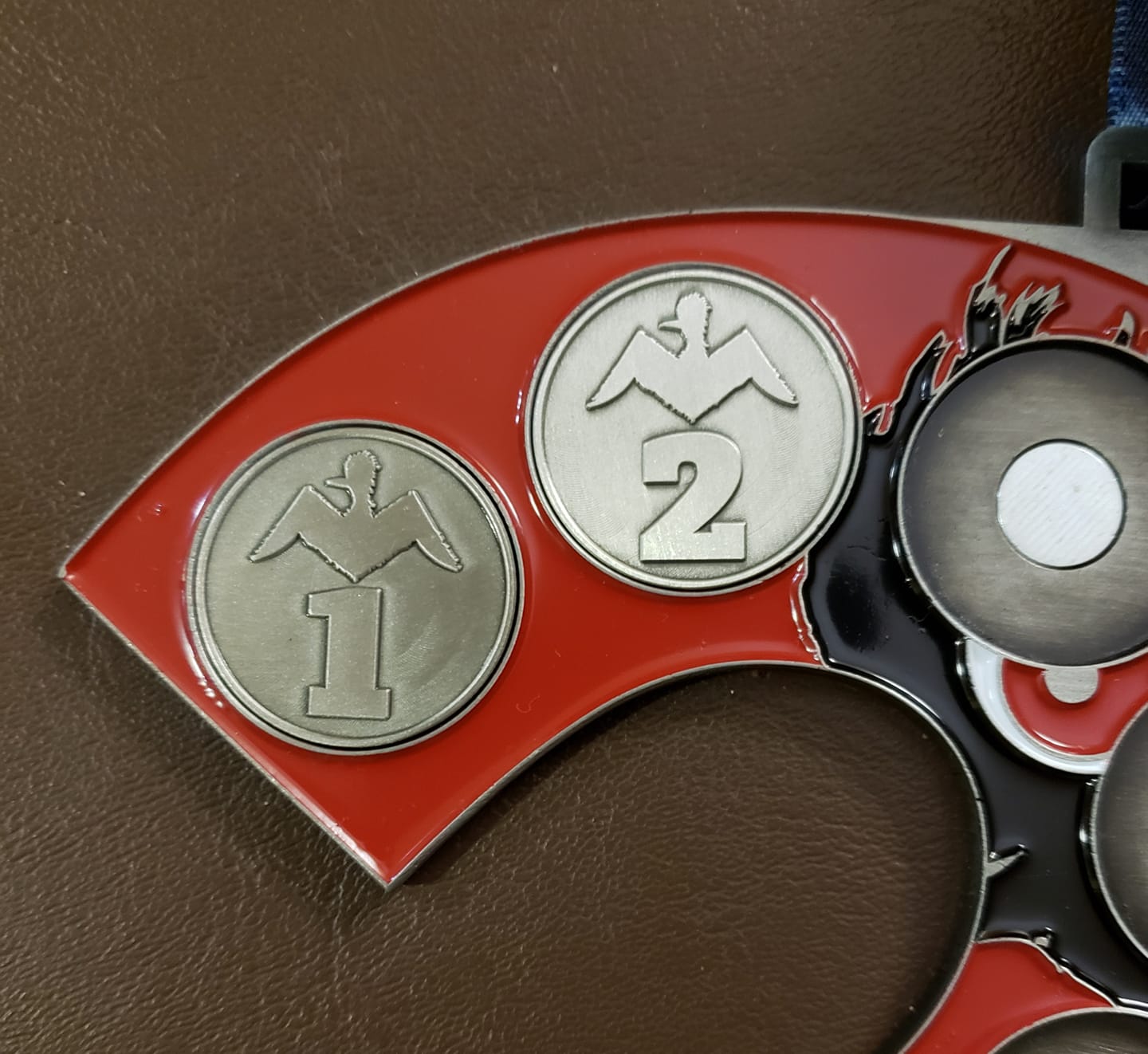
At packet pickup, I received a base plate that has room for 20 small medals.  The medals for the individual races are held in place by magnets.  Originally, each medal was going to have a design reflecting the state where that race was run.  Now that the entire series was being held in Minnesota, they had to come up with a new design for the medals.  The easiest thing to do was to have them numbered 1 through 20.  The bird above the number represents a loon, which is the Minnesota state bird.  It’s also the logo of Mainly Marathons, because anyone who would do a series like this has to be loony.

In a series like this, your days are divided into two parts.  The first part is the race.  The second part is refueling and recovery.  I was eating food during the race, so I had a head start on the refueling.  I didn’t need a full meal until dinner.  When I got back to the hotel, I had two glasses of chocolate milk and a roll.
I began my recovery by putting an ice pack on my right knee for 20 minutes.  My knee didn’t bother me during the race, but that could change overnight.
After icing, I took a hot bath.  Besides washing off the salt and sweat, I wanting to loosen up  my muscles.  Then I did several stretches and worked on my legs with a massage stick.
By now, I was noticing discomfort in my knee.  It felt worse now than at any time during the race.  I iced it again.  Then I did more stretching.  I’m not done with either.  It’s an iterative process, which will continue until I go to bed.
I’ll finish my refueling by having pizza for dinner.  My dinners will double as both post-race refueling and pre-race dinners.  As it happens, pizza is both my favorite pre-race meal and my favorite post-race meal.  By the time this series is over, I may try every pizzeria in the St. Cloud area.

Race Statistics
Distance:  26.2 miles
Time:  4:59:09
Average Pace:  11:25
Lifetime Marathons/Ultras:  406
Minnesota Marathons:  59

Friday, September 11, 2020

Series Preview: Running Ragged 20in20


Starting tomorrow, I’ll be doing a series of marathons on 20 consecutive days.  It’s called Running Ragged 20in20.  The series is sponsored by Mainly Marathons, which puts on series of races all over the country.
Most Mainly Marathons series are set up so you’re running in a different state each day.  One of the challenges of a series like that is having to get on the road and drive for a few hours immediately after each race.  Your legs get stiff, and you can’t spend as much time on recovery activities.  I’ve done a few of those series, but the longest one was five days.  Running marathons for 20 straight days is way beyond my experience.
One of the Mainly Marathon series is called the Heartland Series.  It includes races in Michigan, Ohio, Indiana, Illinois, Iowa, Wisconsin, and Minnesota.  They have another one called the Prairie Series, which includes races in Minnesota, North Dakota, South Dakota, Iowa, Nebraska, Kansas, and Missouri.
The two brothers who own Mainly Marathons live in Minnesota.  Last year, they had a series of four trail marathons near St. Cloud, MN.  They called it the Minnesota Brothers Trail Series.  I ran that series last year.  This year, they expanded that series to six days and renamed it “Summer Camp.”
They wanted to do something special for 2020, so they arranged to hold these three series back-to-back.  If you did all three, you would be racing on 20 consecutive days.  They were planning to have a special award for anyone who did all 20.

Because of COVID-19, Mainly Marathons has had to cancel several of their series.  I wasn’t signed up for the Heartland Series or Prairie Series, but I was signed up for all six days of the Summer Camp Series, and I was hopeful that these races could still take place.
One of the difficulties of putting on a multi-state series during a pandemic is working with permit authorities in several different cities and states.  During the pandemic, each state has had its own guidelines regarding what types of outdoor events can be held.  In July, I saw a notice that the Heartland Series, Summer Camp, and Prairie Series wouldn’t be held in their original format, but would instead by combined into a single series called Running Ragged 20in20.  People who wanted to run 20 marathons and get the special medal still could, but all of the races would be held on courses within 15 miles of St. Cloud, MN.
I was already signed up for six of these races.  Running marathons for 20 straight days seemed awfully intimidating, but I wouldn’t need to do any travel between races.  All of my other fall races got cancelled, so I didn’t have anything else planned.  I couldn’t do the New York City Marathon or any of the international trips I had planned.  This series gave me something different that was still a new challenge for me.  The clincher was that the races are all in Minnesota.  I’ve done every Minnesota marathon at least once, so I felt I should really do these ones as well, as crazy as it sounded.
I’ve been a follower of Le Tour de France for more than 30 years.  I’ve always been impressed with how those professional cyclists can ride hard for several hours and then go out and do it again the next day.  For the first time in my life, I’m doing something similar.  I have the luxury of going at an easy pace, but like those cyclists, I’ll be at it for several hours every day for roughly three weeks.
The races will rotate between five different venues.  Three of these venues were used for last year’s Minnesota Brothers Trail Series, so I was already familiar with them.  Those courses are all trails, but they’re fairly non-technical.  The two new venues have paved routes.  Here’s a calendar showing where we’re racing each day.  Note that we’re at Quarry Park for four days every week.  This park has multiple paths, so I assume we’ll have a different route each day.

The drive time to and from St. Cloud is just long enough that isn’t practical for me to stay at home.  I’d be spending three to four hours driving each day, in addition to running the races.  Instead, I’m staying at a hotel in St. Cloud for three weeks.  That’ll allow me to just focus on running and recovering.
My hotel is one that’s oriented toward longer stays.  Each room has a kitchenette with a full-size refrigerator, and dishes and utensils are provided.  That will make it easy for me to prepare my own meals or get take-out.  I’ve been avoiding dining in restaurants, unless they have outdoor seating.
St. Cloud is close enough that I didn’t need to fly.  That means I’ll have the use of my own car.  It also means I didn’t need to pack light.  I could bring anything I could fit in my car.  I brought things I’ve never brought with me before, including a bathroom scale and a drying rack for clothes.  I brought a variety of running clothes, but I’ll still need to do laundry occasionally.
I picked up my packet today.  I’ll have the sane race bib for the entire series.

My original plan for these races was to run at a slower pace than usual and take walking breaks.  Ideally, I wanted to keep my effort easy enough that I wouldn’t really feel like I was racing.  I wanted it to feel more like each day was a full day of running and walking, but nothing that would leave me feeling sore or fatigued.  Even small amounts of soreness and fatigue can add up over several days.  I had hoped to wake up each morning feeling the same as the day before.
That all changed with a recent knee injury.  I first noticed it five weeks ago.  After a fall during a trail race, my knee just didn’t feel right.  At first, it seemed to be getting better, but I think I aggravated it with some of my weight training exercises.  Two weeks ago, the inflammation in my right knee started to affect my running.  I ran a virtual marathon last weekend, wearing a knee brace.  During that run, I could feel some discomfort in my knee, but it didn’t seem to be getting any worse.  Several hours after finishing, I noticed significantly more soreness around my knee.  I definitely did not feel the same way the next morning as I did the day before.  Since then, I’ve been resting and treating my knee.  It’s improved noticeable, but a week isn’t enough time to heal completely.  It’ll be an issue for this series.
The timing of this injury couldn’t be much worse.  My challenge for the next three weeks will be getting through each race without making my knee worse.  These races don’t have time limits, and I don’t need to travel between races, so walking is an option.  I don’t want to walk the entire way, but I could if I have to.  How much I run and how much I walk will be a daily negotiation with my knee.
This series was intimidating, even when I thought I would be healthy.  Now that I’m running with an injury, it’s downright terrifying.  The good news is that my knee is only inflamed.  Nothing is torn.  I saw an orthopedist who knows what I have planned.  He didn’t tell me not to do the series.  When I asked him about it, he said I wasn’t going to feel great at the end of this series, but I also wasn’t going to do any permanent damage.
This series will challenge my patience and my willingness to accept slow times.  I can hopefully get through it with enough walking, but I’m going to have some long days.

Saturday, September 5, 2020

Virtual Race: 2020 Boston Marathon


The Boston Marathon is normally held on the third Monday in April.  This year’s race was postponed until September because of COVID-19.  At the time, it seemed like the outbreak would be controlled by then.  By June, it was apparent that things weren’t going to improve enough by September to hold a race with 30,000 runners and hundreds of thousands of spectators.  Instead, this year’s race was replaced with a virtual race.
In a virtual marathon, everybody runs 26.2 miles on their own, and then they report their results.  It’s not the same experience as running with other runners.  Everybody is running on a different course, and they may not be running at the same time.
There are a few reasons why race organizers offer virtual races.  First, runners who have trained for months to run a marathon don’t want their training to go to waste.  Second, the runners have already paid entry fees, and it’s not always possible for the race organizer to give refunds.  Often, most of the money has already been spent.  A virtual race is one way to offer runners something for their money, even though it’s nowhere near as satisfying as an in-person race.  Finally, by the time race organizers realize they need to cancel their race, they’re already ordered things like T-shirts and finisher medals.  They usually have the year incorporated into the design, so you can’t just save them for next year.  You could still mail a T-shirt to everybody, but a virtual race is a way for runners to “earn” their finisher medals.
The Boston Athletic Association actually did give refunds to everybody who was signed up to run this year’s race.  They had a separate registration process for the virtual race.  You had to pay an entry fee, but it was substantially smaller than the normal entry fee.  Basically, it covered the cost of the medal and T-shirt, and presumably the costs of administering the virtual race, which included developing a new app and website.
The Boston Marathon finisher medals don’t just say, “2020.”  They also say, “124th Boston Marathon.”  Because of that, the Boston Athletic Association is officially recognizing the virtual race the 124th Boston Marathon.  Next year’s race will be the 125th.
When I heard that, I immediately wondered how it effected streaks.  I had a streak of eight consecutive Boston Marathon finishes.  If I did the virtual race, would it count as my ninth consecutive Boston Marathon finish?  If I opted not to do the virtual race, would it bring my streak to an end?
I’m sure I wasn’t the only one with those questions.  As more details about the virtual race were published, they included a FAQ list.  One of the questions was about how the virtual race would affect streaks.  The B.A.A is being pretty flexible.  If you finish the virtual marathon, it counts toward your streak.  If you chose not to do the virtual race, it doesn’t count against you.  You would still have a streak.  You just wouldn’t be adding to it.
Why are streaks important?  It has to do with the registration process.  Most runners get into the Boston Marathon by running a qualifying time.  Prior to the 2011 race, if you had a qualifying time, you could be sure of getting into the race.  Since then, the number of qualified runners who want to register has exceeded the available slots.  To address that, the B.A.A went to a staggered registration process.  Basically, the better your qualifying time is (relative to the qualifying standard for your age group), the earlier you can register.  Generally, if you can qualify with at least five minutes to spare, you know you’ll get in, but runners who barely qualified might register and later learn that they missed the cut.  The most frustrating part is going into your qualifying race not knowing how fast you need to run to actually get into the Boston Marathon.
Runners who have an active streak of at least 10 consecutive Boston Marathons finishes get to register early.  They still need to run a qualifying time, but as long as they qualify, they know they’ll get in.  This is my goal.  I came into this year with a streak of eight years.  I was expected 2020 to be my ninth year.  Assuming I get into the 2021 race (and finish), I would have a streak of 10, making qualifying for future races much more straightforward.
I don’t do many virtual races.  I was signed up for lots of marathons that got cancelled this year.  Most of them offered virtual races, but I skipped most of them.  I did one in July, but that was mostly because I really needed to motivate myself to get out and do a marathon-length training run to stay in shape.  That wasn’t a consideration for this virtual race.  I’ve done three real races recently.
Let’s be clear about something.  Even though the B.A.A is calling this the 124th Boston Marathon, I still don’t consider it to be a “race.”  Neither do any of my running clubs that keep track of how many marathons I’ve finished.  This won’t count towards my lifetime statistics.  I signed up for the virtual race for one reason.  I wanted to extend my streak of consecutive Boston Marathon finishes.
They created an app called, “124th Boston Marathon Virtual Experience.”  You could download a virtual toolkit that included your race bib.  Here’s mine.

You could either use the app to track your run, or you could wear a Garmin watch or Fitbit and upload results to the app after the run.  I opted to use my watch.  I was skeptical about the accuracy of using a phone to measure distance.
You could run your virtual race any day from September 5 to September 14.  Originally, it was going to be September 7 to September 14.  They made a last-minute decision to give us two extra days.  I think they did that, because some people wanted to do their virtual race while also running a real race somewhere.  Giving us an extra weekend made it easier to find a real race that was actually going on.
Personally, I didn’t want to “double-dip” by doing a real a marathon and also counting it as my virtual race.  Since this was going to be recognized by the B.A.A. as the 2020 Boston Marathon, I felt it should be a run that was distinct from any other race I might do.  That was just my opinion.  As far as most runners and the B.A.A were concerned, double-dipping was perfectly legitimate.
I’m doing a series of real marathons that begins on September 12.  Since I didn’t want to use one of those for my virtual race, it made most sense to do my virtual race as early as possible.  That way, I could have a week of recovery before racing again.
That decision was made more complicated by a recent injury.  Four weeks ago, I fell and banged my knee during the Riley Trails Marathon.  At the time, I thought I just had some scrapes, but the next day, I felt some minor discomfort in my right knee.  It wasn’t painful, but it just didn’t feel right.  I had a couple runs where I felt some minor discomfort in my knee, but it only lasted a minute or two.  Then I’d feel fine for the rest of my run.  The only other times I would notice it were walking up stairs and doing leg extensions.
At first, my knee seemed to be improving, so I kept up my training.  A few days before the Millennium Meadows Marathon, I started to notice knee discomfort while doing things like planks.  I was also having more discomfort with stairs.  It didn’t bother me during my runs, so I still wasn’t too concerned.
I ran the entire Millennium Meadows Marathon without any discomfort, but started having more persistent knee discomfort the next day.  I rested Monday and did weight training on Tuesday.  I didn’t run again until Wednesday.  During that run, I had knee discomfort that never went away.  I stopped after less than two miles.
Thursday morning, I saw a doctor at TRIA Orthopedic Center.  I’ve been there before.  They treat a lot of athletes, and they have a large physical therapy department.  The doctor took X-rays that confirmed that nothing is torn.  I just have some minor inflammation in a couple of the tendons around the knee.  He gave me a knee brace and started me on physical therapy.  I had my first PT appointment immediately after my exam.
The physical therapist I saw on Thursday knew I had a virtual marathon this weekend and a series of marathons starting the following weekend.  She got me started on some exercises, but made an appointment for me to come back the next day to see a colleague who not only works with runners, but is an experienced ultrarunner herself.  Her name is Lauren.
Later on Thursday, I tried another run.  This time I was wearing the knee brace.  I was disappointed to find that my knee didn’t feel much better wearing the brace than it did the day before without a brace.  I suspected the brace wasn’t the right size for me.  It didn’t feel at all snug.
On Friday, I saw Lauren.  She confirmed that the brace was too large and got me one that fits much more snuggly.  Knowing about all my upcoming races, she gave me some different exercises that won’t be as stressful on my knee.  She also helped coach me on how best to get through all my upcoming races with the injury.  That’s one of the things I like about TRIA.  If you go in with a running injury and say, “I have a marathon tomorrow,” they don’t even flinch.  They just take it into account when they give you a treatment plan.
Ideally, I would’ve gone for a short run to try out the brace, but I didn’t want to run the day before my virtual race when my knee was already inflamed.  I had to settle for trying out the brace by doing a few miles of walking.
Roughly 17,000 runners chose to sign up for the virtual race.  The first 15,000 got an extra pre-race package in the mail.

It contained some of the same things you would get with packet pickup for the real race.  Some were more useful than others.  The useful things included a souvenir race bib and some product samples.  One of the not-so-useful things was a clear plastic bag that would normally have been used for gear check at Boston Common.

Although I could’ve printed my race bib, I didn’t have anything to print it on besides plain paper.  A paper race bib doesn’t hold up well once it gets sweaty.  I wanted to wear a race bib, so I chose to wear the souvenir bib instead.  All the souvenir bibs look the same.  They’re all number 2020.  That’s OK.  In a virtual race, wearing the correct bib number isn’t important.  I only wore the bib to make it feel more like a race.  Anyone in my neighborhood who saw me running probably realized this wasn’t an average training run.  On the other hand, it’s not the first time they’ve seen me running for hours.
My route was a 1.75-mile loop through my neighborhood.  I used this same route for another virtual race on July 4.  To complete a marathon, I needed to run 15 laps.  One of the advantages of a loop course is that I didn’t need to carry water with me.  I put several water bottles in a cooler and set it next to our mailbox.
It was a nice enough day that I didn’t feel the need to start early.  I took my time eating breakfast, icing my knee, taking a bath, and stretching.  I didn’t start running until 9:00 AM.  That seemed appropriate.  The real Boston Marathon starts at 10 AM Eastern Time.  In my time zone, that’s 9:00, so I was actually starting at the right time.
One of the product samples was a Clif Bar.  I ate that about 30 minutes before I started running.  I put some of the other product samples out with my water bottles.
As I started running, I felt some slight discomfort in my knee.  It was less discomfort than I would’ve felt without the knee brace, but it was still there.  Doctors will often ask you to rate your pain on a 10-point scale, where zero is no pain, and ten is the worst pain you can imagine.  On that scale, this was only one or two.  I felt it with every stride. But it wasn’t really painful.  Mainly, it was a reminder that my knee wasn’t OK.  I wouldn’t worry as long as there was only minor discomfort.  The important thing was that it not get worse as I continued running.
I really didn’t know how this run would go.  I was cautiously optimistic that the knee brace would prevent or at least minimize further damage to my knee, but 26.2 miles is a long way to run with an injury.  The best case is that I would feel the same from start to finish.  In a worst-case scenario, I might feel more pain with each lap and eventually be forced to stop.  In a middle-of-the-road scenario, I might have to switch to walking to finish my virtual race.  The good news is that there wasn’t any time limit.  We could take as long as we wanted.  The only rule was that it had to be one continuous session.
I started at a pace that felt easy.  It was the same way I run most of my training runs.  When I finished the first mile, I was surprised to see a time of 9:31.  It felt slower than that.  I’ve been training in summer heat for the past few months.  At the start of this run, it was 62 degrees with a nice cool breeze.  It took far less effort than the same pace would’ve taken just two weeks ago.
As I finished my first lap, I asked myself how my knee felt.  I noticed it with every stride, but it didn’t feel any worse at the end of the lap than it did at the start of the lap.  So far, so good.
During training runs, I normally just drink water.  The last time I did a virtual marathon, I drank Gatorade, which is what I would drink during a race.  Since I had some food samples, I just drank water today.
My second mile was also 9:31.  Then I sped up a bit to 9:20 in the third mile.  I didn’t mean to speed up.  It just happened.  The pace still felt really easy.  It was about a minute per mile slower than my usual race pace.
At the end of my second lap, I again asked myself how my knee felt.  It still felt the same.  I had another drink of water and kept going.  I saved the food samples for later.
Over the next few miles, I eased up a bit, running times in the 9:30s.  My knee still felt the same, but I wondered if I would really notice it if there was more inflammation.  I’m pretty good at tuning out pain during a race.  I wasn’t running as hard as I would during a real race, but after a certain number of miles, it would start to take more effort.  Then, I was more likely to tune out the pain.
I was content with the pace I was running.  If anything, I was going too fast, but it still felt pretty easy.  I didn’t care what my time was.  My only goals were to finish and to try to get through it without making my knee worse.
For the first four laps, I just drank water.  After my fifth lap, I opened a package of Clif Bloks.  For the next six laps, I ate one Clif Blok per lap.  There aren’t many calories in a single Clif Blok.  This was more about race psychology than nutrition.  Eating one per lap gave me something to look forward to.  After every 1.75 miles, I had a ginger ale flavored chew as a small treat.
Now that I was eating the Clif Bloks, I was taking longer on my water stops.  I took the time to chew it completely before washing it down with some water.  That added to my mile times.  The miles that included water stops now took just over 10 minutes.  The ones that didn’t took between 9:20 and 9:30.
The app for the Boston Marathon virtual experience was intended to make it feel more like you were in Boston.  Among other things, it would have crowd noise at different places, and if you were using the app to keep track of your distance, it would display where you would be on the actual Boston Marathon course, for the benefit of friends who wanted to track your progress.
I wasn’t running with my phone, but I’ve run the Boston Marathon enough times to be familiar with the course.  As I finished my 11th mile, I asked myself where I would be if I was running from Hopkinton to Boston.  In just over a mile, I would be getting to Wellesley.
The Wellesley “scream tunnel” is at roughly 20 kilometers.  By the time I actually got there, however, I had forgotten all about it.  I was focused on which lap I was on.  I wasn’t really running in Wellesley.  I was running a familiar route through my neighborhood, and that’s where my head was.
From time to time, I passed people who live in my neighborhood.  They’re the same people I see walking when I’m out for a normal training run.  I’m sure some of them noticed my race bib, but nobody commented on it.
As I finished the halfway point of my run, I was on pace to finish in about 4:13.  That was faster than I planned, but I still felt OK.  When I thought about it, my knee still felt the same.  When I wasn’t thinking about it, I sometimes didn’t notice it at all.  I was now optimistic I would get through this race without any significant increase in knee discomfort.
Buoyed by my optimism, I started running a little bit faster.  That wasn’t a conscious decision.  It just happened.  My optimism about finishing without any problems led me to get excited, and I subconsciously sped up.  Now, my times for miles with water stops were in the 9:40s, and my times for the miles without water stops got as fast as 9:03.
As it warmed up and got sunnier, I started to perspire.  I could sometimes feel sweat under my knee brace, which went from mid-thigh to mid-calf.  It felt like my brace might be riding down.  I don’t know if it actually was, or if it just felt that way because of the sweat.  A couple times, I stopped briefly to check.  The part that surrounds my kneecap was still in the right place.  That was the important part.
As I finished my 10th lap, I ate the last of the Clif Bloks.  I had two other food samples.  One was a protein drink that I was saving until after the race.  The other was a Cliff Shot.  I’ve used a few different brands of gel packets, and I’ve tried a variety of flavors.  This flavor was Boston cream pie.  That seemed appropriate.  I was saving that one as a late-race treat.  I had five laps to go.  I planned to eat my gel with two or three laps to go.
After my 11th lap, I just drank water, but it was still a longer stop.  I was getting thirsty now, so I drank more than usual.  I was now past the 19-mile mark.  I asked myself where I would be on the Boston Marathon course.  I wasn’t actually sure.  I was somewhere in Newton, but I couldn’t remember exactly where “heartbreak hill” is.  I know the Newton Hills by sight, but I can’t connect all of them to mile markers.  I know the first one starts at about 16 miles.  I know the second one starts between 17 and 18.  I really wasn’t sure where the third and fourth hills start.  I forgot about it and kept running.
At the 20-mile mark, I was pretty sure I was past heartbreak hill.  The next major landmark would be Boston College.  That’s the last time I thought about where I would be on the Boston course.  I just knew I had three and a half laps to go.
Midway through my 12th lap, I was already getting thirsty again.  When I finished that lap, I took a longer drink of water.  I waited one more lap before having my Boston cream pie gel.
That water stop took so long that I didn’t get back into the same pace.  I was definitely running slower now.  That was OK.  In fact, it was good.  I needed to slow down.  By now, I was starting to notice some discomfort in my left Achilles tendon.  I suddenly remembered feeling the same thing during my last race.  After that race, I forgot all about it.  This Achilles tendon was a problem area earlier in the year, so I wanted to be careful with it.  I shouldn’t run too fast.  The Achilles tendon discomfort actually made me forget about my knee.
When I finished my 13th lap, I finally had the Boston cream pie gel.  Fancy gel flavors sometimes miss the mark.  This one didn’t.  It really did remind me of Boston cream pie.  That lifted my spirits.  I had 3.5 miles to go.  I was beginning to get tired, and I was a little cautious about my left Achilles tendon, but the remaining distance was manageable.
I finished my 14th lap and started the last one.  I was doing this loop for the last time, but there was no need to rush.  I resisted any temptation to put on a strong finish.  I kept moving, but not too fast.
I didn’t actually have to run the whole lap.  With less than a block to go, my watch read “26.22.”  I stopped my watch and stopped running.  I walked the remaining distance back to my driveway.  My final time was 4:13:44.
I gathered up my things, went inside, and took off the knee brace.  I iced my knee and opened up the app to enter my result.  That turned out to be much more difficult than I thought.
The app gave you three options for entering your result.  One involved using the app to measure your whole run.  I wasn’t running with my phone, so I obviously couldn’t do it that way.  Another option was to have the app retrieve the data from a watch which was connected to my phone by Bluetooth.  I had the data on my watch, but I’ve only had this watch for a few months, and I’ve never connected it to my phone before.  I had about six runs stored on my phone, but I had yet to upload any of them.  The third option was to manually enter the data.  I tried that option and immediately got an error screen that looked like this.

This appeared to be a bug in the app, but there wasn’t much I could do about it.  Maybe they would eventually fix it, but probably not right away.  Realizing I probably needed to use a different option, I took the time to load Garmin Connect on my phone.  I already had an account, but the last time I used it, I had a different watch, and I was using it on my computer.  I had to look up my password.  It didn’t work.  I then reset my password and created a new one.
When I finally got logged into my Garmin Connect account, I had to connect it to my watch.  I didn’t know how to do that.  I had to find the user’s manual for my watch to read how to connect it to my phone.  When I finally got it connected, it started synching.  I had six runs that had never been uploaded.  Five of them were marathons.  The synch took several minutes.
When it was all done, I could finally tell the app to get the data from a connected watch.  It said “No activities found.”
Besides the app, there was also a website you could use.  I had to find a link to it in an email.  I had to log in to my Boston Marathon account.  Then I had to give it the username and password for my Garmin Connect account.  It said my device was connected.  That’s all.  I had to look around a little more to find a menu for entering my results.  When I told it to get the results from my phone, it said, “No activities found.”  What the hell?
I belong to couple of Facebook groups that include Boston Marathon runners.  I
asked if anyone else was having this problem.  After several exchanges with different runners who either entered their results or ran into problems, I learned two things.  First, if you want the app to get the data from your watch, you have to connect your Boston Marathon account to your Garmin Connect account BEFORE doing your run.  Oops.  I wish I knew that earlier.  I also learned that the option to enter your data manually worked on the iPhone version.
Neither Deb nor I have iPhones, but Deb has an iPad.  She downloaded the app, and I gave her my account info, so she could log into my Boston Marathon account.  The option to enter my data manually worked.  We needed to enter my finish time, as well as the exact date and time that I started my run.  Finally, we needed to enter a link to the data.  I could see the data in my Garmin Connect app, but I didn’t know how to get a link to it.  After one more exchange with another runner in the Facebook group, I was able to send Deb a link.  She entered the link into the app, and it accepted my results.
A short time later, I got an email with a link to my results.  They included a finisher certificate.

Entering the results took more than an hour.  It was almost as stressful as the run itself.  The important thing is that I’ve extended my Boston streak to nine years.  I don’t know when next year’s Boston Marathon will be held.  They’ve delayed registration, and in all likelihood, they won’t be able to hold the race in April.  Maybe they’ll hold it in September.  Maybe they’ll have another virtual race.  Whenever or whatever it is, it’ll be my 10th.  That will make today’s effort worthwhile.
During the late miles of my run, I was noticing my left Achilles tendon more than my right knee.  Since the run, I haven’t noticed it at all.  I did make a point of stretching it.  I think I’ve been neglecting to stretch it, because that stretch puts pressure on my right knee.
Meanwhile, my right knee felt the same throughout the run, but it has felt worse since finishing.  Now, even walking on level ground causes some slight discomfort.  I have to be particularly careful going up and down stairs.  The physical therapists at TRIA have coached me to take every step with my left foot going up stairs and to always lead with my right foot going down stairs.
I suspect that knee will bother me most tonight and tomorrow but gradually get better.  For the next week, I plan to limit my training to light cross-training activities like walking and low-resistance spinning.  Hopefully it’ll be feeling somewhat better before my next series of races.

Race Statistics
Distance:  26.2 miles
Time:  4:13:44
Average Pace:  9:41
Consecutive Boston Marathon Finishes:  9